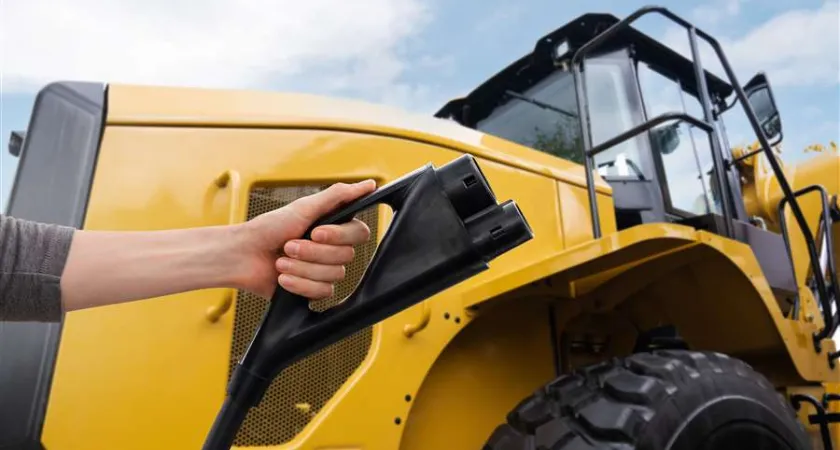
Walk through any major construction exhibition today and the message is unmistakable: the future is electric, connected, and increasingly powered by artificial intelligence. Events such as the upcoming ConExpo in Las Vegas showcase machines brimming with telematics, automation, and alternative powertrains. Yet for many contractors, confidence in how these innovations will perform on real jobsites still lags behind the marketing.
Industry observers warn that the sector faces a credibility gap. Contractors are under pressure from emissions rules, labour shortages, and tighter project schedules, and they want solutions that are dependable rather than experimental.

As the article notes, “closing the credibility gap between the innovation promoted and the trust it has earned in the market will be one of the most important tasks for equipment brands in 2026 and beyond.”
Equipment decarbonisation is moving forward, but not uniformly. Smaller machines used in predictable environments—such as forklifts, telehandlers, compact loaders, and MEWPs—are already proving commercially viable as electric alternatives. In many cities, contractors increasingly view zero-emission equipment as essential simply to access urban projects.
The article explains that for these applications electric machines have become “a ‘ticket to work’ in urban areas, especially with the rapid increase of low emission zones (LEZs) and zero emission zones (ZEZs) globally.”
Heavy construction equipment tells a different story. Machines operating far from grid connections face major hurdles around battery capacity, charging times, and duty cycles. For these segments, diesel engines, hybrid systems, and fuels such as HVO are expected to remain part of the mix for years.
Manufacturers must therefore walk a fine line—promoting long-term vision without overselling short-term capability. Dealers and rental firms, the article argues, are best placed to deliver this balanced message by sharing real-world experiences and focusing on today’s measurable efficiencies.

Artificial intelligence is now embedded in many operator assistance systems, from collision avoidance to predictive maintenance. But the hype surrounding generative AI has also created scepticism.
The report cautions against exaggerated claims, warning of “the rise of ‘AI washing’ – the equivalent of greenwashing with overstated or vague claims about capability. This is a critical trap to be avoided.”
Operators may worry that AI threatens jobs or undermines their judgement. When monitoring systems track behaviour, concerns about surveillance and privacy can also emerge.
Effective communication, the article suggests, should position AI as support rather than replacement, making clear that it should be framed as a ‘co-pilot’ – a support tool that enhances an operator’s skill, not one what replaces it – while always emphasising that human judgment remains the final authority.
Brands are encouraged to focus on practical outcomes instead of technical jargon. A message such as “our system eliminates alarm fatigue by alerting operators only to real hazards” is more persuasive than simply stating that a product “has AI.”
Regulatory developments in Europe and North America mean this transparency will soon be a compliance requirement as well as a marketing choice.
Beyond the technology itself, the decisive factor will be whether end-users believe the promises being made. The article stresses:
“Ultimately, the biggest challenge facing equipment brands in 2026 isn’t electrification, telematics, or AI. It’s trust.”
Contractors want partners who acknowledge uncertainty, provide honest data on total cost of ownership, and offer support throughout the transition. Companies that align engineers, sales teams, and leadership around a single credible narrative will be best placed to win loyalty.
The piece concludes that the winners will be those able to present “a single, credible story — one that acknowledges uncertainty while offering clarity.”
Originally reported by Andy Brown, Head of Content, Construction and Engagement and Anna Kitchener in Construction Briefing.