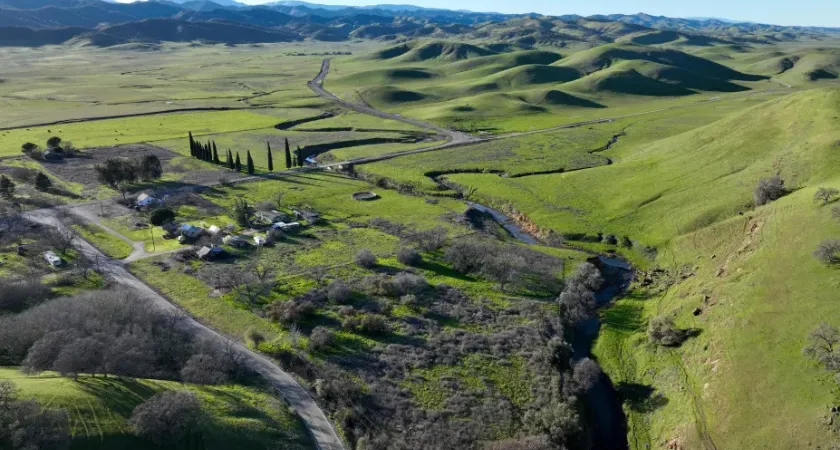
The Trump administration has approved plans to build the Sites Reservoir, a massive off-stream water storage project north of Sacramento that supporters say will significantly strengthen California’s long-term water supply.
The U.S. Bureau of Reclamation on Friday issued a formal “record of decision” for the 13-mile-long reservoir, concluding the federal environmental review process and removing one of the project’s largest regulatory obstacles. Once completed, the reservoir is expected to supply water to roughly 24 million Californians and irrigate about 500,000 acres of farmland across the state.
“This decision reflects years of analysis, public engagement and coordination, and establishes the foundation for construction through sound partnerships that will ultimately result in additional water supplies for California,” said Andrea Travnicek, assistant secretary of the Department of Interior.
If constructed as planned, Sites would be the largest reservoir built in California since New Melones Lake opened in 1979, becoming the state’s eighth-largest water storage facility.
Located in rural Colusa County, the reservoir would store up to 1.5 million acre-feet of water — enough to serve at least 7.5 million people annually. The project would rely on capturing excess flows from the Sacramento River during wet periods and storing that water for use during dry years.
Construction is scheduled to begin by late 2026 or early 2027, with completion targeted for 2033. Crews would build multiple dams across a 13,000-acre footprint and install pipelines to transport water from the Sacramento River.
Estimated to cost between $6.2 billion and $6.8 billion, the project has strong political backing. Gov. Gavin Newsom’s administration has committed $1.1 billion in state bond funds, while the Biden administration previously approved a $2.2 billion federal loan in 2022. Members of both parties in California’s congressional delegation have also voiced support.
Project leaders described the federal approval as a critical turning point.
“This decision affirms what our extensive analysis has shown — that Sites Reservoir can reliably capture and store water in a way that supports both people and the environment,” said Jerry Brown, executive director of the Sites Project Authority. “With this additional environmental approval, we can now leverage all available construction funding and are focused on moving with intensity and purpose toward construction.”
Brown, a former general manager of the Contra Costa Water District, previously helped oversee the expansion of Los Vaqueros Reservoir.
Supporters argue that Sites Reservoir is essential as California faces increasingly volatile weather patterns and recurring droughts. The state has experienced three severe drought periods since 2007, each resulting in water restrictions for cities and significant cutbacks for agricultural users.
Brown noted that recent wet winters underscore the project’s value, saying the reservoir would have filled completely in both 2023 and 2024 had it already been operational.

Despite that momentum, the project remains controversial. Environmental groups have long opposed the reservoir, arguing it would divert water from the Sacramento River and further strain the Sacramento-San Joaquin Delta ecosystem.
“Sites is still a nearly $7 billion gamble that delivers little water at enormous cost, threatens rivers and fisheries, and distracts from real solutions,” said Keiko Mertz, Policy Director of Friends of the River.
Although a lawsuit seeking to block the project was unsuccessful in 2024, critics say the approval does not resolve long-term environmental risks.
The Sites project has gained substantial institutional support, with 22 water agencies committing funding and partnership agreements, including the Santa Clara Valley Water District, Zone 7 Water Agency in Livermore, and the Metropolitan Water District of Southern California. Another 16 agencies are currently on a waiting list.
However, key challenges remain. The State Water Resources Control Board has yet to approve the water rights necessary for construction to begin. In addition, rising costs — driven by inflation, pandemic-era supply disruptions, and tariffs on construction materials — have pushed the project’s price tag up from an initial estimate of $4.5 billion.
Labor tensions have also emerged. Several unions, led by Northern California carpenters, have raised concerns about the selection of Barnard Construction of Montana as an early contractor, citing limited experience with union labor in California.
At a recent California Water Commission meeting, commissioners urged project leaders to resolve the dispute before seeking further funding.
“We really want you to succeed,” said Commissioner Alexandre Makler of Berkeley. “Fix the labor issue.”
Until those issues are resolved, the project’s next steps remain closely watched by regulators, labor groups, environmental advocates, and water agencies statewide.
Originally reported by Paul Rogers in Press Democrat.