A shutdown of construction on the $16 billion Gateway Tunnel project is now only days away, reviving fears of the same political standoff that has haunted the rail link for years. Supporters say the current crisis feels like a replay of President Donald Trump’s earlier declaration that he had “terminated” the project, leaving commuters and construction workers caught in the middle.
Federal funding that had been committed in 2024 is now being used as leverage in negotiations over the Department of Homeland Security and ICE budget. Unless reimbursements resume, work on the new Hudson River rail tunnels will stop on Feb. 6, potentially idling thousands of laborers and delaying one of the nation’s most critical infrastructure projects.
U.S. Rep. Josh Gottheimer, D-5th Dist., said he is pursuing both bipartisan legislative avenues and direct talks with the White House to keep the project alive.
“There was an attempted legislative solution during the initial appropriations bill,” he said. “And since that’s still ongoing, another option might be presented in that process.”
The Gateway fight is quickly becoming a national political issue. Micah Rasmussen, director of the Rebovich Institute for New Jersey Politics at Rider University, warned that Republicans could pay an electoral price if construction collapses.
“Politically, the president’s party should not want this hanging over its head during the midterm elections, particularly with key races in (U.S. Reps.) Tom Kean’s and Mike Lawler’s districts, both in close proximity to the fragile rail infrastructure that Gateway is seeking to strengthen and replace,” he said.
Kean’s district includes major commuter towns such as Westfield and Summit, while Lawler represents parts of New York’s Hudson Valley that depend heavily on rail service. Any prolonged disruption could directly affect thousands of voters.
At the center of the dispute is $4.38 billion in grants already obligated to the project — money transportation experts say should be untouchable.
“Obligated money is supposed to be good as gold and claims paid on time,” said Jeff Davis, senior fellow with the Eno Center for Transportation. “I expected the Trump Administration to hold back portions of promised grants that were not yet obligated, because they have the legal right to do that, but that the obligated amount would be respected.”
Instead, the Federal Transit Administration halted reimbursements on Oct. 1, citing a last-minute rule review. Since then, the Gateway Development Commission has been paying bills with dwindling reserves.
Many officials believe a lawsuit may ultimately be unavoidable. Davis outlined a potential path through the Court of Federal Claims.
“The obvious answer is for GDC (Gateway Development Commission), or N.Y., or N.J., or all of the above to file suit in the Court of Federal Claims under the Tucker Act and get their reimbursements that way, from the Permanent Judgement Appropriation that is out of the control of the executive branch,” he said. “But that would take months, perhaps many months.”
Rasmussen agreed that the courts may be the only institution capable of forcing action.
“A court order seems to be the only thing that the Trump White House feels compelled to respond to, and even that’s not a guarantee,” he said.
.webp)
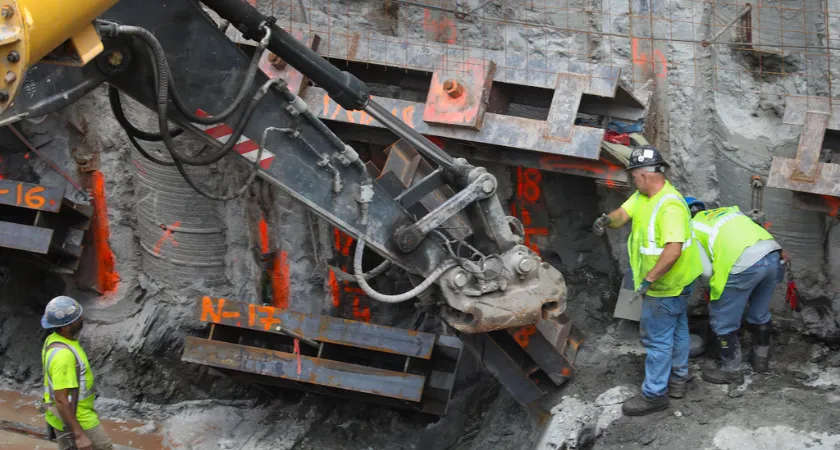
During any legal battle, five active construction contracts would likely sit idle, including preparations for the first tunnel boring through the Palisades in North Bergen. Gateway CEO Tom Prendergast has warned that delays will ripple through the entire schedule, threatening the upcoming award of the main tunnel contract.
Gottheimer said litigation would be costly and slow.
“The best way in the short term is to work with both sides and the White House to find a negotiated way forward,” he said. “The legal option is out there, we’d have a good case, but that’s a long time horizon and a massively costly one for the project.”
The White House has signaled that Gateway funding is tied to broader budget talks. Spokesman Kush Desai said Democrats were blocking a deal by refusing to negotiate over full DHS funding in exchange for releasing the tunnel money, according to Reuters.
Meanwhile, a separate dispute over Disadvantaged Business Enterprises rules has further complicated matters. A regulation finalized Sept. 30 bars consideration of race or gender in federal contracts, prompting the FTA to review Gateway’s compliance.
Davis believes that issue could also be challenged.
“Their objections to a lot of the DBE contracting could probably be fought successfully in court, under ‘reliance’ doctrine if nothing else,“ he said.
“But again, that would be up to a court that would take many months.”
For now, commuters face uncertainty over the future of 116-year-old Hudson tunnels that already cause frequent delays. Gottheimer said he plans to speak with U.S. Transportation Secretary Sean Duffy next week in hopes of breaking the stalemate.
Without a deal, one of America’s most important transportation projects could grind to a halt — with consequences stretching from union job sites to crowded rush-hour platforms across the Northeast.
Originally reported by Larry Higgs in NJ.Com.