Construction crews in Bay City, Michigan, are advancing work on a major infrastructure upgrade with the replacement of the Lafayette Street Bridge over the Saginaw River, a long-awaited project aimed at improving safety, durability and multimodal access along a critical transportation corridor.

The Michigan Department of Transportation (MDOT) has demolished the aging bascule drawbridge and is rebuilding it as part of a $113.6 million project funded largely through a federal grant. Once complete in mid to late 2027, the new bridge will provide a more reliable river crossing while significantly enhancing pedestrian and bicycle connectivity.
“The M-13/M-84 corridor bridge over the Saginaw River, otherwise referred to as the Lafayette Street Bridge was in need of a full replacement,” said Caitlyn French, MDOT Bay Region communications representative. “Originally constructed in 1938, and rehabilitated in 1989, the aging and scour critical bridge was programmed for replacement in 2020. The bridge replacement was postponed indefinitely when construction costs far exceeded original replacement estimates.
“MDOT began analyzing the potential of adjusting the footprint of the bridge or resorting to heavy bridge rehabilitation instead of the full replacement that was needed. In 2023, MDOT was awarded a $73 million federal grant, making the full bridge replacement a reality.”
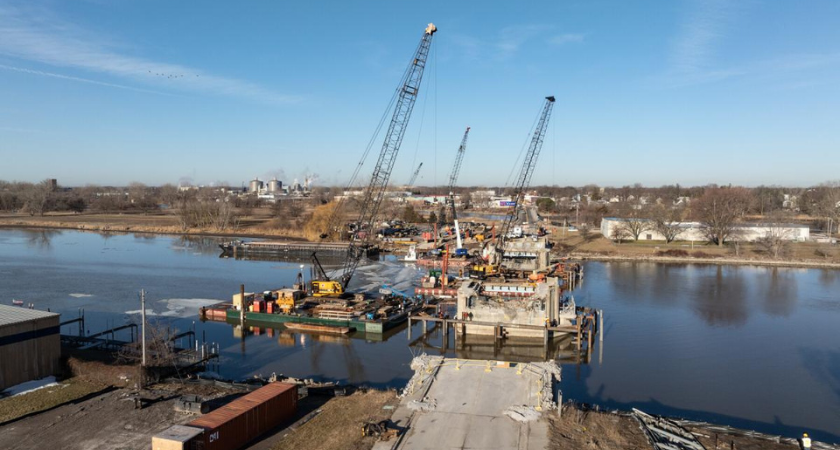
Demolition of the original structure began in early December 2024 and wrapped up in August. The joint venture team of Granite and Kraemer North America is serving as the project contractor. Crews relied on cranes, excavators, barges and boats to safely remove concrete from within cofferdams while navigating the active river environment.
The replacement bridge will maintain one lane of traffic in each direction, while significantly improving non-motorized access. “The new bridge will include a lane in each direction, with a shared-use path along the bridge and connections from an at-grade shared-use path traveling under the bridge,” said French. “The former structure had one lane in each direction and five-foot pedestrian sidewalks in each direction.”
French said the decision to add an 8-foot-wide shared-use path was driven by both traffic volumes and location. “While the Lafayette Bridge moves more than 17,000 vehicles daily, servicing both residential and commercial districts, it also attracts significantly more pedestrian/bicycle traffic than the other three crossings due to its location, shorter bridge approach and connection to Riverwalk Rail Trail, a 21-mile shared use path.”
During construction, traffic is being detoured using M-13, Wenona/Henry Street, M-25 (Veterans Memorial Bridge) and M-84, with additional detour options available via I-75 and the Zilwaukee Bridge. MDOT also resurfaced Wenona/Henry Street and made other roadway improvements to accommodate increased traffic volumes during the closure.
Paul Schiefer, Bay City Transportation Service Center construction engineer, said the deteriorated structure required full removal down to the foundation. “The bridge was in service for a long time. The concrete was in the water continuously hydrating for years, so it's hard concrete that needed to be removed.”
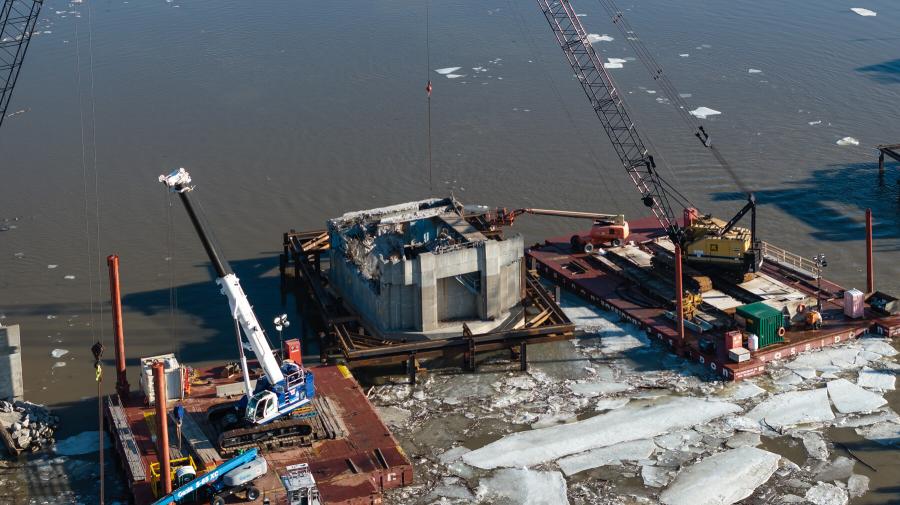
He noted that rebuilding the drawbridge is a complex process. “This work involves the demolition of the old structure, installing new steel H-piles into the bedrock and building the new foundation back up from out of the water.”
Schiefer added that the new foundation will be far more resilient to flooding and scour. “The depth of the new pile is going to be greater than the old structure. Right now, we're on a timber pile with an unknown depth of foundations, whereas we'll be driving H-pile into the shale bedrock to ensure that we're getting to the depth where we're no longer concerned about scour during high-flow events.
“Scour is enough of a concern with rivers such as this that the Federal Highway Administration requires special inspections and necessitates sending out inspectors to monitor structures during high-flow events.”
As for foundation depth, Schiefer said, “This will be variable, but it will be down to the shale bedrock. The water elevation is typically at 578 feet, and we are going to the bedrock which is at 485 feet.”
Construction has also required careful coordination with maritime traffic. “We needed to coordinate with the United States Coast Guard to make sure that construction occurred during the seasonal river closures for maritime activities. While we build the bridge and set the bascule leaves, we will need to make sure that everything aligns with the scheduled seasonal shipping outage.”
Despite year-round construction requirements and supply chain challenges, progress has remained steady. “Everything is going as anticipated. We have not had any delays due to the weather so far. This is an expedited contract that requires construction year-round, where our typical construction schedule is April 15 through Nov. 15.”
For Schiefer, the project carries both professional and personal significance. “We take a lot of pride in this because we live in this community. We want to ensure that this is built correctly, and that it's in operation for as long, if not longer than the structure that was previously in place.”
Originally reported by Cindy Riley – CEG Correspondent in Construction Equipment Guide.