The National Trust for Historic Preservation has filed a lawsuit in the U.S. District Court for the District of Columbia challenging the Trump administration’s ongoing construction of a new White House State Ballroom, arguing the project violates federal preservation, environmental, and planning laws.
The privately funded nonprofit organization, chartered by Congress in 1949, is seeking a court order to halt construction activities until the administration completes legally required review processes, including public comment and federal oversight approvals.
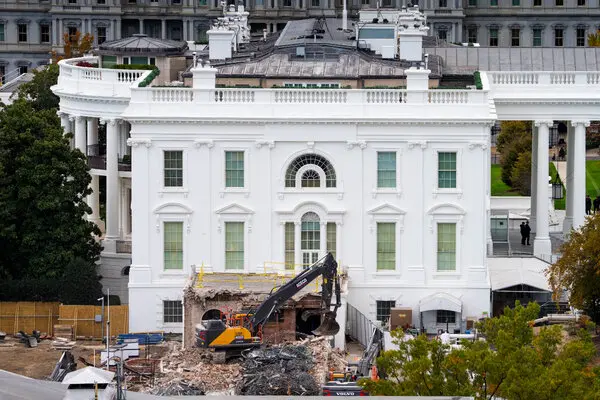
The dispute stems from demolition work carried out in October 2025, when construction crews removed the White House’s East Wing to make way for a new ballroom that is planned to be nearly twice the size of the White House itself.
“The White House is arguably the most evocative building in our country and a globally recognized symbol of our powerful American ideals. As the organization charged with protecting places where our history happened, the National Trust was compelled to file this case,” said Carol Quillen, President and CEO of the National Trust for Historic Preservation, in a statement to the press.
The organization argues that submitting the project to the proper review bodies is not optional under federal law.
“Submitting the project to the National Capital Planning Commission for review protects the iconic historic features of the White House campus as it evolves. Inviting comments from the American people signals respect and helps ensure a lasting legacy that befits a government of the people, by the people, for the people.”
According to the lawsuit, construction began even though project plans were not submitted to the National Capital Planning Commission, as required by the National Capital Planning Act. The filing also claims that no adequate public environmental assessment or Environmental Impact Statement was prepared under the National Environmental Policy Act (NEPA). Additionally, the suit contends that Congress has not authorized the construction, a requirement for projects proposed within federal parkland in the District of Columbia, including the White House and President’s Park.
The National Trust further argues that bypassing these statutory requirements violates the Property Clause of the U.S. Constitution, which reserves authority over federal property to Congress.
.jpg)
Prior to filing suit, the organization sent a letter in mid-October to the National Capital Planning Commission, the National Park Service, and the Commission of Fine Arts, urging officials to pause construction until all legally mandated reviews were completed.
The Trust also raised concerns about the scale of the proposed ballroom, stating that its height and massing could overwhelm the historic White House structure and permanently disrupt its classical architectural balance. The organization cited the Secretary of the Interior’s Standards for Rehabilitation, which it said “offer clear guidance for construction projects affecting historic properties.” The Trust added that “Our concerns went unaddressed.”
The National Trust is currently the sole plaintiff in the case and has retained Foley Hoag as outside counsel.
“We stand ready to assist the National Park Service, the White House, and relevant review agencies in exploring design alternatives and modifications that would accomplish the objectives of the Administration while preserving the historic integrity and symbolism of the People’s House,” the organization’s press release said.
Concerns over the project have also been echoed by other professional organizations. The Society of Architectural Historians expressed “great concern,” emphasizing that major changes to a building of such historic significance should undergo a thorough review process. Meanwhile, the American Institute of Architects (AIA) has offered recommendations focused on transparency, preservation review, proportional design, and professional collaboration.
The White House, a National Historic Landmark owned by the American people and stewarded by the National Park Service, was ranked second on the American Institute of Architects’ list of America’s Favorite Architecture in 2007.
Named defendants in the lawsuit include the National Park Service and Acting Director Jessica Bowron; John Stanwich, Superintendent of the White House and President’s Park; the Department of the Interior and Secretary Douglas Burgum; the General Services Administration and Acting Administrator Michael J. Rigas; and President Donald Trump in his official capacity.
Originally reported by Editorial Staff in New York Almanack.