Kansas City’s long-debated effort to reshape the Country Club Plaza has reached a pivotal moment as city leaders weigh sweeping redevelopment plans — just as the district prepares to lose one of its largest employers.
The Kansas City Council is expected to review updates to the Plaza’s Master Planned Development (MPD) plan in the coming weeks, a proposal that would allow significantly taller buildings, hundreds of new apartments, boutique hotels and a new public square. The review comes about 18 months after Texas-based Gillon Property Group purchased the Plaza following the previous owner’s default on nearly $300 million in debt.

The shopping district, long considered one of Kansas City’s signature destinations, has struggled in recent years with vacant storefronts, declining retail sales and public safety concerns. Gillon reportedly acquired the property for $176 million and now proposes investing roughly $1.4 billion to reposition the Plaza for long-term viability.
Before the City Plan Commission voted unanimously on Dec. 17 to recommend the MPD update to the City Council, Vice Chair Tyler Enders emphasized the importance of public engagement.
“This is the most robust MPD that we’ve seen in any of our tenure,” Enders said before the unanimous vote to recommend the plan to the City Council. “And it’s warranted. It’s a site that people care about. It’s an important site economically, culturally, historically. … There is much more opportunity for discussion.”
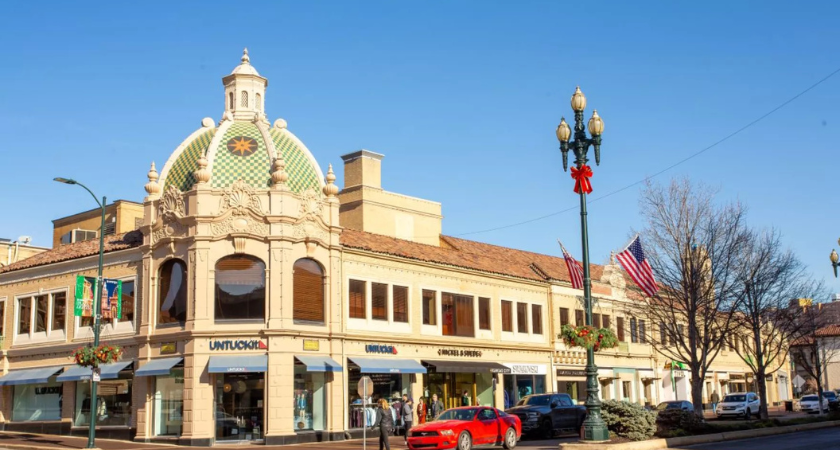
Under the proposed MPD, development rules would apply to 15 city blocks controlled by Gillon Property Group, outlining building heights, architectural standards and preservation requirements. The plan encourages Spanish-style design elements such as roof ornamentation, bell towers and glazed tile, while requiring that at least half of new building facades be constructed from traditional materials including brick, stucco, terra cotta or stone.
Pedestrian upgrades — including expanded sidewalk dining, benches, improved crosswalks and bike infrastructure — are also part of the proposal.
Dustin Bullard, vice president of partnerships and place with Gillon Property Group, said increasing density is critical to reviving foot traffic and attracting new tenants.
“You are incentivized today to stay at your home and order Uber Eats or Amazon hour-delivery,” Bullard said at a Dec. 3 City Plan Commission meeting. “And so how do we create places so that you want to get out of your house?”
However, proposed building heights remain one of the most controversial elements of the plan. While initial concepts included towers up to 200 feet tall, revisions adopted Dec. 17 lowered several structures to a maximum of 120 feet along Ward Parkway, with additional towers proposed at 150 and 178 feet, alongside an already approved 275-foot tower at the Plaza’s western edge.
Opposition has emerged from groups including Historic KC, neighborhood associations and the Kansas City chapter of the American Institute of Architects, which argue that taller buildings could erode the Plaza’s historic character.
“We are so excited about the majority of the improvements (Gillon) wants to bring to the Plaza,” said West Plaza resident Hannah Holland at the Dec. 17 meeting. “However, we also know that the main concern of (Gillon) is not the historical significance or the gratification of Plaza residents — their number one priority is their bottom line. I believe it is the responsibility of our representatives in the CPC and City Council to know the line between rejuvenation and greed.”
Historic KC President Vicki Noteis, who previously served as Kansas City’s planning director, acknowledged Gillon’s collaborative approach but expressed concern about the visual and physical impact of taller buildings.
“What’s unique about the Plaza,” she said, “it’s changed from Sears and tire sales to Gucci and back and forth over the years. It still is an integrated part of the whole neighborhood area around it, and that’s really different than anything else.”
“It’s going to create a ring around the Plaza,” Noteis said before the latest changes, “that caters to a more elite community that would come in there, that they would then become the new patrons of the Plaza. They get all the great views, they get the preferred parking, and it’s like, well, what’s happening to Kansas City’s Plaza?”
Kansas City AIA representative Dominique Davison argued for smaller, more evenly distributed increases in density.
“At a five- or six-story height, you can still look at your outdoor window and recognize the faces of people on the sidewalk below,” Davison said. “This humanizes us and allows for a stronger sense of community in neighborliness, rather than allowing for us to be anonymous and invisible in our glass towers.”

Complicating the redevelopment effort is Lockton Companies’ announcement that it plans to relocate its global headquarters from the Plaza to Leawood when its lease expires in 2030. The move removes a key anchor tenant and heightens concerns about the district’s economic stability.
Kansas City Councilmember Johnathan Duncan, who represents the Plaza area, said the development plan still offers safeguards.
“All of the buildings that they’re talking about are hypothetical,” he said.
“What most people want to ensure is that the Plaza remains the Plaza,” Duncan said, “that you’re not going to remove the Classic Cup and replace it with some glass monstrosity. And I think largely, their development plan does that.”
Mayor Quinton Lucas expressed disappointment over Lockton’s decision while acknowledging the company’s role in the region.
"Lockton is an exceptional Kansas City firm with outstanding leadership and outstanding people," said Mayor Quinton Lucas in a statement Friday. "I wish them continued success.
"I am only disappointed by the misplaced confidence many of us had in the one-time Missouri-Kansas Border War Truce, which was well in effect when negotiations supporting this move began. Regionalism cannot be one sided. The region will only thrive when we look to grow the pie, not rearrange pieces on the chess board."
Gillon Property Group has indicated that selective demolitions will occur, but that many historic facades will be preserved and integrated into new construction — a strategy known as “facade-ectomy.” City leaders argue that added residential and hotel density is necessary to generate tax revenue and sustain the Plaza over the long term.
“Density is important for the long-term health of the district,” Bullard said at the Dec. 3 meeting. “Leasing decisions are oftentimes not just made on the vibes or the feel of the space. They’re made with spreadsheets and back-end math.”
As the City Council prepares to take up the MPD revisions, the future of the Country Club Plaza remains a balance between preservation, growth and economic reality — a debate that is likely to shape Kansas City’s most iconic district for decades to come.
Originally reported by Josh Merchant in KCUR.