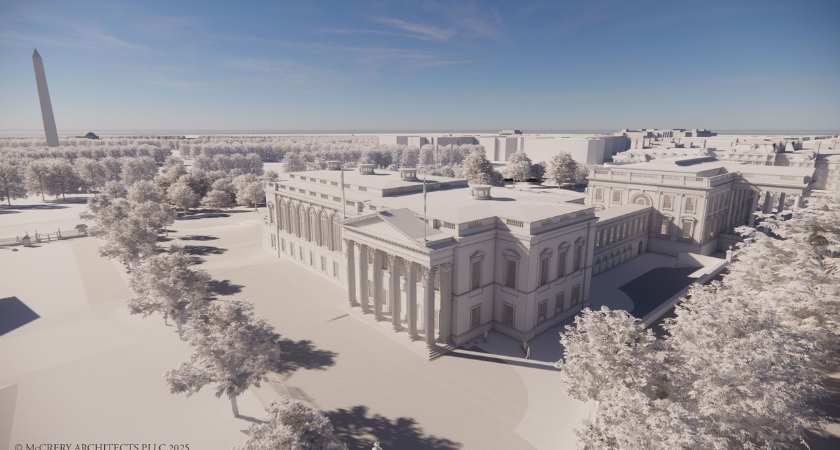
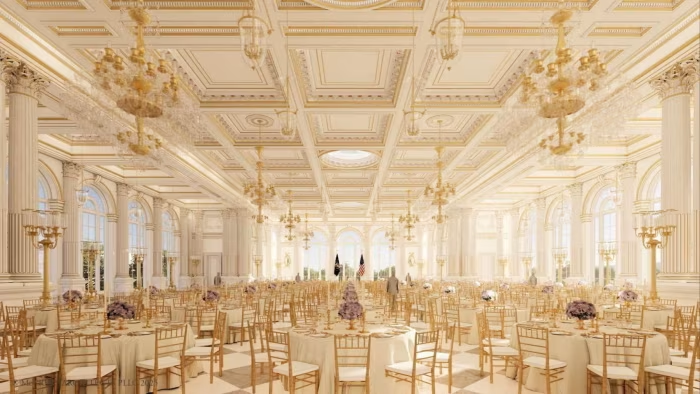
President Donald Trump’s vision for what he has repeatedly called a “beautiful and spectacular” new White House ballroom is entering a critical next phase as the administration prepares to formally submit plans for federal review. The move comes months after the East Wing was unexpectedly demolished to make way for the project, an action that sparked widespread backlash and raised questions about federal oversight.
Will Scharf, the Trump-appointed chair of the National Capital Planning Commission (NCPC), confirmed on Dec. 4 that the White House intends to turn in its designs this month. Although the NCPC is responsible for reviewing major changes to federally owned property in Washington, the commission was not notified or consulted before the East Wing was razed in October.
The White House argues that it acted within the boundaries of the National Historic Preservation Act, which exempts the White House, Supreme Court, and U.S. Capitol from the review requirements that typically apply to historic structures. Previous administrations, however, chose to undergo NCPC review voluntarily, even for minor alterations such as utility structures. This administration did not.
The surprise demolition prompted criticism from preservationists and former first ladies Hillary Clinton and Michelle Obama, who condemned the lack of transparency surrounding the sudden removal of the 62-year-old wing.
At roughly 90,000 square feet, the ballroom would be larger than the 55,000-square-foot White House itself. Carol Quillen, president of the National Trust for Preservation, warned that the addition “will overwhelm the White House itself,” and added that the scale “(may also permanently disrupt the carefully balanced classical design of the White House with its two smaller, and lower, East and West Wings).”
Trump has insisted the project is long overdue, writing on Truth Social earlier this year: “It is something that has been needed and desired at the White House for over 150 years, but something which no other President was equipped to do — But I am, and as long as we are going to do it, we are going to do it RIGHT.”
Despite widely circulated images of excavators along the east side of the mansion, actual construction on the ballroom has not begun. Those machines were part of the demolition effort that tore down the East Wing. A White House official said the loud noises heard by staff — which Trump joked had been bothering first lady Melania Trump — were linked to continued site preparation, not new construction.
Officials maintain that full construction will begin only after NCPC review. While the commission can recommend changes, experts note that the law does not give the panel clear authority to block a project of this nature, calling it a “loophole” in federal oversight. Once the plans are submitted, they are expected to appear on NCPC’s agenda early next year.
Trump has stated that he wants the project completed before the end of his term in January 2029, compressing a timeline that architects say is extremely ambitious for a structure of this size and complexity.
The ballroom’s cost has risen from an initial estimate of $200 million to a current projection of $300 million. Seating capacity has jumped as well — originally 650 guests — but Trump has since claimed the room will hold closer to “a 1,000 people.”
In an October post, Trump explained that costs rose “because it is going to be double the size, and the quality of finishes and interiors has been brought to the highest level.” He also said “the column SPAN has been substantially increased for purposes of viewing. It is actually under budget and ahead of schedule, as my jobs always are. It’s just much bigger and more beautiful than originally planned.”
A White House spokesperson noted that seating capacity can vary widely based on layout, and that standing-room-only configurations could accommodate significantly more people.

The project’s leadership team has also evolved. Architect James McCrery II was introduced with fanfare as Trump’s lead architect in July, but tensions reportedly surfaced after McCrery advised “restraint,” warning that the massive ballroom could visually “dwarf” the White House.
White House spokesperson Davis Ingle told USA TODAY that McCrery will still act as a consultant but will no longer lead the design. Instead, the administration has engaged Shalom Baranes, a Washington, D.C., architectural firm known for its federal restoration work, including modernization of the historic Treasury Department building adjacent to the White House.
The demolition and ongoing planning process have intensified debates about how much unilateral authority a president should have over one of the nation's most iconic landmarks. While the White House’s legal exemptions reduce regulatory hurdles, critics argue that the sudden removal of a historic wing without public review sets a troubling precedent.
Supporters, meanwhile, frame the project as a long-overdue modernization that will expand the administration’s ability to host major international events, summits, and state functions.
As the NCPC review approaches, the ballroom stands as one of the most controversial and closely watched White House construction projects in modern history — and, if approved, the most transformative alteration since the Truman-era reconstruction.
Originally reported by Swapna Venugopal Ramaswamy in USA Today.