.avif)
Inside Acumatica's partner ecosystem: How implementation partners are specializing, what makes customer success work, and why your choice of partner matters as much as your choice of software
SEATTLE — The ERP software you choose matters. But increasingly, construction companies are discovering something equally important: the partner who implements and supports that software can make or break your investment.
At Acumatica Summit 2026's partner general session, executives revealed numbers that tell a compelling story about the construction software ecosystem. The company now works with over 490 partners globally, adding 84 new partners in the last 12 months alone. Annual recurring revenue grew by 25% —a company record. Customer retention hit an eight-quarter high.
But behind those numbers lies a more nuanced reality: not all implementation partners are created equal, and the difference between a good partner and a great one shows up in ways construction owners need to understand before signing contracts.
Rob Kirkey, Chief Revenue Officer of 3Value, offered advice that should resonate with construction company owners: "Find a microvertical that's white space."
3Value started in March 2020—during COVID—with one employee and zero customers. They began serving manufacturing clients because that was founder Nick Knight's background. But instead of trying to be everything to everyone, they picked a specific niche: firearms manufacturers.
"Nick has a penchant for firearms. Who doesn't?" Kirkey said. "We built some IP to make that a complete solution."
From there, 3Value used what they call the bowling pin strategy—finding adjacent markets to the ones they already serve. For them, that meant moving from manufacturing to companies fabricating components in facilities and completing construction on-site, then to traditional construction sectors with general contractors and subcontractors.
They built intellectual property extending the Field Service mobile app specifically for construction subcontractors. Their two-step checklist for evaluating new markets: Is it white space? Is it a bowling pin adjacent to markets we already serve?
For construction owners, this matters because you want a partner who actually understands your specific business, not one treating you as just another client in a broad portfolio.

Andrea Hayes, principal of SVA Consulting, brought a different perspective. Her background in life sciences—a heavily regulated industry—taught her lessons applicable to construction.
"Microverticals are really important to us because there's a whole world of potential customers out there, and it's really hard to know where to focus without having an industry focus," Hayes explained.
But SVA learned the hard way that knowing industry requirements isn't enough. They were winning with buying teams—the people who would actually use the software—but losing at the C-suite level.
"There was actually a mismatch between what the C-suite's executive buying experience or criteria was, and what our value proposition was," Hayes said. "We learned that buyer persona really does matter."
They pivoted to a different microvertical within the same industry with the same requirements but different executive priorities. "Knowing where to pivot and when to pivot, and not going too long on something that isn't working" became lesson number two.
Hayes emphasized financial realism: "Something has to finance your search for a new microvertical. Really focusing on your customer base and making sure you have excellence in that bread and butter is critical."
The construction parallel is clear. The best partners don't chase every opportunity. They know their strengths, they know when to say no, and they maintain financial stability by not overextending into areas where they lack expertise.
When the panel discussion turned to implementation methodology, Hayes offered an analogy that construction owners should remember: "We sometimes think of an ERP implementation as open heart surgery. That is kind of what it feels like to the customer, right? You're going to rip out a whole integral system and replace it."
The stakes are high, which is why Hayes advocates for what surgeons use: checklists. Not creative improvisation, but structured frameworks that reduce risk and cognitive load on teams.
"What methodology is not, is it's not a strategic advantage," she explained. "It's really a baseline for operational excellence. It's not how you stand out. It's really how you avoid being left behind."
Hayes drew on her musical background to make the point: classical musicians spend most practice time on fundamentals—scales, the boring stuff—because it creates muscle memory to perform under pressure. "It brings structure to what would be chaos. It's not always fun. No consultant is excited to update a project plan or decision log. But it's that process that keeps pressure from being chaos."
The bottom line: "Methodology isn't the goal. It's the safety system. It allows you to become strategic partners and have creative solutions to problems."
Armando Huerta, CEO of iTech Support Services, focused on what he calls "a people-centric problem"—the challenge of change management during implementations.
"We can all acknowledge that implementations are hard," Huerta said. "You've got a selection team, functional teams balancing a day job while implementing, resistance to change, and a leadership team looking for ROI yesterday."
His focus: creating positive momentum early by turning skeptics into champions. iTech does this three ways.
First, they create shared vision before setting up the system. "We try to understand your processes, show you what it looks like, and bring insights from other industries or microverticals we serve to provide practical ways to make the day-to-day a little bit better."
Second, they listen while building. iTech recently implemented constant customer satisfaction feedback during implementation—not after. "That allows us to adjust and pivot to the specific people we're serving, understand what's working and what isn't, and change course if needed."
Third, they teach by doing. "It's crucial that we get people in the system as quickly as possible so they understand what life is going to be like once they're live and beyond. This hands-on approach allows our customers to see the light at the end of the tunnel."
For construction companies, this approach matters because field workers, project managers, and accounting staff need to see value quickly—not months into an implementation when they're already frustrated.
Acumatica's channel chief, articulated a crucial shift in how ERP partnerships need to work in 2026 and beyond.
"Many of you have heard me say this before, but our customer acquisition costs and payback horizon mean that if you acquire a customer and they don't renew, it's just an expense to us," Gustafson said.
He described the old world of ERP: one implementation partner with special sauce, delivering 90 percent of value in year one, then essentially set-and-forget. That model doesn't work anymore.
"The new world is really understanding what a growing mid-market set of specialized customers means—whose success means their business requirements are a great fit now, but will evolve and continue to be a fit in the future," he explained. "Go-live is now the first phase of our new long-term relationship with our beloved customers."
Rob Kirkey from 3Value demonstrated what this looks like in practice. His firm committed to reaching out to every customer at least once weekly—easy when they had four customers, more challenging as they grew.
They created a weekly newsletter called "Happenings" that mixes useful information with quirkiness and fun—what's happening at 3Value, what's happening in Acumatica, dad jokes, and recognition of National Cupcake Day. They complemented that with a "Monday Morning Minute" email focused on helping existing customers leverage their Acumatica investment.
3Value also conducts quarterly business reviews and assigns two points of contact for each client throughout their entire journey—an operational contact and a strategic contact. During evaluation, that's the sales professional and an executive sponsor. During implementation, it's the project lead and customer success manager. Post-implementation, it's the customer success manager and an executive.
"Over-communicate" was Kirkey's two-word summary of their customer success methodology.
Armando Huerta emphasized the difference between waiting for problems and anticipating them.
"We don't want to wait till a problem surfaces," he said. "We want to anticipate that. More importantly, what's changed in the business and where is it going? Are you a manufacturer that's now going to add e-commerce? Are you going to create a different module necessary for your business to evolve?"
His team focuses on stabilizing and strengthening the software itself while becoming a trusted advisor. The goal: ensure Acumatica stays aligned with business vision rather than frozen in time.
"How can we be that clarity that provides them with what they should do now, what they should do in the next three to six months, or potentially the next year?" Huerta asked. "What that creates is customers seeing ongoing value, not just initial ROI. We become embedded in their day-to-day operations as that trusted advisor, an extension of their mission."
When partners get that right, "there's no reason that customer should ever get that email from NetSuite," he noted—referring to competitors targeting satisfied customers.
Sanket Akerkar, Acumatica's President and COO, shared ecosystem performance metrics that construction owners should find reassuring:
Qualified opportunities grew 14 percent in 2025 despite market and political turmoil. Annual recurring revenue grew 25 percent—the largest number of new customers, the largest count of new customers, and the largest add-ons to existing customers in company history.
Net revenue retention—reflecting how well partners retain and grow software footprints with existing customers—hit 18 percent. The fourth quarter saw the lowest customer churn in eight quarters.
Perhaps most telling: Acumatica achieved a Net Promoter Score of 31 with an industry-leading 33 percent response rate. "That 31 NPS—we are 30 to 40 points above every single one of our competitors," Khudeira said.
For construction companies evaluating ERP options, these aren't just vendor marketing numbers. They reflect how well the entire partner ecosystem—the companies who will actually implement and support your system—is performing.
Acumatica announced a significant investment in partner capability: Ascent, a new 2.5-day partner-only training summit launching in August 2026 in Denver.
"We're a company that's not standing still. We're pushing the envelope in technology and delivering to our customers," Khudeira explained. "We found that trying to share all that knowledge and information at Summit was not sufficient for what we needed to do to make us all world-class in execution."
Ascent will cover product knowledge, industry expertise, and best practices in marketing, sales, implementation, development, and solution engineering. Partners earned 4,500 enablement badges in 2025; Ascent represents the next evolution in ensuring partners stay current with technology and methodology.
For construction owners, this investment matters because your implementation partner's capabilities directly affect your project success. A partner attending Ascent in August will be better equipped to help you in September than one who doesn't prioritize continuous learning.
Alex from Acumatica's enablement team articulated an important distinction: "Enablement assumes the gap is knowledge. Productivity focuses on execution."
When Acumatica analyzed partner performance across the ecosystem, the biggest constraint wasn't knowledge—partners know the software and their markets. They're constrained by time, focus, and execution.
"You don't lose deals because you don't know what to do," Alex said. "You lose them when the right actions don't happen at the right moment."
Acumatica is building AI-powered guidance that shows up inside partner workflows at critical moments. When registering a new opportunity, partners will see what's worked before and where similar deals stalled. They'll know which questions matter, which edition to lead with, how to size licensing, which customers to reference, and what demos to show.
"That's how execution stays consistent from first call to go-live," Alex explained. "And the most exciting part—this is already underway. You'll start feeling it in how partners run deals very soon."
For construction owners, this means the partner evaluating your needs and proposing solutions will have better tools, better intelligence, and better consistency than ever before.
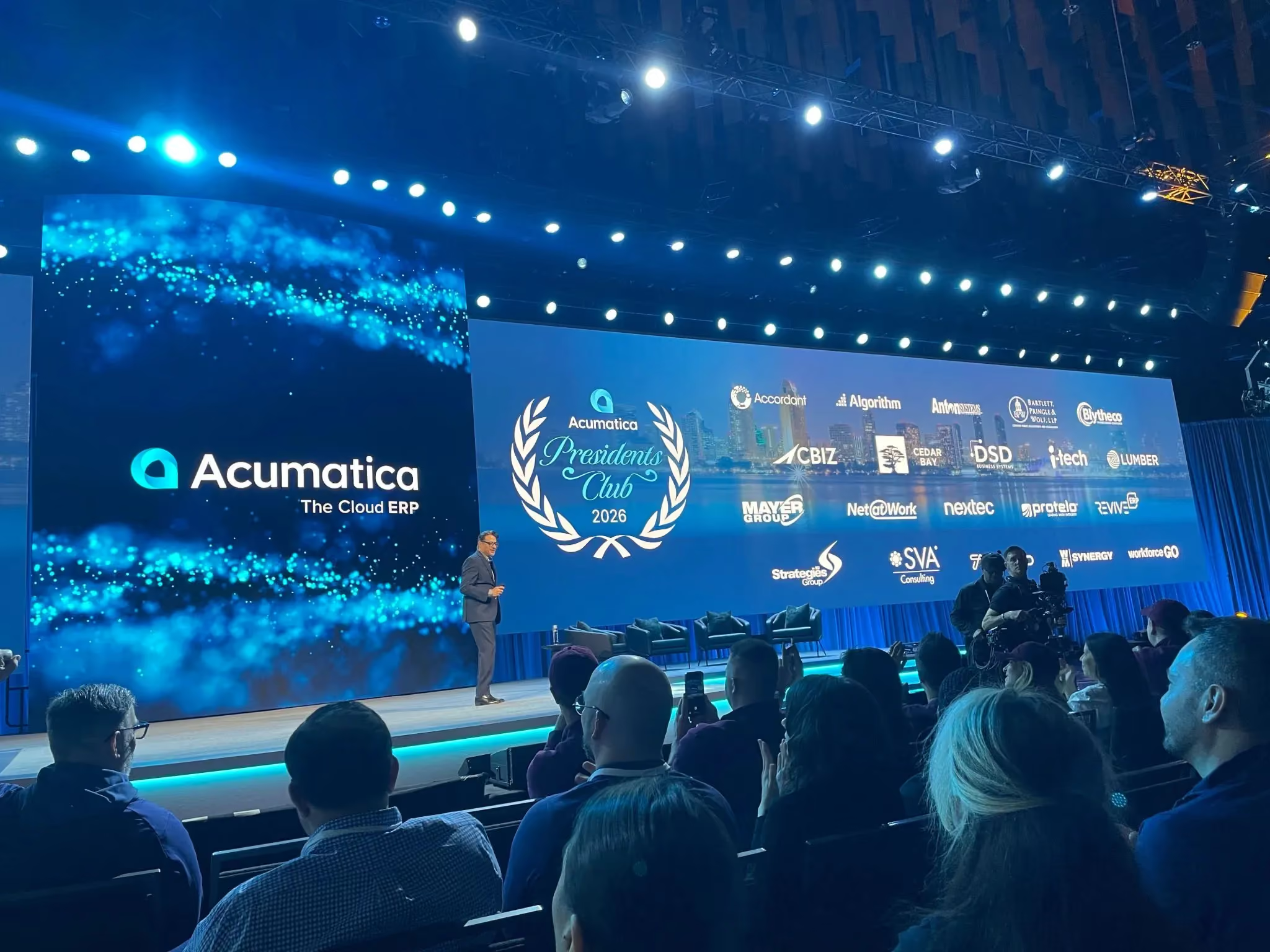
The session concluded with partner awards recognizing top performers across various categories. For construction-focused awards:
The Partner of the Year award honors the partner who demonstrates exceptional performance across multiple dimensions: driving new customer acquisition, maintaining outstanding customer satisfaction ratings, achieving strong renewal rates, delivering substantial growth, and making significant revenue contributions to Acumatica on a global scale.
The winner is: Blytheco
The International Partner of the Year recognizes the partner based outside North America who achieves exceptional results across key performance metrics: new customer acquisition, customer satisfaction ratings, renewal success, business growth, and revenue contribution to Acumatica.
The winner is: Cedar Bay Ltd.
The ISV Partner of the Year award honors the ISV partner who delivers the strongest performance in driving net new customer revenue and expanding existing customer accounts.
The winner is: Traild
The Alliance Partner of the Year recognizes the organization that has most effectively identified and developed NCA opportunities, generating the highest volume throughout 2025.
The winner is: Lumber
The Rookie of the Year award honors the partner who achieves the most impressive customer acquisition results within their first eighteen months of partnership.
The winner is: Protelo, Inc.
The Growth award recognizes the partner who has achieved the most significant year-over-year percentage growth.
The winner is: Anton Systems, Inc
The Strategic Partner of the Year is awarded to a partner with a dynamic, emerging Acumatica practice (under 75 customers) who demonstrates outstanding performance across critical metrics including customer satisfaction, deal closure rates, ASAP engagement, customer retention, and account growth.
The winner is: CBIZ
The Cloud Adoption award recognizes the partner who has shown exceptional dedication to migrating customers from legacy systems to the Acumatica platform.
The winner is: SVA Consulting, LLC
The Development Excellence Award honors a service-only partner that provides outstanding value through expert customization and development on the Acumatica platform for the benefit of partners and customers.
The winner is: Sprinterra
The Implementation Excellence Award recognizes the service partner that maintains the highest standards in Acumatica implementations, demonstrated through on-time go-lives, strong customer satisfaction, positive partner collaboration, and superior delivery quality.
The winner is: Acutrive
The Customer Success award recognizes the partner who exhibits unwavering commitment to exceptional customer outcomes year after year, evidenced by superior satisfaction scores, retention rates, and account expansion achievements.
The winner is: NexTec Group
The Partner Excellence Awards recognize the partners who sold the most industry Editions in 2025 while achieving a high customer satisfaction score.
The winners are:
Construction VAR: Strategies Group
Construction ISV: Workforce Go
Distribution VAR: Net at Work
Distribution ISV: Velixo
Retail VAR: Net at Work
Professional Services VAR: Revive ERP
General Business VAR: Bartlett, Pringle & Wolf, LLP
Reserved for the most successful partners based on new customer acquisition, customer satisfaction, renewals, and revenue contribution. Winners included firms like Accordant Company, LLC, Algorithm, Inc. Anton Systems, Inc. Bartlett, Pringle & Wolf, LLP, Blytheco, CBIZ MHM, LLC, Cedar Bay Ltd. DSD Business Systems, i-Tech Support Services, Inc. Lumber, Mayer Group ERP, NexTec Group, Net at Work, Protelo, Inc. Revive ERP, Strategies Group, SVA Consulting, LLC, Traild, WM Synergy LLC, Workforce Go.
Based on the partner session insights, construction company owners evaluating ERP partners should ask specific questions:
About Specialization: Do you specialize in construction? What percentage of your customer base is construction companies? Can you show me construction-specific IP you've developed? Which construction subsectors do you serve best?
About Methodology: What's your implementation methodology? How do you handle change management? How quickly do you get our people into the system? How do you measure customer satisfaction during implementation, not just after?
About Post-Implementation: What happens after go-live? How often will we hear from you? Who are our points of contact? How do you help us optimize and evolve the system as our business changes? What's your customer retention rate?
About Financial Stability: How many implementations are you doing simultaneously? Do you have the capacity to support us properly? How do you manage cash flow between implementation milestones and ongoing subscription revenue?
About Continuous Learning: How do you stay current with Acumatica releases? Are you sending people to Ascent? How many enablement badges has your team earned? How do you bring new capabilities to existing customers?
The partner session revealed an ecosystem in transition—moving from the old ERP model of big implementation projects and minimal ongoing engagement to a new model of continuous partnership, proactive support, and evolving capability.
For construction companies, this transition creates both opportunity and risk. The opportunity: work with partners who genuinely understand that your success is their success, who invest in construction-specific expertise, and who will help you evolve the system as your business grows.
The risk: choose a partner still operating in the old model—focused on getting through implementation and moving to the next project rather than building long-term relationships.
The session's recurring themes provide a roadmap: find partners with genuine construction specialization, clear implementation methodology, documented customer success processes, financial stability, and commitment to continuous learning.
As Andrea Hayes put it when discussing regulated industries like construction: "Methodology isn't the goal. It's the safety system that allows you to become strategic partners."
That's what construction owners should demand: not just software implementation, but strategic partnership that extends well beyond go-live into the years of optimization, growth, and evolution ahead.
Because as the numbers prove, when the partnership works—when customer success really does equal partner success—everybody wins. Construction companies get systems that evolve with their business. Partners build sustainable practices. And vendors like Acumatica achieve industry-leading retention and satisfaction.
The question for construction owners isn't whether to implement cloud ERP. It's which partner will help you do it right.
Note: This article is based on the Partner General Session at Acumatica Summit 2026, held January 27-28, 2026, in Seattle. The session featured presentations from Acumatica executives and a panel discussion with implementation partners specializing in various industries including construction.