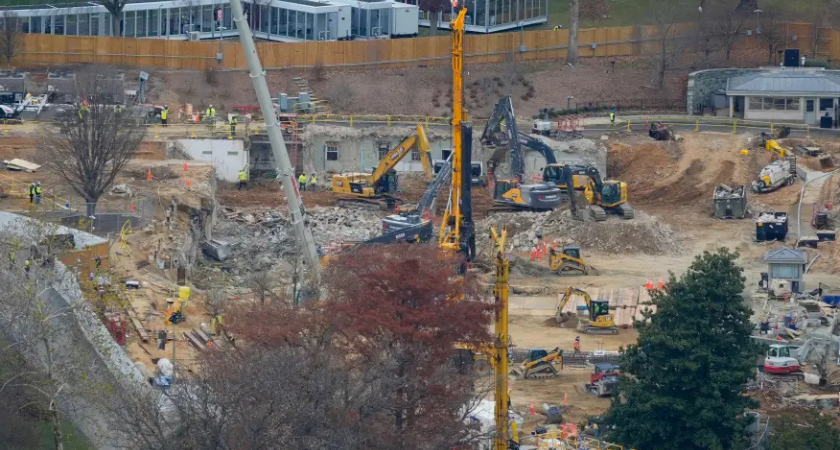
WASHINGTON — The Trump administration says construction of a proposed White House ballroom must continue, arguing in a new court filing that the project is tied to national security needs and that a historic preservation group challenging the work lacks legal standing.

The filing, submitted Monday in federal court, responds to a lawsuit brought last week by the National Trust for Historic Preservation, which is seeking to pause the project until it undergoes additional federal reviews, includes a public comment process and receives congressional approval.
According to the administration, halting work at the site of the former East Wing would interfere with the U.S. Secret Service’s ability to carry out its protective duties. In a declaration included in the 36-page filing, Matthew C. Quinn, deputy director of the Secret Service, said more construction work remains necessary to meet the agency’s security standards.
Quinn wrote that even a temporary pause in construction would “consequently hamper” the Secret Service’s ability to meet its statutory responsibilities and protect the president and other high-ranking officials. While the filing does not spell out the specific security concerns, the administration said it is prepared to provide classified information to the judge in a private, in-person briefing without the plaintiffs present.
The East Wing previously sat above an emergency operations bunker used by the president.
A federal court hearing on the dispute is scheduled for Tuesday in Washington.
Court documents provide the clearest picture yet of how the ballroom project moved quickly through the administration and how its scope continues to evolve. While demolition and site preparation are ongoing, final architectural plans have not yet been completed, according to the filing.
John Stanwich, the National Park Service’s liaison to the White House, wrote that below-ground work at the site is continuing and that foundation construction is expected to begin in January. Above-ground construction, he added, “is not anticipated to begin until April 2026, at the earliest.”
President Donald Trump ordered the East Wing demolished in October as part of a plan to build a privately funded, roughly $300 million ballroom spanning approximately 90,000 square feet. The space is expected to accommodate about 1,000 guests and is intended to replace the use of large temporary pavilions erected on the South Lawn for major events and visiting foreign dignitaries.
The National Trust for Historic Preservation argues that the project violates federal law by bypassing required reviews and approvals. In its lawsuit, the organization states, “No president is legally allowed to tear down portions of the White House without any review whatsoever — not President Trump, not President Biden, and not anyone else.”
The lawsuit also asserts, “And no president is legally allowed to construct a ballroom on public property without giving the public the opportunity to weigh in.”
The Trust contends that plans should have been submitted to the National Capital Planning Commission, the Commission of Fine Arts and Congress before any demolition or construction began. The group said it contacted those entities and the National Park Service in October after demolition had already started, but received no response. The organization did not comment publicly following Monday’s filing.

Justice Department attorneys argue that the president has broad authority to alter the White House, citing more than two centuries of additions and modifications to the Executive Mansion. They also contend that the statutes referenced in the lawsuit do not apply to the president.
The administration further argues that claims related to the East Wing demolition are “moot” because the structure has already been torn down and cannot be restored. Claims related to future construction, it says, are “unripe” because final plans have not yet been approved.
Officials also maintain that the Trust cannot demonstrate “irreparable harm,” noting that above-ground construction is not expected to begin until spring and that required consultations with federal planning and arts commissions “will soon be underway without this Court’s involvement.”
The ballroom proposal has drawn criticism from preservationists, architects and political opponents, who argue the project alters the historic character of the White House. Supporters point to longstanding discussions about the need for a larger event space, noting that a 2000 National Park Service comprehensive design plan identified the need to accommodate growing numbers of visitors and large-scale events.
For now, construction continues as the legal challenge moves forward, with the court expected to determine whether the project can proceed uninterrupted while the lawsuit is pending.
Originally reported by DARLENE SUPERVILLE, Associated Press in WJTV.