New York City government has achieved its lowest level of carbon emissions in 20 years, marking a major milestone in the city’s long-term climate and sustainability strategy, according to a new report released by the Department of Citywide Administrative Services (DCAS).

The latest Executive Order 89 (EO89) Progress Report shows that city government operations have reduced greenhouse gas emissions 31% since 2006, while cutting building energy consumption by 16%, all without disrupting essential public services. Over the same period, citywide emissions—including public, private, and residential sources—fell by 25%, meaning municipal operations are outperforming the broader city.
“This progress reflects what New York City can accomplish when we stay focused and accountable,” said DCAS Commissioner Louis A. Molina. “By reducing emissions across city operations, we’re not only building a more sustainable city for the future, but also ensuring that we can efficiently deliver the public services New Yorkers rely on every day.”
Buildings and Energy Efficiency Drive Results
Much of the emissions reduction has come from city-owned buildings, which account for roughly 70% of citywide emissions. Through a buildings-first strategy, the city has implemented more than 17,500 energy conservation measures across 2,500 facilities, reducing approximately 460,000 metric tons of carbon dioxide equivalent—the equivalent of removing more than 100,000 vehicles from the road.
“These results are proof of what’s possible when a team keeps its eye on the mission,” said New York City’s Chief Decarbonization Officer and DCAS Division of Energy Management Deputy Commissioner Sana Barakat. “I’m incredibly proud of their relentless efforts, creativity, and commitment to drive decarbonization across city government. Our work doesn’t stop here. We will keep pushing forward, finding the highest-impact opportunities, and raising the bar for what city government can achieve.”
Between Fiscal Year 2006 and Fiscal Year 2024, greenhouse gas emissions from city government operations declined from 3.64 million metric tons of carbon dioxide equivalent to 2.52 million metric tons, reflecting sustained progress through building retrofits, clean energy deployment, and improved energy management practices. DCAS has met EO89 reporting requirements annually since 2022 for the 19 city agencies covered by Local Law 97.
On Track for 2030 Climate Mandates
Under Local Law 97, part of the Climate Mobilization Act of 2019, New York City is required to reduce greenhouse gas emissions from government operations 50% by 2030, compared to a 2006 baseline. DCAS reports that current trends indicate the city is on pace to meet or exceed that target ahead of schedule.
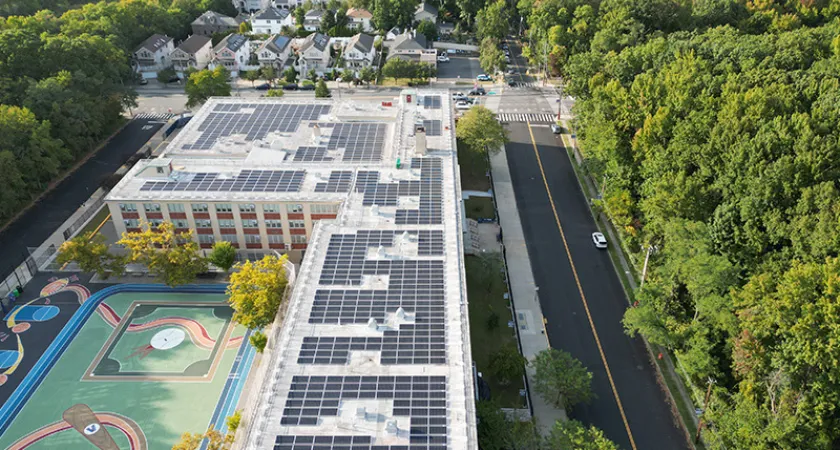
In Fiscal Year 2025 alone, the city installed 7.1 megawatts of solar capacity across 35 sites, bringing total municipal solar capacity to 32.5 megawatts, with another 40 megawatts in development. A joint DCAS, Department of Environmental Protection, and New York Power Authority project at the Wards Island Wastewater Resource Recovery Facility is expected to become the largest clean energy installation at a wastewater facility in the world, combining 10 megawatts of solar with 10 megawatts of battery storage.
Modernized Systems and Workforce Development
DCAS also expanded its use of Building Management Systems, launching six new contracts to allow real-time monitoring of city facilities. These systems help identify performance issues earlier, reduce energy costs, and prevent equipment failures. The agency has increasingly adopted design-build delivery, including solar installations at 25 city schools and the electrification of five NYPD facilities.
During the summer of 2025, DCAS coordinated citywide participation in demand response programs, with 668 municipal facilities across 36 agencies committing to reduce up to 122 megawatts of electricity load. This made New York City the largest single participant in Con Edison and New York Independent System Operator demand response initiatives.
Workforce development also played a role in the city’s climate progress. Through the Energy Management Institute, DCAS trained more than 800 learners across 29 agencies and cultural institutions in FY25, with more than 120 city employees earning industry-recognized credentials in energy management and building operations.
Major Capital Projects Advance Decarbonization
Large-scale capital investments continue to underpin the city’s emissions reductions. In 2025, the city completed a $37 million, two-phase energy retrofit at Lincoln Hospital in the Bronx, recognized as “Energy Project of the Year” at the DCAS Energy Recognition Ceremony. DCAS also launched a $25 million energy-efficient lighting upgrade at the Metropolitan Museum of Art, which will replace nearly 20,000 fixtures with LEDs and modernize lighting control systems throughout the museum.
Together, these initiatives demonstrate the city’s progress toward meeting its climate commitments while maintaining critical public services. DCAS officials say the agency will continue working with city partners to identify new opportunities to reduce emissions, modernize infrastructure, and improve energy performance across municipal operations.
Originally reported by New York City Government.