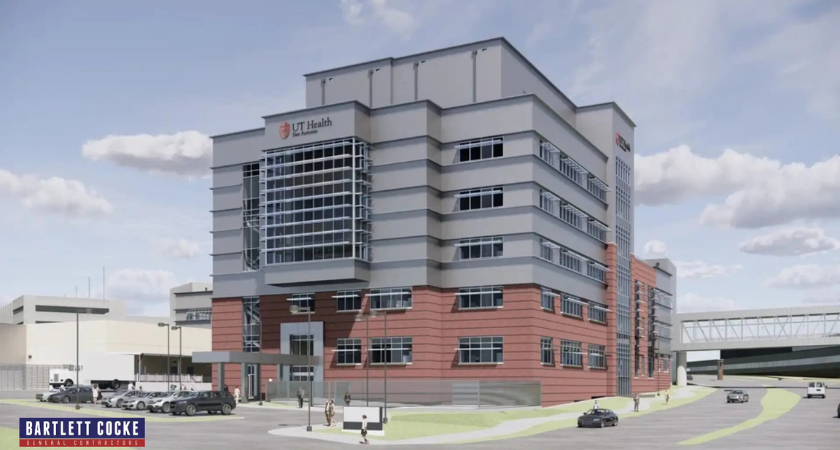
A new research facility at UT Health San Antonio is being designed to support evolving scientific needs while addressing the technical demands of modern laboratory construction.
Bartlett Cocke General Contractors is constructing the approximately 96,000-square-foot Science One Building, a five-story facility intended to support research across several scientific disciplines. The project involves collaboration with Alamo Architects and engineering partners IES, Gonzalez Shah Smith and JQ.
The construction team is using virtual design and construction (VDC) tools to coordinate architectural, structural, framing and mechanical, electrical, plumbing and fire protection systems. Combining these models allows project participants to identify potential clashes in congested laboratory areas, including ceiling plenums, shafts and equipment spaces.
The coordination process also considers installation clearances and future maintenance access. Issues are assigned and tracked through multidisciplinary reviews, allowing teams to resolve conflicts before installation begins. This approach supports more coordinated trade work and creates opportunities for prefabrication.
Bartlett Cocke also drew on lessons from an earlier medical office building project with UT Health San Antonio, reviewing previous requests for information to better understand the owner's expectations and project requirements.
Limited space for material storage and staging creates additional logistical demands. Bartlett Cocke coordinates with trade partners to identify long-lead materials, advance submittals and arrange procurement well ahead of installation.
A shared delivery board, reviewed during foremen's meetings, helps trades coordinate deliveries and identify scheduling conflicts. Access to the site's single tower crane also requires advance planning, particularly when concrete operations take priority.
Construction is taking place beside an active research facility, making communication with UT Health San Antonio and trade partners important to maintaining operations and limiting disruption.
Quality management is another focus. Bartlett Cocke is using Autodesk Forma to document inspections, establish expectations for first-of-kind installations and monitor building progress. The platform provides the owner with visibility into installed work and supports asset tracking through commissioning, turnover and the warranty period.
Science One will include open laboratories, dedicated support spaces and advanced technology infrastructure. The building is also being designed to accommodate a cryo-electron microscopy suite.
Its top two floors are planned as flexible, convertible spaces that can be adapted for future laboratory or clinical research requirements. This design approach gives UT Health San Antonio options as research priorities and technologies change.
Implications for Research Facility Owners and Contractors
The project highlights the importance of early coordination, procurement planning and quality documentation in technically complex construction. For research facility owners, flexible spaces and coordinated building systems can help preserve options for future operational needs. For contractors and trade partners, the work demonstrates how model-based coordination and advance logistics planning can address installation challenges before they affect field activities.
Source: bartlett Cocke.