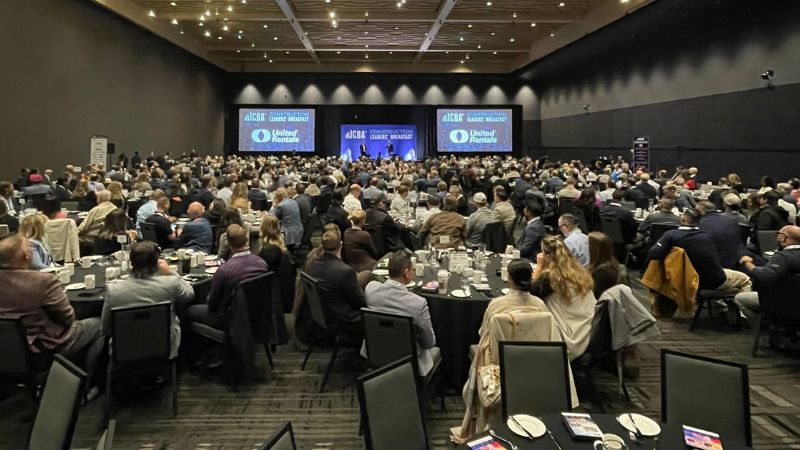
Day 1 of BUILDEX Alberta 2026 opened on October 21 at the BMO Centre at Stampede Park in Calgary. The two-day show brings together more than 2,300 industry professionals, 150-plus exhibitors and over 60 conference sessions.
The ConstructionOwners team spent Day 1 on the expo floor talking with exhibitors. In this first round of conversations, three themes came through clearly: finding skilled people, knowing where crew hours go, and keeping up when the drawings change.
None of these stays a contractor problem for long. A thin labour pool shows up in bids and schedules. Loose time tracking shows up in invoices. A missed design revision shows up as a change order. Sooner or later, owners pay for all three.
Every project depends on skilled hands, and the pipeline for them starts earlier than most owners think.
The ConstructionOwners team met with a representative of The Educational Partnership Foundation (TEPF). This nonprofit organization partners with school districts and training sites to give high school students free access to trades training.
Her message was simple. "We're trying to show high school students that apprenticeship and a trades career is just as viable as a university degree," she said. "There's tons of opportunity in Canada right now to get into the trades."
The programs carry real weight. According to Rocky View Schools, TEPF covers the full cost of programs that normally run $6,000 to $8,000 each. Students train with journeyperson instructors, earn safety credentials such as fall protection and first aid, and log hours that count toward an apprenticeship. Some, like a pipe trades student profiled by the district, finish with high school credits and job offers.
Why it matters for owners: Labour availability shapes every bid and every schedule. Programs that move students straight from the classroom to the job site help keep Alberta's workforce growing, which protects project timelines down the road.
Watch the conversation with TEPF from the BUILDEX Alberta expo floor.
For contractors with crews spread across long distances, the hardest number to pin down is often the simplest one: hours worked.
Aayush Bansal is the commercial project manager at Total Fencing Solutions, a family-run team that handles fencing installation and distribution from Fort McMurray down to Osoyoos, B.C. On a busy day, the company has about 40 workers in the field across Alberta and British Columbia.
Bansal spoke about the day-to-day challenges of running crews across that much territory, and time tracking came up at the top of the list. "Biggest challenge every single day and every single week," Bansal said. "It's a lovely conversation to have with accounting."
Distance is the main culprit. "The biggest difference for us is where we are located and how far my crews travel," he explained. "I'm not tracking when they're on the truck for 45 minutes if they took a lunch break or not."
“Total Fencing runs three branches (industrial, commercial and residential), with different crews and managers that often overlap.”
Why it matters for construction owners: When a subcontractor can't track field hours accurately, the gap shows up somewhere: in overtime costs, billing questions or schedules that slip without a clear reason. Better time data on the contractor side means fewer surprises on the owner side.
Watch the conversation with Total Fencing from the BUILDEX Alberta expo floor.
On large projects, design changes are constant, and working out what each one costs can take weeks of manual comparison.
Adalia Zhao is the founder and CEO of BuildTrace, which supports general contractors with change management. "Whenever the design changes on a large construction job site, we automatically do the overlay and produce the ROM for cost and schedule for the entire construction team," she told the ConstructionOwners team. A ROM, or rough order of magnitude, gives each trade an early read on what a revision means for its scope, budget and timeline.
The goal is to save project teams from re-checking every sheet by hand. "They don't need to spend any extra time to figure out what has changed and what the impacts are for different trades," Zhao said.
What sets BuildTrace apart, in her view, is how it works with contractors. “We're basically on-demand project managers that can be hired at any time,” she said. The company runs on its own internal AI platform, backed by project managers with decades of construction experience who verify the results.
Why it matters for owners: Design changes are where budgets quietly erode. The faster a project team can see what a revision costs and how it affects the schedule, the sooner owners can make decisions, before a small change becomes an expensive change order.
Watch the full conversation with TEPF on why the trades are a career path worth showing high school students.
A nonprofit, a fencing contractor and an AI startup don't usually end up in the same story. But all three are working on the same thing: helping the industry see problems before they become expensive.
TEPF is helping the industry see its workforce gap early enough to fill it. Total Fencing is looking for clearer sight of where field hours go. BuildTrace is giving project teams a faster view of what each design change really costs.
For owners, that raises a few questions to ask before the next project starts. Where will your contractors find their skilled workers? How do they track crew time across sites? And how quickly can they tell you what a design change will cost?
Stay tuned for more updates from BUILDEX Alberta 2026.