Every construction project starts with a stack of documents. Drawings, specs, revisions, addendums, contracts. By the time crews break ground, that stack has been reworked for most of a year.
The decisions behind those changes rarely make it onto the page. When nobody can remember why something changed, the gap tends to show up later as a change order.
Zaid Kahn has spent his career on hard problems. As a former vice president of engineering at Microsoft, he helped build supercomputers. After building three, he looked for a problem that would push him out of his comfort zone.
He found it in the construction industry. In 2025, Zaid co-founded Neuron Factory, a Silicon Valley company building an AI platform for preconstruction. Its core is a knowledge graph that connects documents, teams, and decisions so project teams can spot risks before they turn into costly changes.
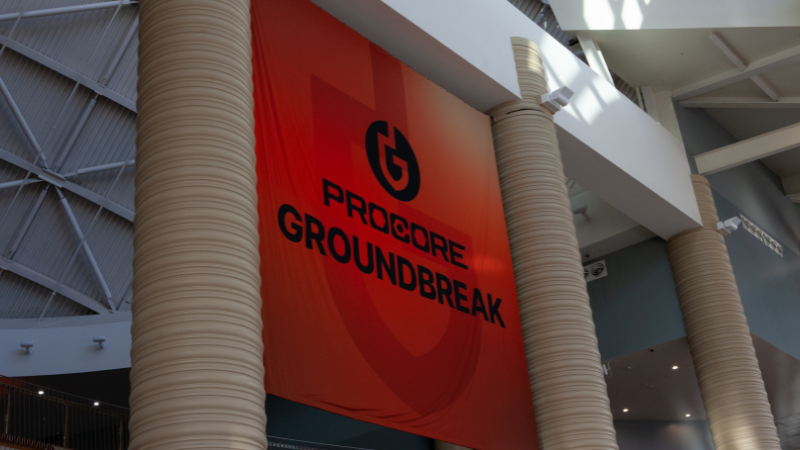
At Procore Groundbreak 2026 in Orlando, Florida, Neuron Factory set up in Innovation Alley on the expo floor. The event brought together thousands of construction professionals, technology leaders and innovators under one theme: build and win together in the AI era.
While at the conference, Caroline Raffetto, editor of Constructionowners.com, sat down with Zaid Khan for a live, in-person episode of CO Pod to talk about why preconstruction has been overlooked, what gets lost between documents, and why the industry is ready to leap forward.
CO Pod: You came to construction from Microsoft. What was that transition like, going from big tech into an industry that hasn't always been tech-friendly?
Zaid Kahn: My co-founder and I gravitate toward hard problems. At Microsoft, I built supercomputers, which were pretty hard things to build. But after you build three of them, you ask yourself what's next. You want to get out of your comfort zone.
We wrote a thesis. A lot of agents are going to do good things, like multi-step reasoning. What's missing is a layer, where decisions can be stored, so those agents have something to draw from. That layer is a knowledge graph.
To build a knowledge graph, you have to find the right domain. Construction was still running on spreadsheets, people, and PDFs. There wasn't really a platform. All those conditions came together, and we said, this is the place to solve this hard problem.
CO Pod: What is the biggest problem Neuron Factory solves for the industry?
Zaid Kahn: Context. Talk to people in preconstruction, before you swing the hammer. From the time the owner makes the call through bidding and planning, that can take about a year.
A lot of decisions get made along the way. New documentation comes in: drawings, revisions, new specs, addendums. The problem is that the context behind those decisions gets lost. It isn't in the documents. It's between them.
People assume the estimator will figure it out. But preconstruction involves lawyers, contracts people, procurement, and more. It's not just estimating.
We bring all of that context to the surface, focused on two things: risks and change orders. The goal is to find those changes before the change orders happen.
CO Pod: That's one of the biggest issues I hear from owners and smaller companies. Those darn change orders. And a lot of those troubles start in preconstruction.
Zaid Kahn: We think preconstruction has been largely ignored. People push the problem down the line.
There's also a huge labor shortage. It doesn't only hit live construction. It hits preconstruction too. If you're short on people and you want to build faster, you have to solve problems up front. Otherwise, you're just kicking the can down the road.
CO Pod: Communication in preconstruction can get disjointed, and a lot of companies don't have the data or insights they need. How does that affect them compared to companies that have it more figured out?
Zaid Kahn: Some companies have enormous amounts of data, but no team that knows how to put it together, read it, and pull insight from it. Even companies that have the data and a team still struggle to get the intelligence out of it.
So we work on both ends. We help mid-sized companies that don't have the resources to surface those risks themselves, so they can act before change orders hit. We also work with billion-dollar-plus companies that don't have the right technical teams to go after it.
CO Pod: Construction people want to build. We're not software people, but we're coming into an era where we're forced to be. Having companies like yours come in and specialize in the tech side is incredible to see.
Zaid Kahn: We had to ask ourselves the same question people ask us: why are these Silicon Valley guys coming in to solve problems in construction? The word I keep coming back to is underserved.
Historically, construction hasn't invested enough in tech. The approach was, "We'll hire people to solve this." That worked, but over the last 30 years, people have been retiring, and not enough new people are coming in.
Now I'm seeing GCs and other companies embrace good tech, and that's refreshing. We've had a warm welcome from customers who value people coming in from tech and working from first principles.
Before, technology was treated like back-end IT. Outsource it, have someone write some code, done. Everything became a point solution. Need estimating? Buy an estimating tool. There was no holistic platform approach. That's something Silicon Valley understands well: platforms and enterprise.
CO Pod: You also have a booth here. Where can people find you?
Zaid Kahn: We're in Innovation Alley. There are a lot of good things in there, and lots of fun things to play with as you walk in. Just come to Innovation Alley.
CO Pod: Here's the hardest question I'll ask you today. Where do you see the industry going, and what big things are on the horizon in the next five years?
Zaid Kahn: The biggest thing will be how AI brings productivity and efficiency. Not just in software. Great things are happening in physical AI that are going to hit job sites and change safety and efficiency.
Look at all of it together, and it's a revolution. What I like about construction today is that it's leaping forward multiple steps, not just one incremental step. The industry needs that. Dare I say, it's long overdue.
Change orders feel like a construction-phase problem. Zaid's point is that many of them are set in motion months earlier. They start in preconstruction, when the reasons behind a decision never make it into the documents.
That year of planning involves more people than most owners picture. Estimators, lawyers, contracts teams, and procurement all touch the project. Each new drawing revision, spec or addendum changes the picture. When the why behind those changes lives only in someone's head, it walks out the door when that person does.
The labor shortage makes this harder. Fewer experienced people are carrying more projects, and many veterans are retiring. Relying on memory and spreadsheets to hold a project together gets riskier every year.
For construction owners, the takeaway is practical. Treat preconstruction as the place to find risk, not just the place to price the job. Ask how your team keeps track of decisions as documents change. Look for tools that connect information across the project, not another point solution that solves one task in isolation.
The industry isn't taking one step forward. It's taking several at once. The companies that capture what they know before the hammer swings will be the ones best positioned to keep up.
Zaid Kahn is the CEO and co-founder of Neuron Factory, a Silicon Valley company building an AI-native preconstruction platform powered by a construction knowledge graph. Before founding Neuron Factory in 2025, he was a vice president of engineering at Microsoft, where he built supercomputers. Zaid speaks on AI, knowledge graphs, and how construction teams can surface risk before it becomes a change order.