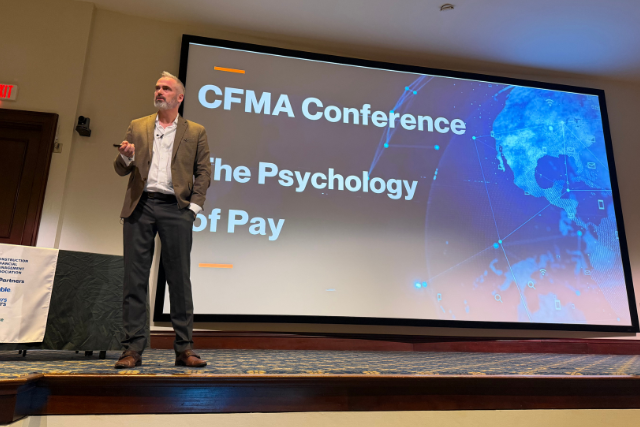
Pay is far more emotional than most business owners want to admit. That idea runs through a candid conversation between Constructionowners editor and CO Pod host Caroline Rafetto and compensation strategist Kevin Monaghan, recorded at CFMA Virginias.
Kevin Monaghan is the founder of Intuitive Compensation Group, a niche compensation firm that designs custom key-employee compensation packages for business owners. His work blends financial structuring with behavioral insight, so owners can reward top people, align interests, and keep ownership and control without giving away equity. He is a top-rated Vistage speaker and the author of Buckets: How Business Legends Keep Their Hustlers and Book Outbid.
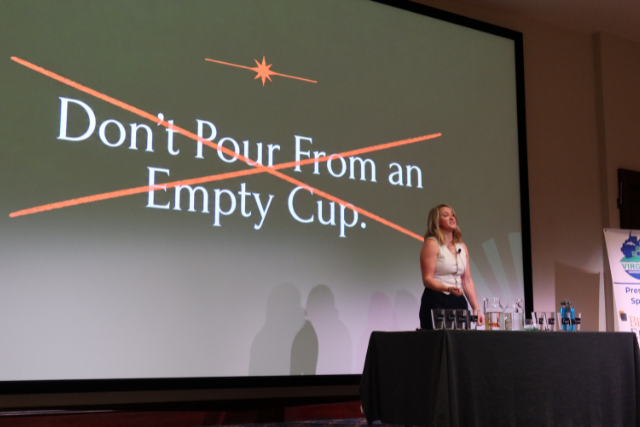
In the interview, Kevin explains why traditional incentives so often backfire, why "big wins" and delayed gratification work better, and why story matters more than dollars. He also shares the two situations he sees most in construction, and how key employees can compete with private equity in an ownership transition without needing money of their own. Along the way, Caroline reflects on what it feels like to work toward a shared goal as a team.
The conversation below has been lightly edited for clarity and readability.
Caroline: Hello everyone, Caroline Rafetto here with another interview at CFMA Virginias. Today I'm joined by Kevin Monaghan. Kevin, who are you, and what are you doing here?
Kevin Monaghan: Today we spoke at the construction event, and the goal was to put new arrows in their quiver. We're a niche compensation company. We teach people how to be more effective with pay, how to treat employees with packages and programs that motivate them, and how to solve pay problems by thinking outside the box.
Caroline: One of the most interesting parts of your session was big wins versus incentives: how to motivate and retain your workers. Something you said stuck with me: incentives are not the way to go. Tell our owners and our audience about that.
Kevin Monaghan: It's a conflict of interest, because most of the companies we work with are extremely well run. Everybody at this conference is investing to get better. When we think about pay, we want it to be rational. We want to explain it easily. But pay is far more emotional than we understand. As soon as you involve people, the complexity comes forth, every time.
Smart, rational people want to justify their actions. They think, "If this happens, then we can do this, and it would be a good thing." The problem is that the institutions they would swear by say don't do it. MIT, Harvard, Harvard Business Review, the London School of Economics: study after study says incentives don't work.
We showed examples like Nike, Jack Welch at GE, and Lee Iacocca. These people did their best work when there was no incentive. Then management and the board wanted to reward them for how great they were doing, so they put an incentive in place. It worked briefly, but everything the CEO was incentivized to do to get a payday hurt the rest of the employees and the ownership.
That's very hard for small business owners to see. In the presentation, we zoomed out to where the problems were, but along the way it looked like it was working, and that confirms things for a rational person. Humans just aren't wired like that.
So we try to put positive emotions back into pay, where people aren't talking about money and are solving the company's problems instead. Otherwise, you get this: Sally got 3%, and John got 4%. Sally is mad because John got a higher percentage. John is mad because Sally's 3% was more than his 4% in dollars. All of that is terribly damaging to getting work done, solving problems, and working together.
Caroline: Even that comparison, "I get X, and you get Y,” is almost apples to oranges. It can be so harmful to a team's growth mindset.
Kevin Monaghan: It creates a culture where you pit employees against each other for half a percent more in raises. It's not worth it.
Caroline: So what would be worth it for these leaders to do instead?
Kevin Monaghan: We know we work in the delayed gratification business. Delayed gratification is the only way to get positive emotions back into pay, particularly as you start paying up. The problem is that it's an unwelcome guest. It's uncomfortable, hard to talk about, and risky. Nobody really has a process for it, because owners' skill sets are in growing construction companies and leadership, not the one time a year pay comes around.
So we help people create big wins. We often start with a very select person or team inside a company, because it's addicting. Once it's in place with one, the owner goes, "Oh my gosh, this worked with this person or team. How do we do this more?" A big win is clear outcomes. We show ownership how much money they can make by investing in clear outcomes for their people.
Caroline: That helps retention, but also team morale. We can see in the numbers how much more effective people were. What the numbers won't show is how much happier they were.
Kevin: Look at your own company. It's talking about a big win: an IPO. A lot of private companies won't IPO, but how fun is it to work together toward one? What's your experience?
Caroline : It's been the hardest but most fun thing I’ve ever done. If I had to do it alone, it would only be the hardest thing I've ever done. I'm pretty independent, but I can't bounce ideas off myself the way you can with a team. That collaborative effort is what makes it fun.
Kevin Monaghan: That's what you want: employees showing up and working together, not worried about standing out above someone else to get a bonus. That's what incentives usually do. They put blinders on a person, and it becomes "what's in it for me" instead of "we." The only way back is a culture where everybody works for delayed gratification. Owners understand that, because they started the company under stress. They put their lives on the line, made payments, took risks, and it paid off. We want them to instill that in everybody else.
Caroline: You also talked about having a story. Tell me about that.
Kevin Monaghan: Story is more powerful than dollars. Money is the worst leader.
Caroline: You're telling that to a journalist. To me, story is over everything.
Kevin Monaghan: It's hard to get people to believe a story, because it's an art form, not a science. As you saw in the session, we use the hero's journey, like Star Wars. You need a story-arc element, and we know what it is when it comes to pay.
Caroline: What big wins are working for the construction companies you work with? It differs company to company, but what's working in creating that story?
Kevin Monaghan: In construction, there tend to be two stories.
The first is the transition story. Often, an owner wants to build toward a transition or exit, but employees can't compete because they don't have the money. My book outlines how key players, or your children in the company, can come to the table and compete with private equity multiples. That's the owner's big win: "I would transition this, as long as I'm extracting the value I need.”
The second is a company with great players. Maybe that team helped take it from $20 million to $80 million, and the owner went from $1 million in EBITDA to $5 million. The employees say, "That was great, but I went from $180,000 to $220,000, and it just got absorbed into my lifestyle." They want more, but equity is messy. So we help them design privatized, short-duration ESOPs that work. It's not an ESOP, but think of it as a little privatized ESOP for key players, leadership teams, or sometimes just someone with a license you can't lose.
Caroline: I love that you brought up ESOPs. They're getting a lot of attention, and many owners I talk to have transitioned or are considering it.
Kevin Monaghan: Here's what they're looking at. Private equity brings the biggest offer, but it comes with a lot of risk. A construction owner does not want to become an employee for the last five years of their working career.
Caroline: No, they work too hard for it.
Kevin Monaghan: So they look internally. But selling to their own team or children is a principal transaction. It's a note they have to self-finance, and those people don't have any money. So that's out. The only other thing people bring them is an ESOP, which fits in between. The owner thinks, "I don't have to be an employee, and I get to extract wealth. Great.”
What they don't know about is what we teach: a capital transaction. That's what private equity uses. Private equity has advanced degrees, and it's complex. We make it simple so that owners can use private equity strategies without the private equity team. Your key players can bring a seven-, eight,-, or nine-multiple to the table without needing money. You stay in control and keep flexibility. No debt on the books, no loans, no valuation fights. No money, no problem.
Caroline: In a perfect world, it sounds like everyone should be doing this. Why aren't they?
Kevin Monaghan: I hate to say it: nobody gets paid. Think about the transaction world. If I'm a bank, I need you to have a loan. If an attorney says, "I can solve this without the loan,” the bank is never going to bring that attorney in. Same with the business broker: there's no transaction, and the business stays in control. So nobody is incentivized to do it.
If you could help a business owner do this kind of transaction, private equity would pay you hundreds of thousands a year, plus millions in bonuses, to use it against the business owner, not for them. If you do it for the business owner, which is what the team I outline in the book does, it's much harder to get paid. You have to educate so much and spend so much time before someone can commit.
Caroline: We could keep going for hours. If you're listening, reach out to Kevin. I'm not a finance person. Talk to me about money, and I leave the room. But your session kept me there, because connecting finance with emotion is how you reach people and make a difference. Thank you for sharing your insights. Anything else for us today?
Kevin Monaghan: We put out Book Outbid and Buckets on the two concepts we help with, so people can continue their education and see if it’s something that can work.
Caroline: Thanks so much for being here today. We'll see you next time on CO Pod.
Kevin Monaghan's message is simple to say and hard to practice: pay is emotional, so treating it as a purely rational exercise tends to backfire. Short-term incentives can look like they're working while quietly turning teammates into competitors and steering leaders toward their own payday instead of the company's.
His alternative is to build compensation around delayed gratification and clear “big wins,” shared outcomes that give people a reason to pull together. Start with one key person or team, wrap the plan in a story people believe, and let the results make the case for doing more.
For construction owners, that thinking shows up in two common situations:
As Caroline put it, connecting finance with emotion is how you reach people. Owners who want to go deeper can start with Kevin’s books, Buckets: How Business Legends Keep Their Hustlers and Book Outbid, or connect with him through Intuitive Compensation Group on LinkedIn.