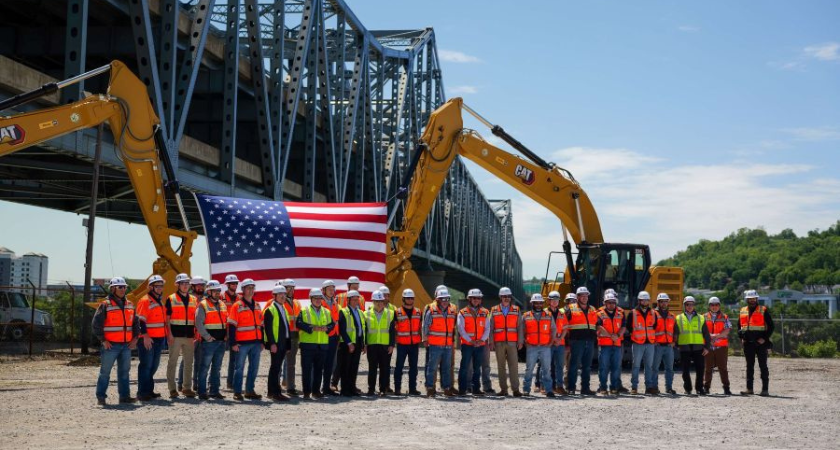
A major infrastructure initiative aimed at relieving one of the most congested freight corridors in the United States has officially entered the construction phase, signaling a long-term investment in regional mobility, safety and economic throughput.
Work has begun on the Brent Spence Bridge Corridor Project, which will expand and reconfigure the interstate connection between Cincinnati, Ohio, and Covington, Kentucky. The effort centers on a new companion cable-stayed bridge designed to run alongside the existing structure, which has long been recognized as a critical traffic bottleneck along the I-71 and I-75 corridor.
.jpg)
The project is being delivered by a joint design-build team led by Walsh Construction and Kokosing Construction, with design support from major engineering partners AECOM and Jacobs. Early construction activities include utility relocations, initial approach work and foundation preparation for river-based bridge components.
The program represents a significant investment in both transportation infrastructure and freight mobility. The corridor carries more than $1 billion in daily freight movement, making it one of the most economically significant highway segments in the Midwest. Project planners have positioned the expansion as a long-term solution to congestion and aging infrastructure constraints that have impacted regional logistics for decades.
Beyond the new companion span, the broader corridor improvement plan includes extensive roadway redesigns on both sides of the Ohio River. This work involves more than 40 combined overpasses and underpasses, along with redesigned interchanges intended to improve traffic flow and reduce collision risks associated with outdated ramp configurations.
The existing Brent Spence Bridge, originally opened in the early 1960s, will also be modified to better serve local traffic. Planned improvements include restored shoulders for emergency use, updated ramp geometry and enhanced multimodal access, including pedestrian and bicycle connections aimed at improving regional connectivity.
Funding for the project includes one of the largest federal transportation grant allocations awarded in recent years, supplemented by contributions from state transportation agencies in Ohio and Kentucky. The financing structure reflects increasing reliance on combined federal-state investment models for large-scale highway infrastructure projects.
From a construction standpoint, the project is expected to be one of the most labor-intensive infrastructure efforts in the region, with projections of roughly 6 million work hours and a peak workforce exceeding 700 skilled trades workers, potentially reaching 1,000 during peak phases. The scale of labor demand underscores ongoing workforce pressures in the heavy civil construction sector, particularly for complex bridge and highway programs.
Industry analysts view the Brent Spence Corridor expansion as a critical case study in modern design-build delivery for mega-infrastructure projects. Coordinating multi-state agencies, large design teams and phased construction sequencing across a live interstate corridor introduces significant logistical and safety challenges that require continuous stakeholder alignment.
Construction timelines indicate the companion bridge is expected to open in 2031, with full corridor improvements continuing into the early 2030s.
For infrastructure owners and contractors, the Brent Spence Bridge Corridor Project highlights the continued scale-up of federally supported mega-projects that rely heavily on design-build delivery and multi-firm collaboration. Contractors with bridge, highway and heavy civil expertise will see sustained demand as states prioritize freight mobility, safety improvements and long-term corridor modernization over incremental repairs.
Source: Walsh Group.