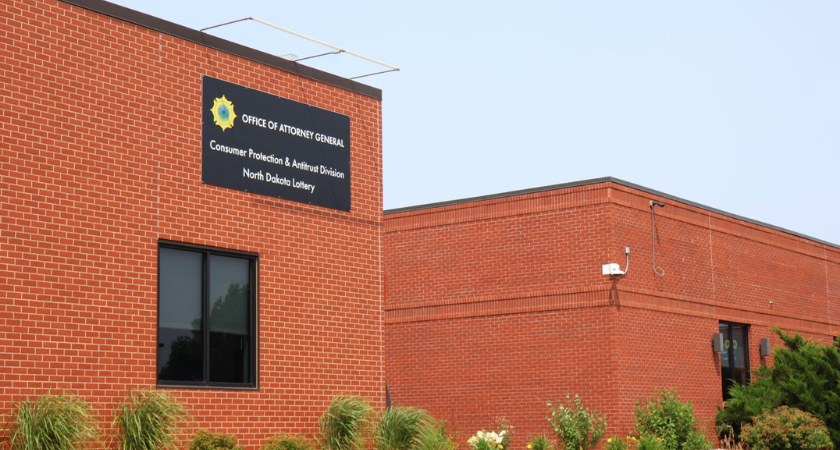
The owner of a south Bismarck property leased to the North Dakota Attorney General’s Office has agreed to pay more than $14,000 to resolve financial discrepancies tied to a long-scrutinized renovation project. The settlement surfaced Tuesday during a meeting of the Legislative Audit and Fiscal Review Committee, which has been tracking unresolved questions about the project for months.

State officials originally selected the Burlington Drive building around 2019 as a consolidated space for several Attorney General’s Office divisions. The decision later came under intense scrutiny due to Rep. Jason Dockter’s involvement as a co-owner — a controversy that resulted in his conviction on a conflict-of-interest misdemeanor and findings of three ethics violations.
Concerns over the project intensified after Attorney General Wayne Stenehjem’s death in 2022. His successor, Attorney General Drew Wrigley, notified lawmakers that inconsistencies in the project’s financial accounting required further attention. Despite a limited initial review by the state auditor and an outside investigation, the North Dakota Ethics Commission said in a June report that unanswered questions remained.
The Attorney General’s Office disputes that conclusion, telling lawmakers earlier this year that it views the matter as resolved. However, the attorney for Stealth Properties LLC, the building’s owner, said at the time he was unaware the agency considered the issue settled.
Further review identified an estimated $14,600 overpayment to Stealth tied to lease adjustments stemming from the renovation. While Stealth maintained it had already fully compensated the state, the two sides ultimately worked through the discrepancy.
According to Stealth’s attorney, Monte Rogneby, the company chose to pay the disputed amount to close the matter cleanly. “Stealth was uncomfortable with the public record being that there’s some disagreement between the Attorney General’s Office and Stealth,” Rogneby told lawmakers.
Rogneby explained that major renovations were originally budgeted based on estimates, with both sides expecting a reconciliation once work was completed. “Everybody understood that it was an estimate, and when the building was done, there would have to be a reconciliation,” he said.
The final renovation exceeded early cost estimates by $1.7 million. The Attorney General’s Office covered about $1.3 million in overruns using internal budget sources, with another $400,000 financed by increasing monthly rent payments to Stealth. After learning the project ran significantly over its projected cost, Wrigley informed the oversight committee, prompting further audits.
Those follow-up reviews included an examination by State Auditor Josh Gallion and a separate inquiry by the Montana Division of Criminal Investigation. The Montana investigator noted limitations due to lack of subpoena authority. Mountrail County State’s Attorney Wade Enget then reviewed the material but concluded additional probing would be necessary.

Rogneby argued Tuesday that earlier audit findings were incomplete, saying he later submitted additional financial documentation — including invoices — that helped resolve the dispute. Records showed the Attorney General’s Office eventually recovered more than $530,000 from Stealth, according to a Nov. 4 memo from Chief Deputy Attorney General Claire Ness.
Lawmakers questioned whether the Ethics Commission had the same documentation. Sen. Kathy Hogan asked if the additional records could address the unresolved issues cited in the commission’s June report. But Pat Monson, the attorney who led the commission’s investigation into Dockter, said the commission had reviewed everything available. “We had all the documents,” Monson said. “It was just that the documents didn’t necessarily support the numbers.”
She added that gaps in documentation created uncertainty about how taxpayer dollars were used.
Ness maintained that the Attorney General’s Office made no improper payments. “The Attorney General’s Office did not pay Stealth any money that was not backed up by an invoice,” she told lawmakers.
Committee members also sought confirmation that both parties formally considered the project reconciled. Ness said written email exchanges show agreement and that a formal legal settlement document does not apply in this situation. “A reconciliation is not a settlement agreement, so that’s just not going to exist,” she said.
Several lawmakers indicated they believed the matter had been thoroughly examined. “There’s no ‘there’ there anymore,” said Rep. Mike Nathe. “There was in the beginning, but there’s not now.”
Originally reported by Mary Steurer in North Dakota Monitor.