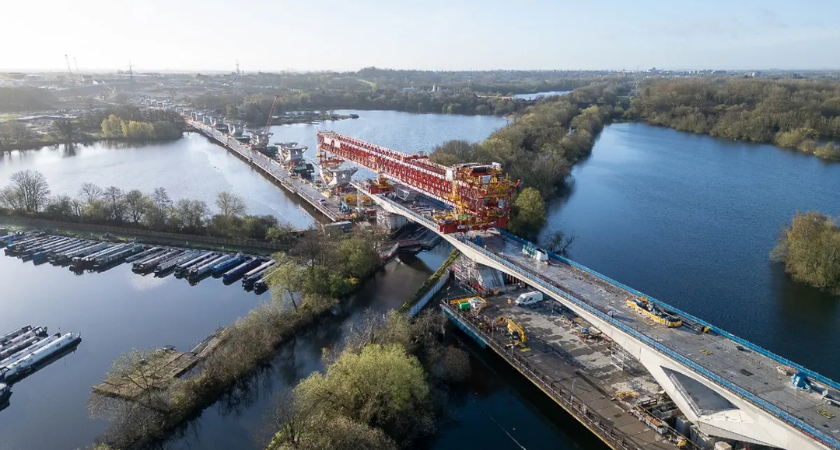
Balfour Beatty is closing out 2025 with momentum driven largely by its performance in the United Kingdom, even as its U.S. operations continue to struggle. According to the company’s year-end trading update, the London-based infrastructure contractor expects growth across several key financial indicators, reinforcing its position as one of the sector’s most stable multinational builders.
The firm anticipates its order book will rise 20% in 2025, a significant lift from last year’s £18.4 billion ($24.5 billion). Much of that growth stems from strengthening demand in the U.K., particularly in the energy and infrastructure sectors, which collectively generated £3.5 billion in new orders over the year. The company’s involvement in high-profile megaprojects — including work on the HS2 rail system — continues to serve as a cornerstone of its backlog performance.
Total revenue is projected to come in 5% higher than 2024’s £10 billion, supported again by U.K. operations. Profits from operations are also expected to exceed last year’s £252 million, with the company citing stable performance in U.S. buildings and robust gains in British energy work as primary contributors.
“Our immediate priority is to finish 2025 strongly, while laying the groundwork for further progress in 2026, where I expect the Group to continue on its journey of delivering PFO growth from its earnings-based businesses,” CEO Philip Hoare said in the company’s announcement.
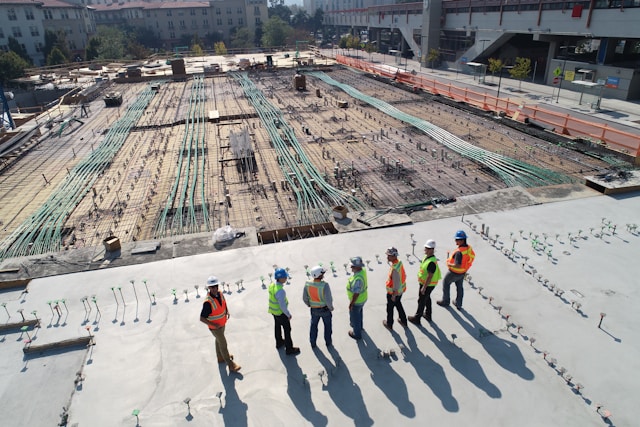
While U.K. growth is buoying the overall outlook, Balfour Beatty acknowledged that its U.S. construction segment continues to act as a headwind. In 2024, the division saw its revenue decline 2%, landing at £3.6 billion. Losses continued into 2025, with the segment posting an £11 million loss in the first half of the year.
The company has previously identified problems within its U.S. Civils division, particularly tied to a highway project where design issues triggered significant rework and cost overruns. During Balfour Beatty’s August half-year earnings call, then-CEO Leo Quinn — who has since stepped down — told investors that the project was a major factor behind the underperformance.
Quinn said at the time that design-related complications “dragged on its U.S. Civils business,” underscoring how complex infrastructure contracts can disrupt otherwise stable growth plans when technical errors arise.
Despite these challenges, the company is expecting better conditions ahead for its American backlog. Balfour Beatty anticipates its U.S. order book will expand more than 10% in 2025, rising above the $8.9 billion recorded in 2024. The growth includes approximately $750 million in correctional facility contracts across the Southeast and $400 million in new data center work in Virginia and Oregon — sectors that continue to show strong capital investment.

Balfour Beatty also highlighted plans to extend its shareholder-focused strategies. The company confirmed that it will launch another share buyback in 2026, following a similar program executed this year. Leadership said these initiatives align with ongoing efforts to strengthen long-term value and reinforce confidence across its global markets.
Operationally, the company maintains that its overall results remain firmly in line with expectations, with 2025 performance supporting its broader targets for 2026. Executives noted that focusing on core strengths — particularly U.K. public infrastructure, energy frameworks and design-build buildings — remains key to balancing inconsistencies in other geographies.
Even with its U.S. unit under strain, Balfour Beatty is entering the new year with a healthier portfolio and stronger forward visibility. The company’s ability to weather regional weaknesses while capitalizing on its dominant U.K. position continues to set it apart from competitors navigating economic uncertainty.
With U.S. demand expected to stabilize and major U.K. contracts ongoing, Balfour Beatty’s leadership is signaling confidence that its operational and financial trajectory is firmly pointed upward heading into 2026.
Originally reported by Matthew Thibault in Construction Dive.