Washington and Oregon have cleared a major regulatory hurdle in their effort to replace the aging Interstate 5 bridge over the Columbia River, after the U.S. Coast Guard approved plans for a fixed-span crossing rather than a movable bridge.
The decision allows the two states to proceed with a bridge design providing 116 feet of clearance above the river, eliminating the need for a lift span to accommodate tall marine vessels. Project leaders say the determination reduces complexity and could save hundreds of millions of dollars as cost estimates for the long-delayed project continue to climb.
Coast Guard officials notified elected leaders and transportation agencies on Friday that the service had issued a “preliminary navigation clearance determination,” valid for three years. The ruling aligns with what Washington and Oregon formally requested as part of the Interstate Bridge Replacement Program.
The approval “will eliminate the only stoplight on Interstate 5, put an end to commute interruptions, and save millions in construction costs,” said U.S. Sen. Maria Cantwell, D-Washington.
“The vast majority of the maritime community agrees that the new bridge design will not only allow river commerce to continue but also improve safe passage down the river,” Cantwell added. As chair of the Senate committee overseeing the Coast Guard, she had pressed agency leadership to issue a decision by Jan. 16.
Washington Gov. Bob Ferguson welcomed the announcement, calling it a win for commuters and the regional economy.
“This is the right decision for our economy, and for commuters who use this bridge every day,” Ferguson said in a statement released by the Interstate Bridge Replacement Program. “A fixed span bridge has overwhelming support from the maritime industry, businesses and community groups.”
Oregon Gov. Tina Kotek echoed that sentiment, saying the ruling provides long-awaited certainty for planners.
“The bridge replacement program now has the clarity it needs to advance and position us to build a safer, multimodal river crossing and corridor that will serve both states for generations,” Kotek said.
State Sen. Marko Liias, D-Edmonds, chair of the Senate Transportation Committee, said the Coast Guard’s decision marks a turning point for the project.
He said he was “really excited to see that the Coast Guard listened to the communities,” adding, “We’re one step closer to getting this bridge replaced.”
Liias described the determination as “a really critical decision point” that will allow planners to refine the bridge’s design and produce more precise cost estimates.
Not everyone supported the outcome. Washington state Rep. John Ley, R-Vancouver, a longtime critic of the project, said the Coast Guard failed to adequately consider future navigation needs.
“I’m disappointed. The Coast Guard’s job is to protect navigation not only for today but for the future,” Ley said. With reduced clearance, “you are truly restricting marine traffic in a big way.”
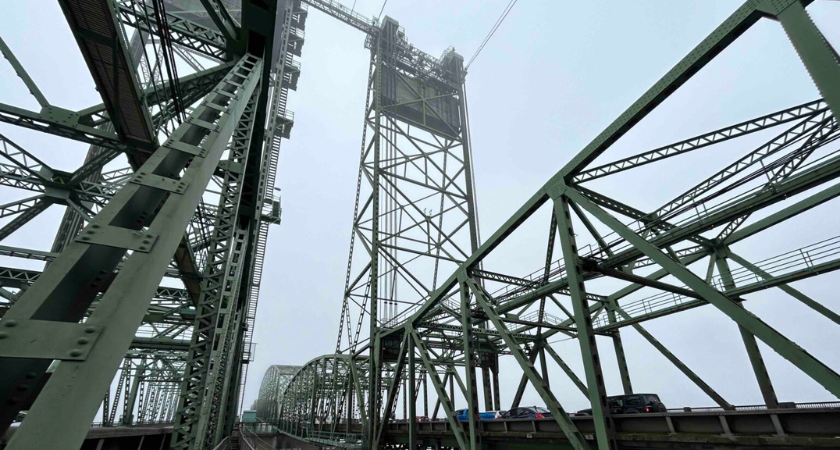
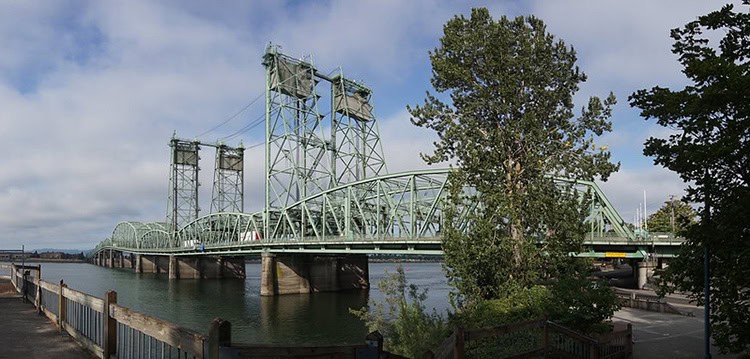
The current Interstate Bridge includes a movable span that lifts to provide 178 feet of clearance when tall vessels pass, temporarily halting traffic. More than 131,000 drivers crossed the bridge daily in 2021, compared to just 33,000 in 1961. Supporters of a fixed span argue that eliminating bridge lifts will improve safety, reduce congestion and speed commutes.
The existing structure, which rests on wooden piles driven into potentially unstable soils, is considered vulnerable in a major earthquake. One span is more than 100 years old.
Because bridge height affects river navigation, the Coast Guard plays a central role in permitting. In 2022, the agency raised objections, saying a fixed span could “create an unreasonable obstruction” to future marine traffic, but stopped short of rejecting the design outright.
Washington and Oregon responded last fall with a revised Navigation Impact Report, reiterating that a fixed-span bridge “is the best design option” and would continue to accommodate 99% of river traffic. The states also pledged $140 million in compensation to four companies whose operations would be directly affected by the reduced clearance.
Those agreements cover Thompson Metal Fab Inc., Greenberry, JT Marine and Advanced American Construction. Records show payments totaling nearly $90 million to Thompson, $46.9 million to Greenberry, $2.2 million to Advanced American Construction and $2 million to JT Marine. The funds would only be released if construction contracts are finalized.
John Rudi, chief executive officer of Thompson Metal Fab, endorsed the agreement in a December letter to the Coast Guard.
“The agreed mitigation will preserve the jobs and manufacturing capability in Clark County and the Portland Metro area,” he wrote. “We are also members of the community and recognize the need for a bridge as proposed by IBR.”
While the Coast Guard’s decision answers a key design question, major uncertainties remain, including the final price tag and construction schedule. Project estimates have ranged from $5 billion to $7.5 billion, with some lawmakers warning the total could approach $10 billion or more as inflation and materials costs rise.
Federal grants totaling $2.1 billion have already been awarded, and both states have committed roughly $1 billion each. Tolling on the existing bridge, set to begin in 2027, is expected to generate at least $1.2 billion. Additional funding is being sought from the Federal Transit Administration to support a planned light-rail extension into Vancouver.
Program managers are now seeking final federal environmental approvals, which would allow contract negotiations to begin later this year. If timelines hold, construction could extend into the early 2030s.
“We know it will be more than the resources we have,” Liias said. “We will have to figure out how we phase it.”
Rep. Ley remained skeptical that the states can close the funding gap.
“At the end of the day, whether the price is $12 billion or $14 billion or $17 billion, the two states do not have the money,” he said. “I don’t know how they can get it.”
Originally reported by Jerry Cornfield in Washington State Standard.