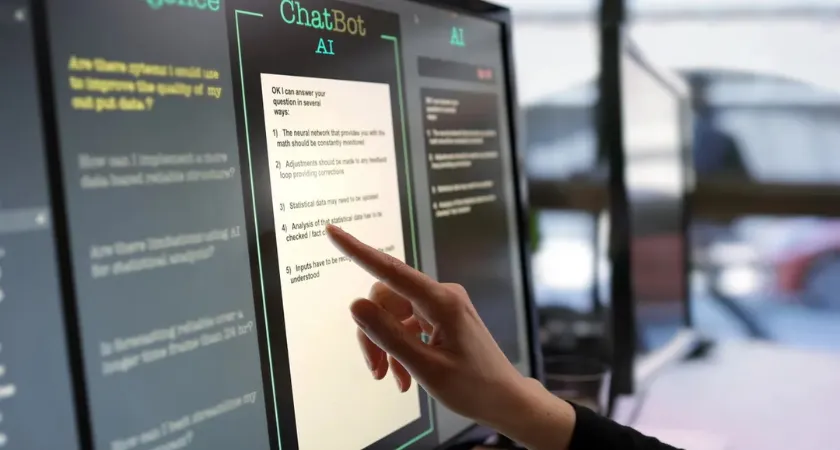
The construction industry is increasingly turning to artificial intelligence—and more specifically, AI agents—to simplify the growing complexity of managing job sites, while also preparing for a looming shortage of skilled workers.
Construction software providers are rolling out AI-powered tools designed to assist site managers and foremen with time-intensive tasks such as safety monitoring, document review, and daily reporting. These systems can sift through vast volumes of project data to flag potential issues and surface insights that traditionally required years of experience.
The push toward AI adoption comes at a critical moment for the industry. A surge in data center construction is driving demand for skilled labor just as the workforce continues to shrink. The construction sector is currently short about 349,000 workers, according to January 2026 data from the Associated Builders and Contractors trade group. At the same time, roughly 41% of today’s construction workforce is expected to retire by 2031, according to the National Center for Construction Research and Education.

Software firm Procore Technologies has emerged as a key player in this shift. The Carpinteria, California-based company introduced several AI agents last year aimed at handling routine jobsite tasks, including tools that function as digital log keepers, foreman assistants, and automated action-item generators for office workflows.
Founded in 2002, Procore reported $339 million in revenue in its most recent quarter. Its AI capabilities rely on multiple models, including those developed by OpenAI.
Procore’s Assist tool uses large-language models to summarize jobsite information and construction documents, enabling project managers to quickly locate specific details—such as fire-rating requirements for certain walls or rooms—that might otherwise be buried in paperwork. Other AI features automatically extract data from project files to generate required submittal lists, reducing administrative burden.
Procore is one of several companies supplying digital tools to the construction industry. Larger players such as Trimble and Autodesk are also investing heavily in AI, alongside startups that focus on scheduling, design optimization, and progress tracking.
Beyond document management, AI is being used to monitor construction progress in real time. Startups like AI Clearing and OpenSpace use computer vision to analyze aerial and ground-level images of job sites. Meanwhile, New York City-based Skillit is deploying AI agents to match construction workers with available jobs.
One major advantage of AI-powered tools is their ability to support natural language input, allowing workers to interact with software through speech instead of keyboards.
Dictating into Procore’s AI system allows superintendents at Minneapolis-based Mortenson to log daily site updates while moving through projects, said Gene Hodge, the company’s vice president of innovation.
“If you can input data that way, and not have to do it in front of a computer, having that user interface improvement is really great,” he said.
Florida-based contractor Kaufman Lynn has taken the technology a step further by building a custom AI agent using Procore’s platform. The agent pulls information from nearly a dozen internal systems and automatically generates formatted monthly progress reports.

“Something that took us six to eight hours is done within minutes,” said Tim Bonczek, an executive vice president at the firm.
While adoption is growing, it remains uneven across the industry. About 60% of construction firms are already using some form of AI, according to International Data Corp., though usage is largely concentrated among larger companies. Smaller firms are still in the process of digitizing operations after only recently moving to cloud-based systems, said IDC analyst Jeff Hojlo.
Beyond efficiency gains, industry leaders see AI as a tool for preserving institutional knowledge as veteran workers retire.
Mortenson, for example, is exploring ways to capture expertise from longtime employees who have built major stadium projects.
“We have a number of people retiring in our sports division that have built a lot of stadiums, and we’re talking about, ‘How do we capture all of the knowledge that they’ve built?’” Hodge said.
That effort often requires companies to formalize information that previously lived only in employees’ heads, said Aviad Almagor, Trimble’s vice president of technology innovation.
“Historically, this data sometimes just resides in the heads of those experienced employees,” he said. “Let’s sit with the expert, who is our domain expert, and ask them to make this data more visible to the system and to the other employees.”
Skanska is already applying this approach. The construction firm has developed an AI-powered safety agent trained on thousands of documents created by experienced safety leaders, including policies, procedures, and best practices. The system also incorporates feedback on how those experts approached decision-making in the field.
“We already had very intentional mechanisms in place to capture the success stories, best practices and lessons learned from our project teams throughout the business, so generative AI became a new way for us to unlock that,” said Will Senner, Skanska’s senior vice president of preconstruction.
Still, trust remains a hurdle. Convincing workers to adopt AI tools instead of traditional methods like pen and paper is an ongoing challenge, said Amy Bunszel, Autodesk’s executive vice president of architecture, engineering, and construction.
As the industry balances innovation with workforce realities, many construction leaders see AI agents not as a replacement for skilled labor—but as a way to extend it.
Originally reported by Belle Lin in The Wall Street Journal.