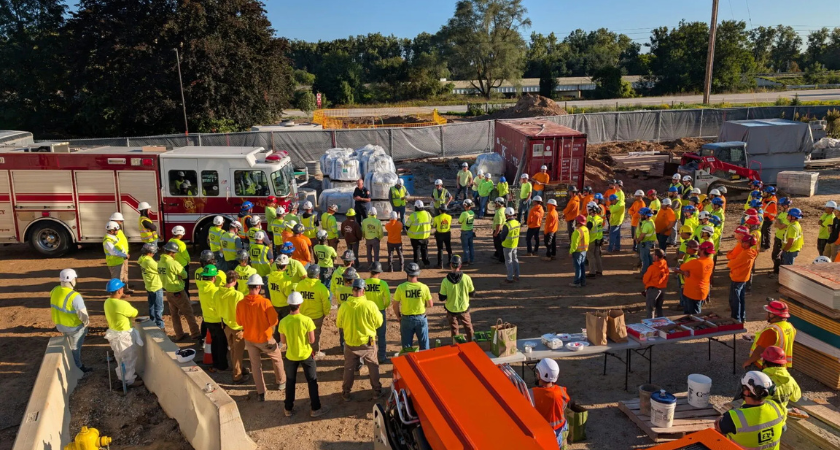
The rapid acceleration of AI infrastructure spending is reshaping the economics of construction work, driving salaries sharply upward for those involved in the massive data center buildout sweeping the United States. As Big Tech races to expand digital capacity, labor tied to these facilities is now commanding a premium—sometimes pushing workers into six-figure earnings.

Major hyperscalers including Google, Amazon, Microsoft, and Meta continue to pour unprecedented capital into data centers, defying concerns about a potential AI bubble. Industry leaders say the demand for sites capable of supporting advanced compute has outstripped available labor, creating a premium market for skilled tradespeople.
In an interview with Fortune, Raul Martynek, CEO of DataBank, said that tech companies could invest “upwards of $100 billion” into U.S. data center construction in 2026 alone. That trend is reinforced by Bank of America, which recently estimated that global hyperscale spending is set to rise 67% in 2025 and 31% in 2026, reaching $611 billion in just two years.
The surge in spending has translated directly into wage growth. Construction firms typically operate under tight margins and cost-sensitive contracts, Fraser Patterson, CEO of the AI-driven hiring platform Skillit, told Fortune. But data center projects have completely altered the dynamic.
“Because of the huge demand and the nature of this construction work, which is fueling the arms race of AI… the budgets are not as tight,” Patterson said. “I would say they’re a little more frothy.”

According to Skillit data, the average construction worker earns $62,000, or $29.80 per hour, on non-data-center projects. But the same tradespeople—including electricians, operators, and workers across 40 different specialties—earn $81,800, or $39.33 per hour, on data center sites. That’s nearly a 32% jump in pay, with many tradesworkers reporting income levels that push them well into six-figure territory.
The Wall Street Journal also reported that the most skilled workers—those coordinating complex systems, operating specialized equipment, or navigating accelerated timelines—are benefiting the most from these wage spikes.
Those accelerated schedules are a major factor. Data center projects that traditionally took years to build are now being completed in as little as six months, Patterson said, as tech companies demand faster delivery to support soaring AI workloads.
Meanwhile, the pipeline shows no signs of slowing. Tech giants currently operate 522 data centers and are building 411 more, The Wall Street Journal reported, citing Synergy Research Group.
Alongside higher pay, the data center boom is influencing workforce trends and reshaping perceptions of construction careers. Patterson said the dramatic rise in wages and long-term project volume is attracting a new generation of workers.
“AI is creating a lot of job anxiety around knowledge workers,” he said. “Construction work is, by definition, very hard to automate.”
“I think you’re starting to see a change in the labor market,” he added.
The longevity of the boom is uncertain, but for now, data center construction remains one of the hottest, highest-paying segments of the skilled trades—powered by tech’s unrelenting demand for AI-ready infrastructure.
Originally reported by Nino Paoli in Fortune.