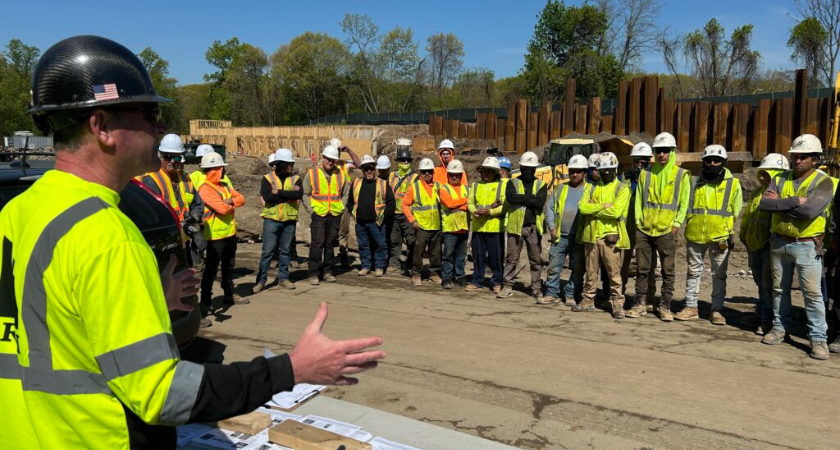
At New York Build 2026, industry leaders highlighted a growing paradox: while robotics and artificial intelligence are advancing rapidly across construction jobsites, poor data quality and fragmented workflows continue to limit their full potential.
From automated layout robots to AI-powered scheduling tools, contractors are increasingly deploying advanced technologies to streamline operations. These tools can scan installations, analyze drawings and identify risks before they disrupt project timelines — offering a glimpse into a more efficient, data-driven future.
Yet despite these gains, experts say success ultimately depends on one critical factor: reliable, consistent data.
Across the industry, firms are already seeing measurable benefits from integrating AI into project workflows. At companies like Turner Construction, teams are leveraging large language models to analyze schedules, detect inconsistencies and improve decision-making speed.
In one case, a senior executive developed a custom tool using Claude AI to evaluate project performance and uncover scheduling conflicts in just a few days — a task that previously would have taken significantly longer.
“It becomes very clear what things need more input and oversight and what things you can start to delegate to these systems,” said Eric Hull of Mancini Duffy. “Even over the last year, especially over the last few years, the amount that you can trust in the accuracy of these systems has grown exponentially.”
These tools are also reshaping how construction professionals interact with project data, allowing teams to automate repetitive tasks and focus on higher-value decision-making.
“I think AI is here to take away the menial and manual, time-consuming part of your job,” said Shiva Dhawan of Attentive.ai. “It gives you back time so that you can build on more jobs.”
As AI adoption grows, panelists emphasized that human expertise remains central to successful implementation. Rather than replacing workers, these technologies are redefining roles — particularly for experienced professionals who can interpret and guide AI outputs.
“It’s not just the AI, it’s the orchestrator, the person who knows this capability, knows how to manage this capability,” said Ben Ferrer of Turner Construction. “That’s really where our mindset is starting to shift. It’s the operator that makes the difference.”
This shift is creating a new layer of responsibility within project teams, where individuals must bridge the gap between digital tools and real-world construction execution.
Despite promising use cases, inconsistent and incomplete data continues to undermine AI and robotics performance.
“Garbage in, garbage out,” said Vincent Poon of Structure Tone. “If the information is good, you’re going to get a good output.”
However, construction data is often fragmented. Design models may not align with field conditions, and updates frequently arrive in disconnected revisions or bulletins. This lack of consistency introduces risk when automated systems rely on flawed inputs.
“We had a bad experience with a certain GC, didn’t check anything, and just took our model wholesale, all kinds of problems with layout,” said Anthony Hartke of Turner Construction. “So, having an understanding of what information we’re being provided, what we rely on, what we need to be keeping an eye out for. If we’re not communicating and we’re assuming, we’re going to have problems.”
To overcome these challenges, firms are experimenting with integrated workflows that connect robotics and AI into continuous feedback loops. For example, robots can scan completed work, AI can analyze discrepancies and crews can then address issues in near real time.
While this approach holds promise, its success depends on how well it fits into existing construction processes.
“At the end of the day, does it integrate with the existing process? Is it authentic? Does it add complication? Does it add time? Does it add effort?” said Poon. “Those are the things that we look at.”
Panelists noted that simply adding new technology to outdated processes will not deliver meaningful improvements.
“If you take an old broken process and jam it into a new tool, all you’ve got is a new shiny tool with an old broken process,” Hartke said. “So, to adopt robotics efficiently and effectively, you need to look at that process, potentially retool and rebuild it, to operate effectively.”
One of the biggest hurdles lies in the disconnect between digital precision and real-world variability. While AI models operate in controlled environments, construction sites are inherently unpredictable.
“The digital world is perfect. The world’s not perfect, we’re messy,” said Bill Seery of Consigli Construction. “Have the prefabricators done this enough where they can show me real world examples? If they’re showing me all models and nothing of physical pictures, that starts to scare me, because that means they haven’t actually dealt with the real world before.”
The discussion at New York Build reflects a broader industry trend: technology adoption is no longer the main barrier — integration is.
Key takeaways for contractors include:
As construction firms continue investing in digital transformation, the next phase will likely focus less on acquiring new tools and more on refining the systems, processes and data pipelines that allow those tools to deliver consistent value.
In the near term, companies that prioritize clean data and strong coordination practices will be best positioned to capitalize on the growing capabilities of AI and robotics across the jobsite.
Originally reported by Sebastian Obando, Reporter in Construction Dive.