
McALLEN — U.S. Rep. Monica De La Cruz says she is exploring new legal avenues to allow migrant workers to remain in the construction industry as South Texas builders struggle with workforce disruptions tied to immigration enforcement.

The Edinburg Republican announced plans to meet with the U.S. Department of Labor after builders raised concerns that increased Immigration and Customs Enforcement activity at construction sites has made it difficult for projects to continue. De La Cruz said the industry may need a dedicated visa program, similar to the H-2A visa used in agriculture, to stabilize the workforce.
“We’d like to see where the construction industry would fit,” De La Cruz said.
President Donald Trump won reelection after pledging to ramp up deportations. Over the past year, ICE officers have arrested more than 9,100 people in South Texas, intensifying fears across labor-dependent industries such as construction and hospitality.
De La Cruz said her approach reflects a responsibility to her constituents, even when it creates tension within her own party.
“They elected me to represent them in Washington, D.C., and to be their voice, even when it pushes against the Trump administration,” De La Cruz added. “At the end of the day, I want to represent South Texas, and I want to represent our community and make sure that we continue to be prosperous.”
While Republicans have long argued that stricter enforcement would open jobs for U.S. workers, some lawmakers are now acknowledging the economic strain facing industries that rely heavily on immigrant labor. A growing number of GOP members are signaling openness to a new category of legal work authorization for nonagricultural sectors.
De La Cruz’s comments followed a closed-door meeting Monday with the South Texas Builders Association, where contractors voiced concerns about work stoppages, legal uncertainty and employee fear stemming from ICE raids.
Mario Guerrero, executive director of the association, said builders are seeking clarity on their rights when enforcement actions occur on job sites.
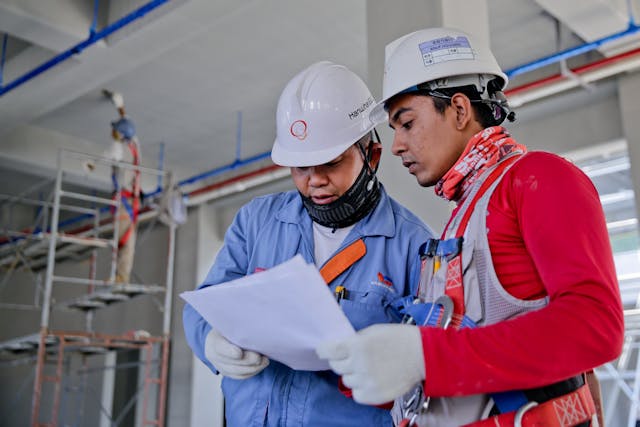
“We’re trying to figure out what rules apply with all these raids that are happening, if there’s any that do apply, because we’re not really being informed if people need to show warrants or not,” Guerrero said. “She’s willing to figure that out and get us that answer.”
Industry leaders say the labor crunch has worsened in recent months as workers avoid job sites out of fear. The issue gained momentum after Guerrero convened a large gathering of more than 300 business leaders in November, drawing participants from construction, real estate, banking and lumber sectors, along with local officials.
Representatives from each industry described stalled projects, labor shortages and mounting economic strain linked to enforcement actions.
Since that meeting, Guerrero and other leaders have met with members of Congress, including De La Cruz and U.S. Rep. Henry Cuellar, a Laredo Democrat who co-sponsored bipartisan legislation aimed at creating a new visa classification for essential nonagricultural workers.
“We’re trying to do the right thing,” Guerrero said. “If we need to keep having these meetings in order for us to keep moving in the right direction, that’s what we’re trying to do.”
De La Cruz has previously pushed for immigration reform tied to labor needs. Last year, she introduced the Bracero 2.0 bill, which sought to modernize the H-2A agricultural visa program by streamlining applications, allowing limited job mobility and extending contract durations.
Although the bill has not advanced to a vote, the Department of Homeland Security adopted new rules in October to simplify the H-2A application process — a move that industry advocates say could serve as a model for construction.
For South Texas builders, the hope is that similar reforms could provide stability in an industry already strained by labor shortages, rising costs and delayed timelines.
Originally reported by Berenice Garcia in The Texas Tribune.