Denver leaders are moving to temporarily halt new data center construction as concerns intensify over environmental strain, tax incentives, and community impact.
.webp)
On Monday, Denver Mayor Mike Johnston and members of the Denver City Council announced plans to pursue a moratorium on additional data center development within city limits. The pause would remain in place while officials craft updated regulations aimed at making the rapidly expanding industry more accountable to surrounding neighborhoods.
The proposal arrives amid mounting public criticism of large-scale computing facilities — particularly in north Denver’s Globeville-Elyria-Swansea area — where residents argue that the environmental and social costs outweigh the economic benefits.
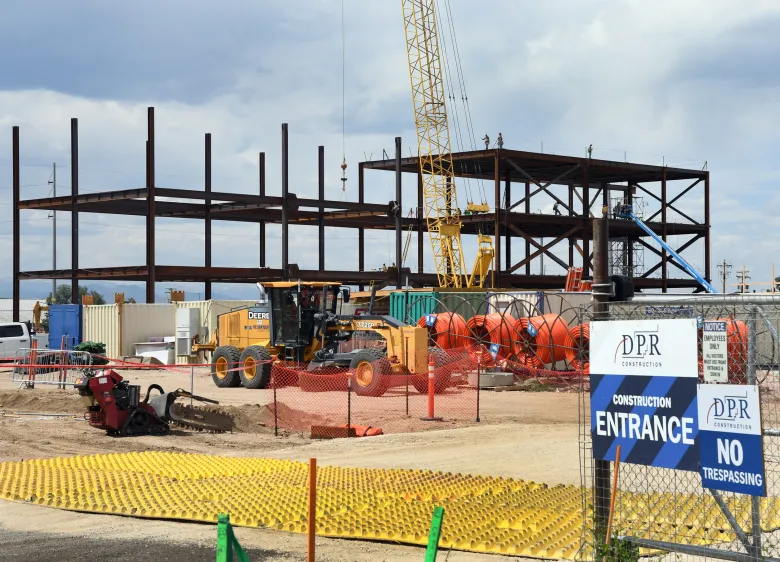
Construction continues on a three-building campus operated by CoreSite near the National Western Complex. The Denver-based company has indicated the site could see major expansion as demand for data processing, cloud services and artificial intelligence infrastructure grows.
Residents in Globeville-Elyria-Swansea say data centers consume vast amounts of electricity and water while adding to an already heavy pollution burden in their neighborhoods. Some community advocates also argue the facilities contribute to broader concerns about digital surveillance and data privacy.
A petition circulating online from the GES Coalition calls for a binding community agreement to ensure responsible development.
“This cumulative burden is not accidental,” says a petition circulating online calling for a community pact for more responsible development, written by the nonprofit GES Coalition. “It is the outcome of colonial dispossession and extraction, then decades of zoning, redlining, highway construction and industrial siting that concentrated pollution next to working-class homes alongside the legacy of the Vasquez Boulevard/I-70 Superfund site, a 4.5-square-mile smelting contamination footprint affecting multiple neighborhoods,” the petition reads.
Companies like CoreSite can’t claim to be a “good neighbor” while offering nothing more than “PR, voluntary promises, or private conversations,” the coalition says.
The area already contends with multiple environmental stressors, including heavy interstate traffic, oil refining operations, industrial plants, and power generation facilities. Residents argue that adding energy-intensive data centers further strains air quality, water supplies and neighborhood livability.
City officials say the moratorium would allow Denver to reassess zoning, water consumption, energy sourcing and affordability impacts tied to future projects.
“Data centers power the technology we depend upon and strengthen our economy,” said Denver Mayor Mike Johnston, in a joint statement with City Council members. “But as this industry evolves, so must our policies. This pause allows us to put clear and consistent guardrails in place while protecting our most precious resources and preserving our quality of life.”
If approved by council vote, the temporary halt would give the city time to develop clearer standards governing responsible land use, renewable energy requirements, and protections for ratepayers. Officials say the review process would include input from residents, climate experts and industry representatives.
The local proposal coincides with debate at the Colorado Capitol over competing data center bills.
One proposal, House Bill 1030, would grant a 20- to 30-year sales and use tax exemption for data center construction. Supporters argue Colorado risks missing out on high-paying tech jobs and AI investment without competitive incentives.
However, nonpartisan legislative staff estimate the tax breaks could reduce state general fund revenue by at least $29 million annually. Critics say that revenue loss could trigger reductions in other tax credits benefiting low-income residents.
A competing measure, Senate Bill 102, takes a different approach. Instead of tax incentives, it would require new data centers to secure renewable energy sources for their substantial electricity demands. The bill also aims to prevent utilities from passing infrastructure costs on to residential customers and bars discounted “economic development” electricity rates for data center operators.
In promoting the city’s moratorium effort, Council member Darrell Watson emphasized environmental stewardship and fiscal responsibility.
“Data centers use significant energy and water. We have a responsibility to manage their growth in our communities wisely and sustainably. We can protect the health of Denver communities, strengthen our climate commitments, and continue to keep our city moving forward responsibly.”
Despite the ongoing debate, data center construction across Colorado continues at a steady pace, with dozens already operating and more in development — even without long-term tax incentives in place.
Industry analysts note that demand for cloud computing, artificial intelligence processing and enterprise data storage is accelerating nationwide. That growth has turned cities like Denver into attractive hubs due to available land, fiber connectivity and relative geographic stability.
Yet as infrastructure expands, so too does scrutiny. Environmental groups warn that high energy consumption could complicate climate goals, particularly if new renewable generation fails to keep pace. Water usage for cooling systems has also become a flashpoint in drought-prone Western states.
The coming weeks will determine whether Denver joins a growing number of municipalities nationwide that are rethinking how — and where — data centers can operate. For now, city leaders say the proposed moratorium is less about halting progress and more about recalibrating it.
If approved, Denver’s pause could reshape the conversation around how fast-growing tech infrastructure aligns with environmental justice, economic equity and long-term sustainability goals.
Originally reported by Michael Booth in Colorado Sun.