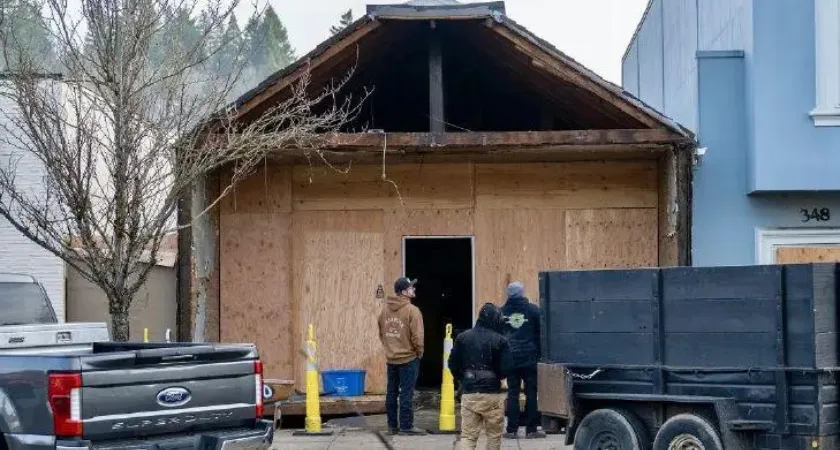
The revitalization of several Downtown Estacada buildings, using a grant from the state, has officially begun.
The city secured an Oregon Main Street Revitalization Grant of $400,000 last summer to support critical upgrades to a pair of prominent, historic buildings — 381 and 342 S. Broadway. The goal is to enhance safety, improve functionality, and preserve Downtown’s historic charm.
.webp)
342 S. Broadway: a historic building formerly the Estacada Post Office and Telephone Co. The building is being rehabilitated into a mixed-use live/work space.
381 S. Broadway: home to Estacada Athletic Arts, the building will get upgrades to its mezzanine and infrastructure to expand programming and improve accessibility.
“A huge thank you to Oregon Main Street for supporting vibrant, revitalized communities across our state,” the city wrote online.
Local leaders say the two Broadway properties represent more than aging structures—they are anchors of Estacada’s commercial core. By converting one building into a live/work space and modernizing the other for expanded community programming, the city hopes to attract new residents, entrepreneurs and visitors to the downtown district. Officials believe the improvements will complement recent streetscape investments and encourage additional private renovation projects along the corridor.
The Oregon Main Street Revitalization Grant is a competitive program administered by Oregon Heritage, part of the Oregon Parks and Recreation Department. It supports the rehabilitation, restoration, and adaptive reuse of buildings within downtown areas, with the goal of spurring economic development, private investment and job creation.
Because Estacada is a member of the Oregon Main Street Network through the Downtown Estacada Commission, the city was qualified for this funding.
Both properties remain privately owned. The city applies for the grants on behalf of the building. Estacada staff manage grant disbursement and compliance (the money must be used for construction and rehabilitation activities).
Under the terms of the grant, the previous business occupant gets first dibs at retaining the space if they choose to do so.
The Oregon State Lottery provides funding for the grant, which requires a 30% match from private investments by the property owners, Estacada Urban Renewal funding, and in-kind contributions.
In total, 35 grants were awarded for more than $10.5 million.
City officials expect construction activity over the coming months to bring short-term jobs and long-term economic benefits. The live/work conversion at 342 S. Broadway is designed to create flexible space for small businesses or creative professionals, while the upgrades at Estacada Athletic Arts aim to broaden youth and community programming.
Downtown advocates say preserving historic character while improving building safety is critical to keeping local businesses competitive. Improved accessibility and modern infrastructure could open the door for new tenants, expanded class offerings and year-round events that draw families into the city center.
The Broadway corridor contains some of the city’s oldest commercial architecture, much of it built during Estacada’s early railroad and timber era. Over time, deferred maintenance and changing building codes made it difficult for owners to keep the structures fully occupied. The state grant program is intended to bridge that gap by helping small communities tackle costly seismic, electrical and accessibility upgrades.
.webp)
Unlike many redevelopment grants, the Oregon Main Street program requires significant local participation. Property owners must contribute at least 30% of project costs, ensuring private investment accompanies public dollars. Estacada Urban Renewal funds and in-kind labor will help meet the match requirement, reducing the burden on individual owners.
City staff will oversee reporting, contractor compliance and reimbursement requests to make sure the work meets preservation standards set by Oregon Heritage. Only construction-related expenses are eligible, meaning the funds will directly support visible improvements such as structural repairs, new entrances, elevators, roofing and façade restoration.
Construction schedules for both properties are expected to extend through 2026, with phased work planned to minimize disruption to nearby businesses. Community members will see scaffolding and street activity as crews address long-needed infrastructure issues. Once complete, officials hope the projects will serve as a model for future revitalization efforts on additional blocks.
Originally reported by Christopher Keizur in Your Oregon News.