Construction sites across North Carolina are slowly coming back to life after a weeklong Border Patrol operation triggered widespread fear among immigrant workers, particularly in the construction industry — a sector heavily dependent on Latino labor.
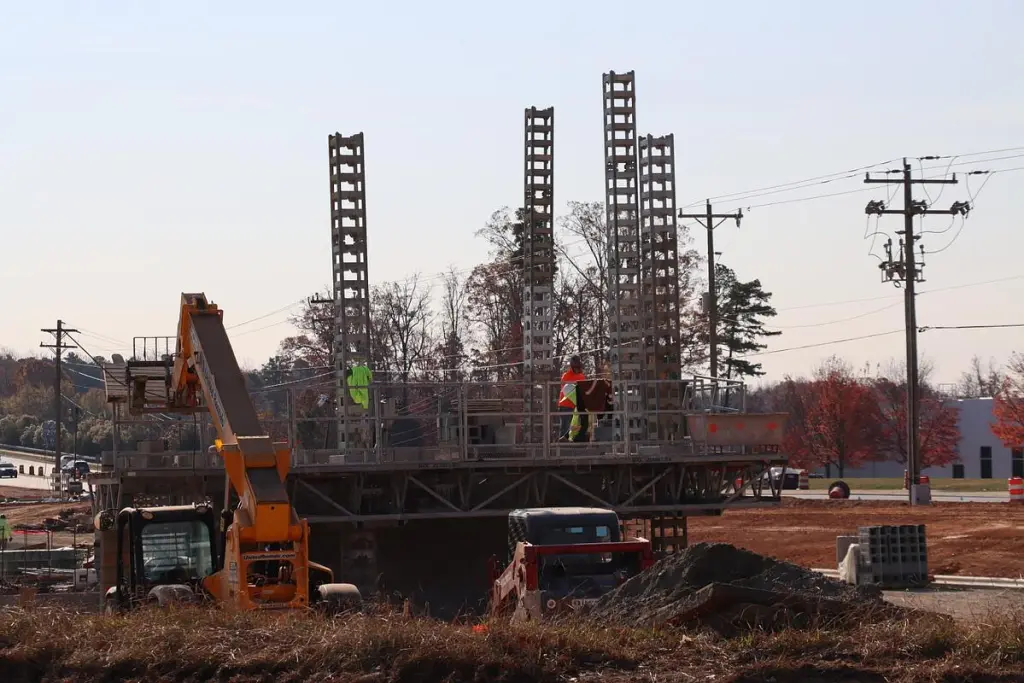
The enforcement action, known as “Charlotte’s Webb,” began in early December and led many construction workers to stay home, worried they could be detained or deported simply for showing up to work. In Charlotte, a plumber working on construction projects in the city’s southeast said he did not leave his home for several weeks after the operation began.
“We have to hide as if we were criminals, something we are not, but that’s how they see us,” he said, requesting anonymity. The worker has lived in the United States for 25 years, including 13 years in Charlotte.
While federal authorities said the operation targeted people with outstanding deportation orders, community advocates and early data suggest a broader impact. On Dec. 3, the Department of Homeland Security reported more than 425 arrests in the Charlotte area. Of the first 130 cases reviewed, only 44 involved people with criminal records. Advocacy groups such as Siembra NC documented dozens of arrests involving construction and landscaping workers across the state.
“They say they’re going after criminals, people with records, but that’s not true. They’re coming after us, the working class,” the plumber told Enlace Latino NC.
As fear spread, construction sites emptied almost overnight. Workers stayed home, projects stalled, and contractors scrambled to adjust schedules and contracts. For many families, the consequences extended far beyond lost income.
The Charlotte plumber, who files taxes as an independent contractor, said he has been relying on money set aside for tax payments to survive.
“By the end of the year, I’ll owe about five or six thousand dollars”, he said.
The situation has deeply affected his family, especially his children, who were born in the United States.
“My son is very scared. At night he checks on me: ‘Are you OK, Dad?’ In the morning, before school: ‘I hope you’re OK when I get back,’” he said.
Even after Border Patrol agents were no longer visibly present, the fear has lingered. Reports of similar operations in other states have kept many workers from returning to job sites.
“My plan is to survive on what I have until the second week of December and then see how things look so I can get back to work,” he said.
.jpg)
In Zebulon, near Raleigh, Carlos — a pseudonym used for safety — chose to keep working as an HVAC technician but said job sites were eerily empty.
“When he arrived at job sites, ‘they looked completely deserted,’” he told Enlace Latino NC. Carlos has lived in North Carolina for more than 20 years.
“Many construction sites shut down because most of us who work in this sector are Latino or Hispanic.”
To reduce risk, Carlos’ family limited outings, relying on his sons — one a U.S. citizen and the other a DACA recipient — to handle errands. He also paused his weekend soccer league, a common gathering space for construction workers.
“Several people I know were affected. Friends told me some of their guys got taken,” he said. “I had to stop everything because people were scared. And I include myself.”
The slowdown has had a measurable economic impact. A Raleigh-based construction contractor with 23 years of experience said fear among his mostly Hispanic workforce halted operations for nearly two weeks.
“We lost around $60,000 in contracts,” he told Enlace Latino NC. “Some jobs were urgent. If we didn’t go, they had to hire another company.”
Although the contractor and his wife have legal immigration status, many of his workers do not. He said Latino workers are often the backbone of demanding construction jobs.
“Some of them are the only ones bringing income into their homes,” he said. “Their fear isn’t just being detained, it’s the inhumane treatment they’ve seen.”
Construction is a major economic driver in North Carolina, generating $41.4 billion in 2024. According to the National Association of Home Builders, one in four construction workers in the state is an undocumented immigrant.
NAHB President Buddy Hughes warned of broader consequences if enforcement continues to disrupt the workforce.
“Mass deportation is not the answer,” Hughes said. “With a shortage of more than 200,000 workers in the construction industry, any disruption to the labor force would raise housing costs, limit supply and worsen the nation’s affordability crisis.”
The contractor, who is also a pastor, said he and volunteers recently delivered food to a worker’s family that had gone without income.
“They have kids and nothing to eat because the father hadn’t been able to work,” he said.
.jpg)
For Carlos, who is adjusting his immigration status through his youngest son, the enforcement surge has raised concerns about long-term consequences.
“We’re afraid our process might stop or something might change,” he said. “You know the president has been changing a lot of legislation. It makes you think.”
Since January 2025, the Trump administration has expanded immigration enforcement, rolling back discretionary guidelines and increasing detentions, including for individuals with pending cases.
Workers say the atmosphere has changed.
“With this president, it feels like the racism that already existed has woken up — what many people kept inside,” the Charlotte worker said. “In past years, you didn’t see so much hostility toward immigrants.”
Outside a Home Depot in Charlotte, another construction worker expressed similar frustration — despite having legal status and voting for President Trump.
“This chaos, this disgrace… it even makes me regret voting for him [Donald Trump],” said Olman Cantarero, originally from Honduras and a U.S. resident for 28 years.
“It’s very stressful, even if you’re good. You feel like you have to carry your passport because sometimes just looking Latino is enough,” he added.
While some construction activity has resumed, workers say the return to normal is fragile.
“We have to stay alert to our surroundings, what we hear and see, to know when it’s safe to go back to work,” said the Charlotte plumber, who remains largely confined to his home.
Anna Hernández, executive director of Transforming Nation Ford, said the situation echoes the early days of the COVID-19 pandemic.
“Returning to normal is going to be a long process… not only economically, but for our health, our safety and our community,” she said.
Originally reported by Claudia Rivera Cotto in Enlace Latin NC.