Madison-based Findorff is overseeing construction of the Wisconsin History Center in Madison, Wis., a $161 million project that will more than double the exhibition space of the state’s former historical museum and serve as a major cultural destination when it opens in 2027.
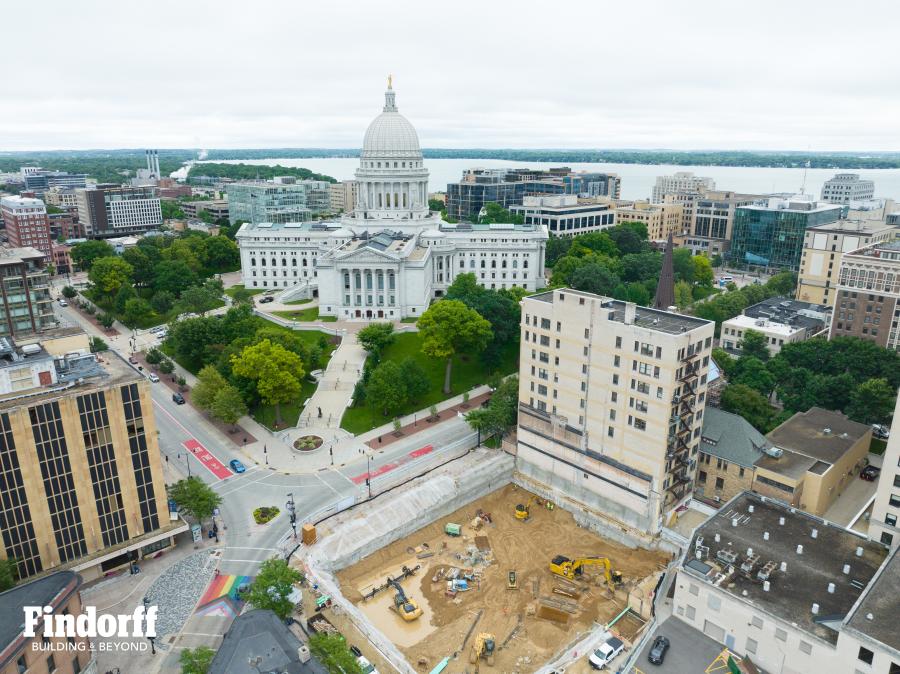
Envisioned as an open gateway to one of the nation’s most significant historical collections, the new 100,000-sq.-ft. facility replaces the Wisconsin Historical Museum, which previously operated out of a former hardware store on Madison’s Capitol Square. The older facility struggled to meet growing demand from school groups and residents and lacked the space needed to fully showcase the state’s extensive collections.
“This is a historic project for Wisconsin,” said Christian Overland, who serves as Ruth and Hartley Barker Director and CEO of the Wisconsin Historical Society. “We are building more than just a museum. We are creating a place where all Wisconsinites can see themselves in history, and where connections between the past, present and future will enrich the lives of each guest.”
Once complete, the Wisconsin History Center is expected to welcome approximately 200,000 visitors annually, including as many as 60,000 students. The facility will house three core galleries, a rotating community gallery highlighting local history from across the state, and a large temporary gallery capable of hosting national-caliber traveling exhibits.
The center also will feature a café, retail storefront, sensory room, classroom, lunchroom, and a fifth-floor event space with an adjoining rooftop terrace designed for public and private gatherings. In addition to in-person exhibits, the Wisconsin Historical Society plans to extend the center’s reach statewide and beyond through advanced technology and digital engagement.
Overland said public response to the project has been overwhelmingly positive.
“We have been humbled and inspired by the incredible public, private and community support for the project. It has been 20 years in the making, and we cannot wait to deliver the nation's next great history destination to the people of Wisconsin and beyond.
“The groundbreaking was terrific. It was a real awestruck moment for the many people who have contributed to the project and believe in our vision. More than 200 elected leaders, tribal partners, private donors and community champions gathered on Wisconsin's Capitol Square to celebrate the milestone moment.”
Findorff is overseeing building construction, working with Wisconsin-based Continuum Architects in association with SmithGroup as lead designer. Ralph Appelbaum Associates, known for exhibition work at institutions such as the United States Holocaust Memorial Museum and London’s Imperial War Museum, is designing the exhibits.
“The Wisconsin Historical Society is stewarding the future history center under the guidance and expertise of some of the nation's leading experience designers, curators, scholars and historians, infusing insights from a wide range of community voices and perspectives, and in consultation with Native Nations,” said Overland.
SmithGroup principal and lead architectural designer Monteil Crawley said the building’s exterior draws directly from Wisconsin’s landscape and industrial heritage.
“The center is wrapped in a layered façade that provides movement and depth to the building's exterior that, much like history, reveals new perspectives as your vantage point changes. Local materials, including weathered zinc, embossed stainless steel, granite and glass create a dynamic exterior inspired by Wisconsin's ever-changing landscapes, the movement of the surrounding lakes and the state's rich history of industry and innovation.”
According to Findorff project manager Scott Goelden, managing construction logistics in a dense downtown environment has been one of the project’s primary challenges.
“Given the downtown location, deliveries will need to be just in time. Also, work will need to be sequenced in a way to minimize overlap between enclosure activities by multiple trades.”
Construction began in April 2025 and remains on schedule, Goelden said.
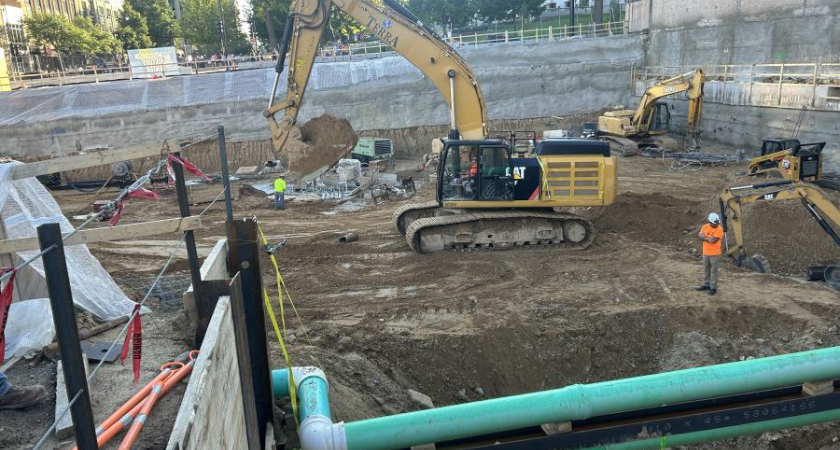
“Mass excavation is nearing completion, with earth retention activities following closely. Excavation for foundations is under way.”

Excavation has progressed efficiently due to favorable soil conditions that are both well-draining and easy to work with, though crews must carefully coordinate operations around adjacent buildings and the site’s complex geometry.
A tower crane was installed last summer, requiring a dedicated power source, a substantial footing and a 400-ton all-terrain crane. Concrete work began around the same time.
“Lean concrete must be placed beneath all footings to ensure proper bearing and provide a clean surface for waterproofing,” said Goelden. “Multiple formwork systems will be used depending on the application, including footings, foundation walls and vertical concrete shafts.”
Early construction phases also included demolition of existing foundations, utility coordination, underpinning of adjacent buildings and installation of temporary electrical service. Demolition work was handled by Terra Engineering and Construction Corporation under contract with Pepper Construction.
Key project milestones include structural completion in early 2026, a weather-tight building envelope by the third quarter of 2026, and substantial completion by May 2027. Approximately 12,000 cu. yds. of material will be removed during construction.
“Construction in the Midwest is designed to withstand a range of weather conditions,” said Goelden. “While rain, high winds, snow and freezing temperatures can impact specific tasks, crews are equipped to adapt. As the building takes shape, enclosed areas will allow work to continue with minimal disruption.”
The structure will feature structural steel with composite decks, CMU and cold-formed metal framing, and a façade combining metal panels, curtainwall, precast elements and stone.
For Goelden, the project’s significance extends beyond construction.
“It’s a symbol of civic pride and cultural legacy. Designed to serve generations of visitors, it will stand as a welcoming and inspiring space that reflects the values and history of the state of Wisconsin. We're honored to contribute to a development that will enrich the community and leave a lasting impact.”
Originally reported by Cindy Riley – CEG Correspondent in Construction Equipment Guide.