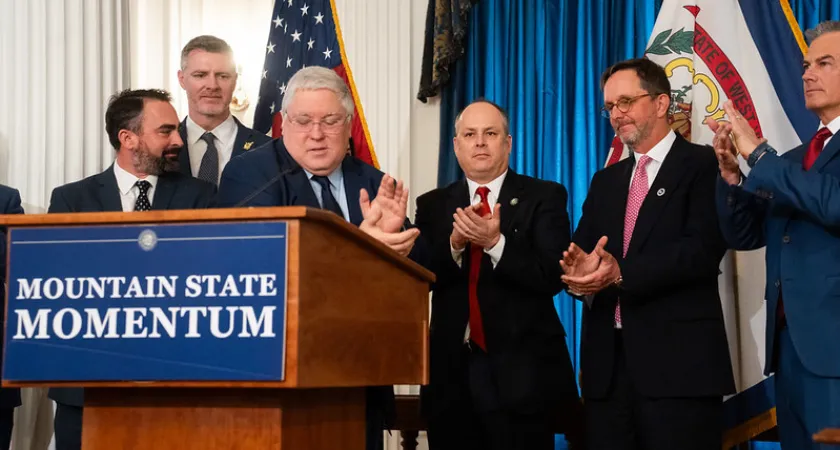
Gov. Patrick Morrisey announced plans for a massive data center development in Berkeley County, calling it a transformative investment for West Virginia’s economy.
.webp)
The $4 billion project will span 548 acres in Falling Waters and is being led by Penzance Management, a national real estate owner, operator and fund manager with experience delivering data center sites pre-leased to hyperscale users.
“This is going to be a difference maker for Berkeley County. It’s going to be a difference maker for West Virginia as a whole,” Morrisey said during a press conference at the state Capitol.
The governor estimated the project would generate approximately 1,000 construction jobs and about 125 permanent positions once operational.
Penzance Managing Partner Victor Tolkan described the company’s approach as building tailored facilities for large-scale cloud and artificial intelligence clients.
“We build to suit for hyperscalers. That’s what we do,” Tolkan said during the announcement.
“So we find land, we entitle land, we work with the municipalities, to get what we need — which is powered land, appropriately produced, and then we partner with the hyperscalers who will effectively be our tenants.”
While Penzance has developed data centers in markets such as Chantilly, Virginia — including projects pre-leased to Amazon Web Services — Tolkan declined to name the potential tenant for the West Virginia facility.
“No, I can’t,” Tolkan said. “I want to add, there are times when we’ve actually signed leases and those people are in buildings and I still can’t.”
Across the United States, data center construction has surged amid growing demand for artificial intelligence processing and cloud computing. Industry analysts estimate capacity could double by 2030 as thousands of facilities are either operating, planned or under construction.
West Virginia leaders have aggressively pursued data center investment in recent years, particularly as neighboring Virginia has become the nation’s largest data center hub. Lawmakers passed legislation designed to allow developers to harness localized energy systems and clarified how property tax revenues from such projects would be distributed.
Morrisey described the Falling Waters development as part of that broader strategy, branding such facilities as “high impact intelligence centers.”
“Can you feel the buzz?” Morrisey asked a packed reception room during the announcement.
Still, several key details remain unresolved, including the identity of the end user, the final construction timeline and whether long-term employment numbers could vary.
“I think they are not prepared to announce the exact ribbon cutting or the opening, but I know they’re working very hard on that and we’re optimistic,” Morrisey said.
Regarding permanent job estimates, Morrisey acknowledged they are based on industry averages tied to facility size and energy capacity.
“Based upon what I’ve learned, there are estimates that are made. We think they are good faith estimates and we get to that amount but whether it ends up being 124 or 132, there’s always could be some variance. But the size of the facility and what it’s intended to surface, that’s what puts those numbers together.”
The project drew praise from local officials, including Berkeley County Commission President Eddie Gochenour, who called it a rare opportunity for the region.
“This is really a fantastic opportunity that we’ve never had before. There are some unanswered questions, but I feel very confident after meeting with your team,” Gochenour said.
.webp)
While data centers can generate substantial property tax revenue, they often face scrutiny over aesthetics, energy consumption and noise. Nationally, debates over siting and environmental impact have intensified as development accelerates.
Tolkan acknowledged tensions in other markets but praised West Virginia’s approach.
“It’s becoming more and more acrimonious,” Tolkan said of the broader development environment. “It’s pushing people apart. And what we see here in West Virginia is everybody working together as one.”
If completed as planned, the Berkeley County project would represent one of the largest single private investments in West Virginia history — and a major step in the state’s effort to compete for next-generation technology infrastructure.
Originally reported by Brad McElhinny in WV Metro News.