Construction crews are nearing completion on a new bridge linking westbound traffic from Interstate 820 to Interstate 30 — a $267 million mobility upgrade designed to ease congestion for commuters traveling from Fort Worth to Aledo.
.webp)
The project, which includes multiple bridge connections at one of Tarrant County’s busiest highway intersections, represents the type of infrastructure investment local leaders say is critical to sustaining North Texas’ rapid growth.
But industry leaders warn that future projects like it could stall if Congress fails to pass a long-term Surface Transportation Bill before current federal funding expires at the end of September.
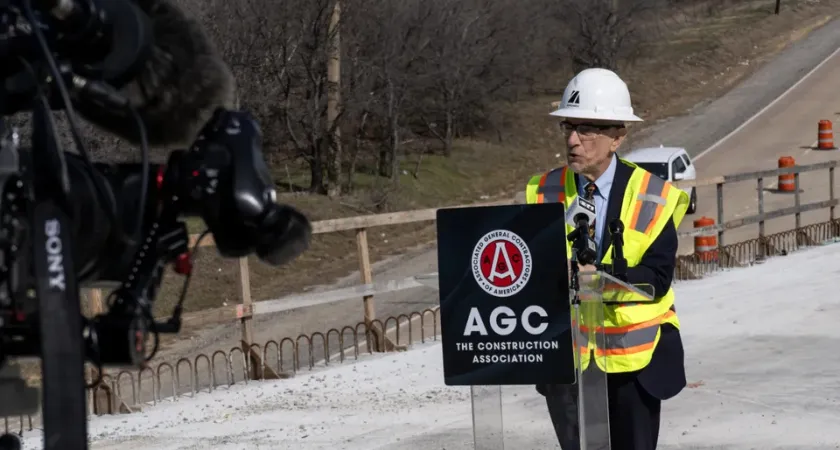
The concern comes as the Associated General Contractors of America ramps up pressure on lawmakers with a $2 million national advocacy campaign known as America’s Moving Forward, aimed at highlighting the economic importance of sustained transportation funding.
Ken Simonson, chief economist for the contractors association, said infrastructure spending plays a central role in regional competitiveness.
“Improving highways and transportation systems makes it easier for companies to thrive and expand by lowering shipping costs, accelerating deliveries and connecting firms to clients and investors,” said Simonson.
Between December 2020 and December 2025, North Texas added 47,100 construction jobs — a 22% increase — reflecting the region’s surge in public and private development.
Construction growth has helped the Dallas-Fort Worth area outpace 14 other major metro regions nationwide over the past five years, according to industry data. Road expansions, bridge upgrades and interchange redesigns have supported population growth, distribution hubs and industrial development throughout Tarrant County and surrounding communities.
Without renewed federal funding, however, that momentum could weaken.
Without a long-term transportation bill in place, Simonson said, “it is hard to see how the DFW area will be able to sustain its meteoric job growth.”
Industry economists note that major transportation projects often require years of environmental review, engineering design and right-of-way acquisition before breaking ground. Any interruption in federal funding could ripple through planning pipelines, delaying bid solicitations and increasing long-term costs due to inflation.
In June 2025, the Regional Transportation Council — part of the North Central Texas Council of Governments — approved a sweeping $217.3 billion long-range transportation plan outlining road, rail and air quality improvements through 2050.
The blueprint includes highway widenings, freight corridor enhancements, public transit expansions and air quality initiatives intended to support one of the nation’s fastest-growing regions.
At the local level, Fort Worth officials are drafting their own comprehensive mobility strategy, known as Moving a Million, to align city-level priorities with state and regional transportation goals.
Those long-term strategies depend heavily on predictable federal funding streams.
Clint Henson, director of special projects for Zachry Construction Corp. and president of the Associated General Contractors of Texas, emphasized that projects like the I-30 and I-820 interchange are economic engines.
Highway projects like the one at I-30 and I-820 “represent growth for workers, businesses and the communities that surround projects like this,” Henson said.
He added that transportation officials and contractors must plan years ahead, making funding certainty essential.
The funding bill is needed later this year as contractors and transportation officials begin planning road projects years in advance, Henson said.
Industry leaders caution that delays could extend beyond construction firms.
Transportation infrastructure supports freight mobility, warehouse development, manufacturing growth and retail distribution networks across North Texas. Major employers often evaluate highway access and congestion levels before selecting sites for new facilities.
A lapse in federal funding could slow contract awards, discourage private-sector investment and create uncertainty in bond markets that finance large-scale public works.
While existing projects already under contract are likely to continue in the short term, new project starts could face postponement if federal reimbursements become uncertain.
For fast-growing suburbs west of Fort Worth, including areas along Interstate 30, infrastructure expansion is closely tied to housing development and commercial growth. Without expanded roadway capacity, congestion could intensify, potentially dampening real estate momentum.
If lawmakers fail to renew or expand transportation funding before the September deadline, states may rely on temporary extensions — a strategy that has been used in past funding disputes but often complicates long-term project scheduling.
Short-term extensions typically provide limited funding windows, making it difficult for state transportation departments to commit to multiyear megaprojects.
.webp)
Contractors warn that uncertainty alone can delay hiring, equipment purchases and subcontractor commitments.
The stakes are particularly high in Texas, where population growth continues to strain highway systems and freight corridors. North Texas remains one of the country’s largest logistics hubs, making reliable infrastructure funding critical to maintaining its competitive edge.
For now, industry groups are urging Congress to act before the deadline approaches, arguing that predictable transportation investment remains foundational to economic growth across the region.
As lawmakers debate federal spending priorities, contractors say the future of North Texas road expansion — and the jobs tied to it — hangs in the balance.
Originally reported by Eric E. Garcia in Fort Worth Report.