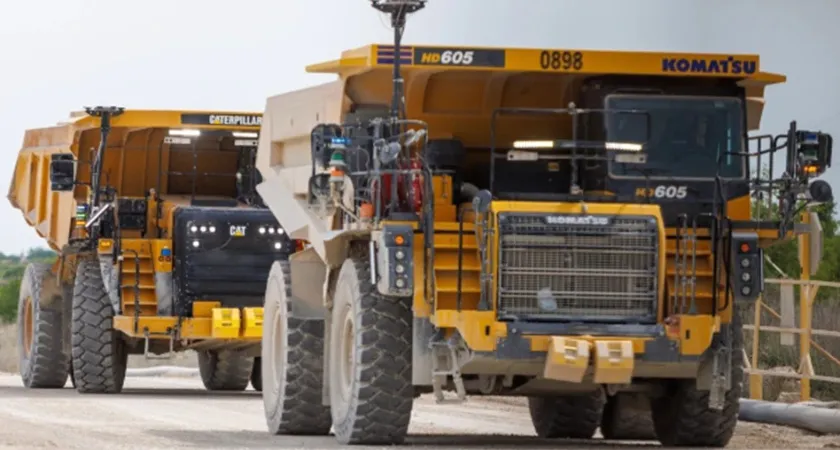
Heidelberg Materials has reached a key milestone in its automation push, with its autonomous haul truck fleet transporting more than 2 million tons of limestone in just eight months at its Lake Bridgeport Quarry in Texas.

The achievement marks one of the most significant large-scale deployments of autonomous haulage technology in the North American aggregates sector to date, underscoring the company’s broader digital transformation strategy.
The milestone was achieved at Heidelberg’s Lake Bridgeport Quarry, where the company deployed a mixed fleet of original equipment haul trucks equipped with artificial intelligence-powered autonomous technology.
“We are excited to mark this important milestone at our Lake Bridgeport Quarry,” Heidlberg Materials North America President and CEO Chris Ward says. “The successful deployment of Pronto’s AHS technology at Lake Bridgeport showcases our strong commitment to leveraging innovative and scalable solutions at our operations that contribute to enhancing efficiency and safety while also addressing the recruiting challenges we face at many of our operations across North America.”
The autonomous haulage system (AHS), powered by technology from Pronto, was introduced following a successful pilot program in 2023. Since then, the fleet has operated continuously, safely moving limestone across the quarry while collecting real-time operational data.
According to the company, the system enhances precision in haul cycles, reduces idle time and optimizes fuel use — all of which contribute to higher productivity and lower operating costs.
Building on the Texas milestone, Heidelberg said it plans to expand autonomous hauling to more than a dozen additional sites across North America, Europe and the Asia-Pacific region.
The rollout reflects a growing trend in heavy construction materials production, where automation is increasingly used to offset labor shortages and improve safety performance.
Quarry operations often face challenges recruiting and retaining skilled haul truck operators, particularly in rural areas. Heidelberg said the shift to autonomy at Lake Bridgeport helped the local management team address ongoing workforce constraints — an issue widely shared across the aggregates industry.
Beyond labor considerations, the autonomous fleet contributes to improved safety by minimizing human exposure to high-risk operating environments. Autonomous trucks follow programmed routes and operate with advanced detection systems, reducing the likelihood of collisions and operational variability.
Heidelberg also emphasized the environmental advantages of digital fleet management. Real-time performance monitoring allows for better route optimization and reduced fuel consumption, helping operations lower emissions intensity.
The milestone positions Heidelberg among a growing number of global materials producers investing in digital and AI-driven solutions to modernize quarry and plant operations.
Autonomous hauling, predictive maintenance tools and data analytics platforms are becoming more common as producers seek operational resilience amid volatile labor markets and rising cost pressures.

By surpassing 2 million tons transported autonomously in under a year, Heidelberg has demonstrated that large-scale digital adoption in quarry environments is not only feasible but scalable.
As the company continues expanding the technology to additional sites worldwide, the Lake Bridgeport deployment may serve as a blueprint for how automation can enhance efficiency, safety and sustainability in heavy materials production.
With the construction industry facing persistent workforce shortages and productivity challenges, automation initiatives like this one could play a growing role in shaping the next generation of aggregates operations.
Originally reported by Chris Sweeney, Managing Editor in CD Recycler.