Acumatica Summit 2026 showcases real-world results as AI and cloud platforms move from promise to performance
SEATTLE — When Brian Cassell joined Storm Smart in 2021, the Florida-based hurricane protection company was struggling with the kind of operational headaches familiar to any growing construction business. Different systems that didn't talk to each other. Manual processes eating up staff time. No clear way to track whether jobs were actually profitable until well after completion.
Three and a half years later, Storm Smart has doubled its revenue on the path to $200 million, expanded from two branches to seven across Florida's coast, and grown to more than 430 employees. The company now processes roughly 800 jobs per month with field workers collecting payments on mobile devices at job sites.
"We realized very quickly that in order to scale this operation, we needed to build a strong foundation," Cassell, the company's CFO, told attendees at Acumatica's Summit 2026 conference this week. "A lot of our systems weren't talking to each other. There was no automation. We were doing a lot of manual effort, and it really became a drain on the organization."
Storm Smart's story captured attention at the conference not because it's unique, but because it's increasingly common. After years of hearing about how artificial intelligence and cloud computing would transform construction operations, contractors are finally seeing tangible results—and the numbers are hard to ignore.

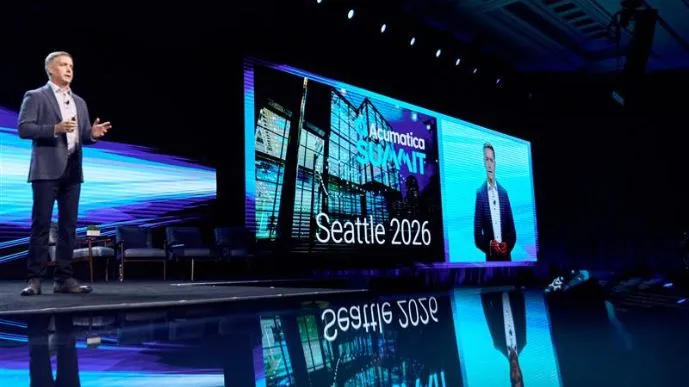
At this week's conference, in his keynote speech, Acumatica CEO John Case made a point of distinguishing between technology hype and technology that actually works. "I think too often, the technology industry focuses on the potential innovations, the promise of what's to come, the prototypes, the promise of tomorrow," Case told the crowd. "But that's not what I want you to be the most excited about."
His message: The future contractors have been hearing about for years has arrived. Cloud-based systems combined with artificial intelligence are delivering measurable improvements right now, not in some distant tomorrow.
The data backs him up. Construction companies using the platform reported reducing lead times from three to six weeks down to four to eight business days. On-time delivery rates jumped from 70 percent to consistently hitting 95 to 100 percent weekly. Companies are processing nearly 40 percent more shipments daily while closing their books in minutes instead of weeks.

Acumatica President and COO, Sanket Akerkar described the company's approach as creating a "digital replica"—essentially a digital twin of a construction business where every element connects. People, equipment, materials, processes, subcontractors—all represented in one integrated system.
For construction specifically, this means connecting the back office, front office, and field operations so project managers, accountants, and field technicians all work from the same real-time data. No more waiting until month-end to discover a job lost money. No more wondering whether materials arrived or which subcontractor is behind schedule.
"It's about bidding on projects, managing projects, and helping employees on the construction site," Akerkar explained. "Everything connects together, ensuring that all employees have all the information they need to get their jobs done."
A demonstration showed how this works in practice. When a window manufacturer noticed lower-than-expected margins on a large construction order, the system traced the problem across three different failure points: broken glass sheets at receiving that weren't caught and reported, production running on an older, slower machine instead of the new one, and expedited shipping to make up for the production delay.
"None of this is surprising," said Debbie Baldwin from Acumatica's product management team, who walked through the scenario. "Broken material, slower machine, expedited shipping—this is just normal business. The difference is that I don't have to guess where the margin went. I can see it across sales, purchasing, production, and shipping, all connected."
For construction companies, she noted, similar issues might be subcontractor delays, material price increases, or change orders that don't get properly captured in project costs.
If there's one technology that's been overhyped in construction, it's artificial intelligence. But Acumatica's Chief Engineering Officer Miten Mehta demonstrated AI applications that go beyond the buzzwords.
"In the end, ERP and AI are just means to the end," Mehta told attendees. "What matters is how do we help you do your job faster, better, cheaper, and how do we help you succeed in your business."
The company's AI Studio lets users create natural language prompts that automate tasks, generate insights, or change data based on business rules—all without writing code. During a hackathon the day before the keynote, 12 teams built functional business solutions in 24 hours, with some writing zero code and others adding minimal customization.
For construction companies, practical applications include analyzing project opportunities to predict likelihood of closing, summarizing case histories, and detecting cost anomalies before they become serious problems.
The new AI Assistant, launching in the 26 R1 release, works conversationally. Project managers can ask "show me the five most profitable items" or "what's the shipment status for order 8889" and get instant answers with charts and next-step recommendations—no need to navigate through multiple screens or run custom reports.
Mehta demonstrated how different roles use the same system differently. A financial controller checking profitable products for planning season sees charts and recommendations. A salesperson looking up a customer's last order gets details needed to quickly place a repeat order. A warehouse manager checking inventory status gets real-time quantities across multiple locations. A customer service rep tracking shipments can immediately tell customers when orders shipped.
The platform is already processing about one million business objects through AI every month, with usage growing rapidly as more companies adopt the features.
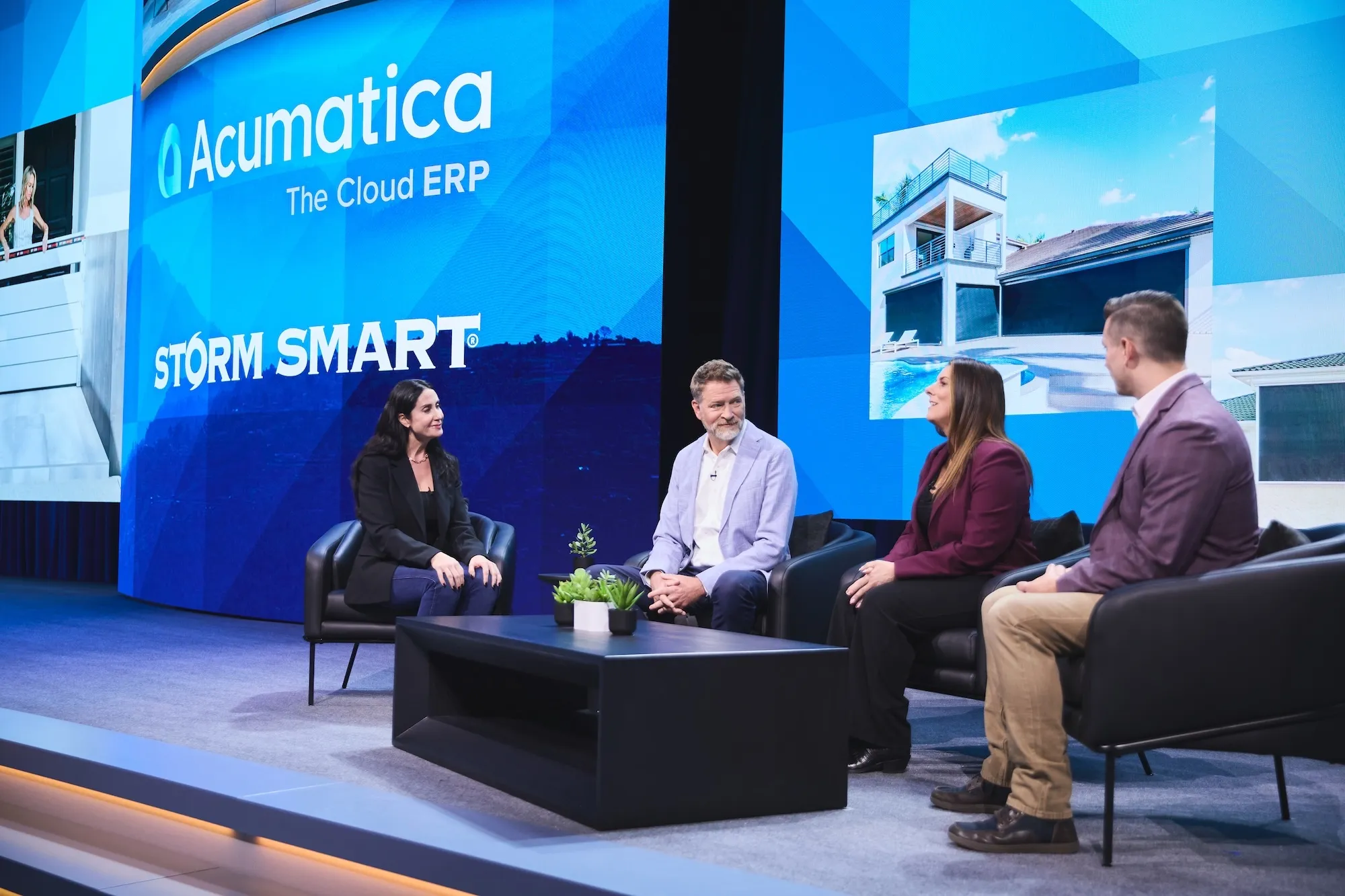
When Storm Smart took the stage, Jennifer Pellechio the Director of Technology at Storm Smart didn't sugarcoat the challenges. She said that getting to 90% user adoption across hundreds of employees required intentional planning and discipline.
Her first piece of advice drew knowing nods from the audience: "Do not bring bad data into your new ERP. It is so critical. Your new system is not your old system. Start fresh."
Storm Smart looked hard at their manual processes before implementation, figuring out how to fix them rather than simply replicating old problems in new software. That meant documenting workflows, identifying bottlenecks, and being willing to change how things had always been done.
The company also established "user champions" throughout the organization—employees from every department who led adoption efforts. "It cannot just be the IT department. It cannot just be leadership," Jennifer Pellechio said. "You really need the people with boots on the ground to understand that the system needs to be simple, easy to use, and that adoption is critical."
Cassell added his own advice: don't rush. "I like things that get done quick," he admitted. "But I would encourage you not to rush. Take your time, have your processes documented. It's not going to be perfect out of the gate. You continue to make enhancements, you continue to innovate."
Daniel Collins from Strategies Group emphasized that go-live isn't the finish line. "A lot of people approach go-live as the finish line. You've got to have the discipline to know that you're going to continue to improve," he said. "Every time you add a new line of business, you need to expand on what you do. You need to change your system."
Storm Smart has lived that reality, launching new product lines including Flood Smart last spring and impact garage doors this spring, plus expanding into dealer networks across the United States—all built on the foundation of their integrated system.
Perhaps the most telling sign of successful technology adoption: when field workers don't even realize they're using it.
"Our field workers don't even know about the automation," Pellechio said with a smile. "They just know they have what they need at their fingertips. They're able to collect invoice payments right in the field, help serve our customers, and move them through that project journey. I like to call it magic. It's really automation through business events."
Storm Smart accomplished most of this automation without writing custom code. Instead, they used Acumatica's built-in business events—automatic triggers that fire when certain conditions are met. When a job status changes, invoices generate automatically. When materials arrive, inventory updates in real time. When field technicians complete work, project managers see updates immediately.
Processing 800 jobs per month with this level of automation means Storm Smart's finance team hasn't grown proportionally with revenue. When the company started with Acumatica in 2018 at a third of current revenue, they had two people in finance. Today, with triple the revenue, one finance controller handles it all.
"That has been great for a business owner," Cassell said. "And ultimately helps the bottom line."
For construction company owners evaluating whether new technology is worth the investment, disruption, and risk, Storm Smart's results offer a clear answer.
The company has maintained an 80 percent positive discharge rate in Washington DC foster care programs and 68 percent in Maryland—meaning children are successfully reunified with families, adopted, or transition to independent living. In their supported employment program serving people with developmental disabilities, 22 out of 65 participants are employed with jobs tailored to their specific needs and abilities.
Wait—those statistics are from PSI Family Services, another featured customer and the conference's Impact Customer of the Year. A nonprofit health and human services agency serving vulnerable populations in the Washington DC and Maryland area, PSI demonstrates that effective technology isn't just about profit margins.
"When you're classified by your limitations rather than your talents or your strengths, it weakens your sense of self," said Shawn Rubin, PSI's Chief Advancement Officer, quoting one of the organization's founders. "Technology should never, ever overshadow mission. It should strengthen it."
PSI needed to reconcile clinical effort with financial reality while managing reimbursements that lag up to a year. Their "financial truth engine," as Rubin calls it, lets them see the true cost of care by program in near real-time, allowing informed decisions without compromising the services they provide.
Back in the construction world, Cassell's advice to peers considering similar transformations was succinct: "Do not bring bad data into your new ERP. Don't rush. Have your processes documented. It's not going to be perfect out of the gate, but you continue to make enhancements and innovate."
And perhaps most importantly: "No way would we have been able to grow from two branches to seven branches. No way would we have been able to launch new products. We would not have been able to do that if we had not put in Acumatica."
Acumatica delivered nearly 1,000 features and enhancements last year, and the pipeline for 2026 includes more AI capabilities, better reporting tools, and deeper industry-specific functionality. The company recently acquired CoreChain, a B2B payments platform, and announced a partnership with Abbott Exchange to improve payment processing for mid-market companies.
But Case's closing message emphasized that construction owners shouldn't wait for what's coming. "The ideas have become real and usable today," he said. "You have in your hands the tools and insights to drive results today. We don't want you to wait for something in the future."
His challenge to the audience: "What result are you looking for? What are you trying to drive?"
For companies like Storm Smart, the answer is clear. They're not waiting for the future of construction technology. They're living it now, one job at a time, one field worker at a time, one satisfied customer at a time—all backed by systems that finally work the way construction companies need them to work.
Note: Acumatica Summit 2026 was held in Seattle, Washington, January 27-30, 2026. The company focuses on mid-market businesses and offers industry-specific editions for manufacturing, distribution, retail, construction, and professional services.