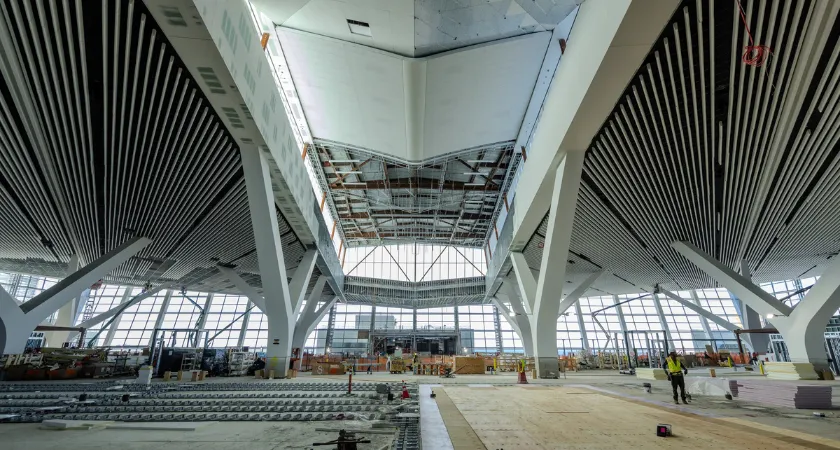
The scale of construction underway at John F. Kennedy International Airport is coming into sharper focus as new images reveal the vast interior of the airport’s future Terminal One. The multibillion-dollar redevelopment, designed by Gensler with construction led by AECOM Tishman and the Port Authority of New York and New Jersey, is one of the largest aviation projects currently underway in North America.
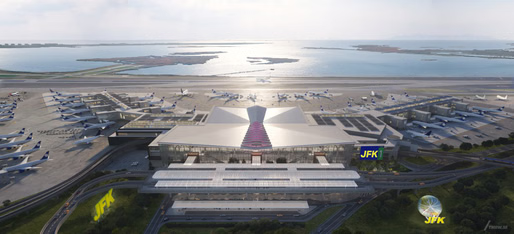
Photographs taken in October 2025 show cavernous passenger halls, unfinished concourses and the skeletal framework of what will become one of the most technologically advanced terminals in the country. Despite its raw appearance, officials say the project remains on track for a phased opening later this year.
“The airport’s huge new Terminal One will encompass 2.6 million square feet of passenger check-in zones, security checkpoints, baggage-claim areas, restaurants, duty-free shops and boarding gates.”
“It’s so massive that it is supplanting three of the eight terminals that once made up Kennedy: the existing Terminal 1 and the demolished Terminals 2 and 3.” — The New York Times
The redevelopment represents a fundamental rethinking of how travelers will experience JFK. Instead of a patchwork of aging buildings added over decades, Terminal One is intended to function as a single, coherent gateway capable of handling growing international traffic for decades to come.
When complete, Terminal One will be among the largest airport terminals in the world, featuring expansive check-in halls, modern security screening areas and a marketplace-style retail program. Designers have emphasized natural light, intuitive wayfinding and digital systems meant to reduce wait times.
The project is also transforming the physical footprint of the airport. By replacing three former terminals with a single structure, planners hope to streamline aircraft movements and improve curbside access. The consolidation is expected to increase gate capacity while reducing the confusing transfers that have long frustrated passengers.
The NYT’s recent site visit underscored just how ambitious the undertaking is. Cranes, temporary scaffolding and miles of mechanical systems currently fill spaces that will soon host millions of travelers each year. Seeing the development in its unfinished state “makes it hard to believe the terminal is scheduled to welcome its first passengers in a phased opening later this year.”
Delivering a 2.6-million-square-foot terminal in the middle of one of the world’s busiest airports has required intricate choreography. Construction crews are working alongside active runways and existing terminals, often during overnight windows to avoid disrupting operations.
The Gensler-led design team has coordinated with airlines and federal agencies to integrate new security technology, baggage systems and sustainability measures. The terminal is expected to feature energy-efficient façades, advanced air-handling systems and infrastructure capable of supporting next-generation aircraft.
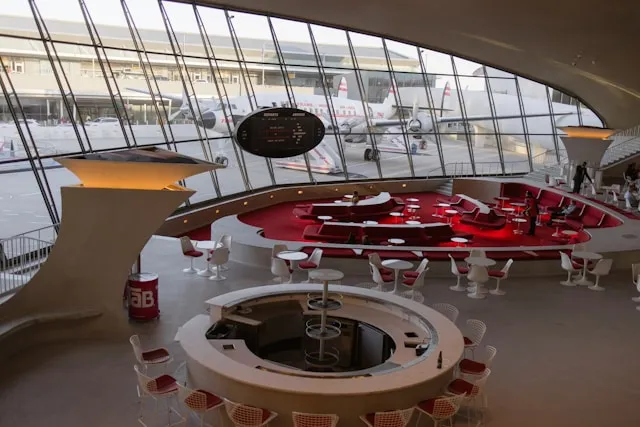
AECOM Tishman, serving as construction manager, has described the effort as equivalent to building a small city. Thousands of workers, engineers and tradespeople have been involved since ground was officially broken on the project several years ago.
Over the coming months, the focus will shift from structural work to interior fit-out. Retail tenants will begin building out restaurants and duty-free shops, while testing of baggage systems and passenger boarding bridges gets underway.
The Terminal One program is part of a broader $19-billion transformation of JFK that also includes the new Terminal 6 and upgraded roadways and transit connections. State officials have framed the investment as essential to maintaining New York’s role as a global aviation hub.
For architecture and aviation observers, the latest images provide a rare glimpse of a megaproject in transition — not yet a functioning terminal, but no longer simply a construction site.
Originally reported by Alexander Walter in Archinect.