Los Angeles leaders have approved sweeping changes that make it significantly easier to convert vacant commercial buildings into housing — a move that could unlock thousands of new apartments across a city grappling with both a housing shortage and record office vacancies.
.webp)
The newly adopted Citywide Adaptive Reuse Ordinance streamlines approvals for building conversions and expands eligibility far beyond the limits of the city’s original 1999 policy.
For developers like Garrett Lee, the shift is already reshaping plans.
After years of trying to fill a downtown office high-rise with white-collar tenants, Lee has begun transforming the property into nearly 700 apartments.
“This is monumental for the city.”
The previous adaptive reuse ordinance, adopted in 1999, applied mainly to downtown buildings constructed before 1975. It helped spark a residential revival in the city center, transforming formerly empty office towers into lofts and apartments.
Under the new guidelines, commercial buildings as young as 15 years old — located anywhere in Los Angeles — can now be converted to housing with city staff approval instead of lengthy discretionary reviews that sometimes escalated to the City Council.
By removing uncertainty over timelines and approvals, the city hopes to make conversions more financially feasible.
“When you take that risk off the table, it materially improves the feasibility of conversions,” said Lee, president of Jamison Properties.
“It addresses both the housing shortage and the long-term office vacancy issue,” he added.
Los Angeles currently has more than 50 million square feet of vacant office space, according to industry estimates, spread across commercial corridors such as Wilshire Boulevard, Westwood, Ventura Boulevard, South Los Angeles and the Harbor District.
The ordinance is not limited to office towers. Industrial properties, retail buildings and even parking garages are eligible for residential conversion. City planners envision shopping center owners repurposing excess retail space or garages into housing units.
Ken Bernstein, a principal planner with the city’s Planning Department, said the previous approval process could be cumbersome.
“That could be a very time-consuming, cumbersome and expensive process,” he said.
The new rules, he added, “unlock the potential” of underutilized buildings throughout the city.
The expanded ordinance has already encouraged developers to revive stalled projects.
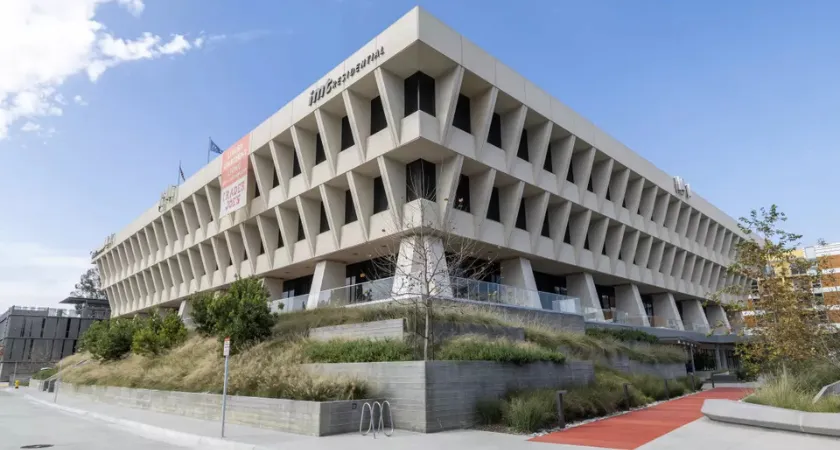
David Tedesco of IMT Residential plans to convert the former Sunkist Growers headquarters in Sherman Oaks into 95 apartments. The inverted pyramid-shaped building, long a landmark visible from the 101 Freeway, had previously been slated for office renovation before pandemic-driven vacancy changed the math.
The new rules mean “we could move forward a lot faster” and avoid a potentially lengthy environmental impact review, Tedesco said.
Jamison Properties is also redesigning projects to maximize unit counts under the new framework.
“We’re taking projects that are fully designed already and we’re redesigning them for more, smaller units,” Lee said, which helps reduce rents.
The rolling 15-year eligibility window ensures that more buildings will qualify every year. Recently built properties may also require fewer seismic upgrades, reducing conversion costs.
“Vintage matters,” Lee said. “Converting a building from 1990 versus one from 2010 is night and day due to the differences in code eras.”
In cities such as New York and Washington, adaptive reuse has led to conversions that add 1,000 to 2,000 residential units per building, Lee noted, suggesting similar potential in Los Angeles.
Despite streamlined approvals, significant financial headwinds persist.
Higher interest rates have raised borrowing costs. Tariffs have increased material prices. Labor shortages — worsened by immigration enforcement crackdowns — have added uncertainty to construction timelines.
Developers also cite Measure ULA, Los Angeles’ transfer tax on high-value property sales, as a major obstacle.
Measure ULA “is really impeding developers from doing any development in the city of Los Angeles,” said architect Karin Liljegren, who specializes in adaptive reuse projects and helped craft the ordinance.
At the same time, apartment rents in the Los Angeles metro area have softened. Median rent fell to $2,167 in December — the lowest level in four years, according to Apartment List. While some analysts see this as temporary stabilization, others warn that prolonged rent stagnation could undercut conversion economics.
Nella McOsker, president of the Central City Assn., praised the ordinance as “tremendous” and said it creates “incredible flexibility” for property owners. However, she argued that Los Angeles should consider financial incentives similar to those offered in other cities.
Programs in New York, Washington and Boston offer property tax abatements. San Francisco provides transfer tax exemptions. Chicago uses tax-increment financing, and Calgary offers direct grants.
McOsker said similar incentives may be necessary in Los Angeles to help projects “pencil out,” especially as the city faces budget constraints.
The 1999 ordinance helped reimagine downtown Los Angeles from a largely commercial district into a livable residential neighborhood. City officials now believe the broader citywide approach could replicate that transformation in multiple districts.
.jpg)
Beyond addressing office vacancy, adaptive reuse also offers environmental benefits. Reusing existing structures can reduce demolition waste and lower the carbon footprint associated with new construction. It can also accelerate housing delivery compared with ground-up development.
Still, the long-term success of the ordinance will depend on market stability, access to capital and political willingness to adjust complementary policies such as tax structures and tenant protections.
For now, developers are recalculating projects and revising floor plans — betting that streamlined approvals will mark the beginning of a new housing chapter for Los Angeles.
Originally reported by Roger Vincent, Staff Writer in LA Times.