.png)
Platform Addresses Critical Labour Shortage with Integrated Payroll, HR, and Productivity Solutions Tailored for Canadian Compliance
Toronto, ON — As Canada's construction sector grapples with persistent labour shortages and mounting compliance complexities, a new workforce management solution has entered the market with the promise to transform how contractors manage their teams. Lumber, an AI-native construction workforce management platform, has officially launched its Canadian operations, bringing purpose-built tools designed specifically for the unique regulatory landscape north of the border.
Lumber's entry into Canada comes at a pivotal moment for the industry. According to the Canadian Occupational Projection System, the construction sector faces a projected shortage of skilled workers through 2033, with 25,600 job openings expected but only 25,000 workers anticipated to fill them. This gap is particularly acute as the AI economy drives unprecedented infrastructure development, including data centres and renewable energy projects that demand specialized expertise.
Lumber distinguishes itself from traditional HR and payroll platforms through its laser focus on construction's unique challenges. While generic workforce management systems struggle with the complexities of multi-union environments, prevailing wage compliance, and job costing across dispersed worksites, Lumber was built from the ground up to handle these intricacies seamlessly.
"Small to medium-sized construction firms face a formidable challenge as they confront labour constraints and a complex regulatory environment testing the limits of their operational capacity and profitability," said Shreesha Ramdas, Founder and CEO of Lumber. The platform's AI-powered approach aims to help management teams at construction firms deploy what Ramdas describes as a "game-changing workforce experience."
The platform integrates three core modules—Payroll, HR Management, and Productivity—into a unified system that addresses the full lifecycle of workforce management. This holistic approach eliminates the need for contractors to cobble together multiple software solutions or rely on paper-based processes and Excel spreadsheets, which remain surprisingly common in the construction industry.
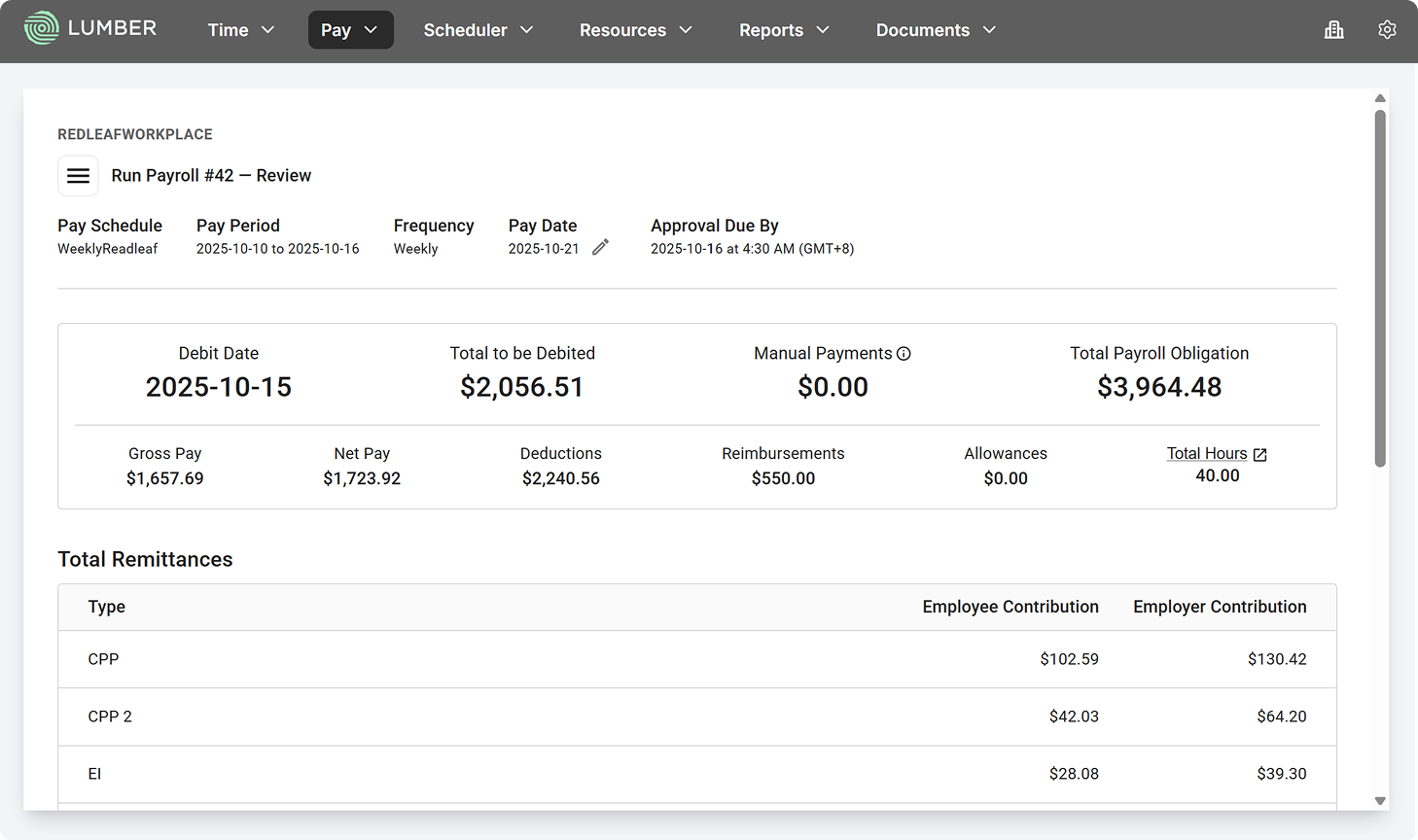
Payroll processing in Canadian construction presents challenges that go far beyond basic wage calculation. Contractors must navigate federal and provincial labour laws, union collective bargaining agreements, multiple pay rates for different job classifications, and complex remittance requirements—all while ensuring accuracy and timely payment to maintain workforce morale.
Lumber's payroll module automates these complexities, handling union reporting, expense management, and remittances while cutting processing time by up to 95 percent compared to manual methods. The system automatically applies correct prevailing wage rates based on job classification, location, and project type, generating fully compliant certified payroll reports that align with both federal and provincial requirements.
For contractors working with multiple unions, the platform automates union wages, dues, deductions, and hourly benefits as defined by collective bargaining agreements. This eliminates the error-prone manual calculations that can lead to compliance violations and strained labour relations. The system also manages Records of Employment (ROE), flexible pay cycles, and liability tracking—essential features for maintaining regulatory compliance across Canada's diverse provincial jurisdictions.
Perhaps most significantly, Lumber's AI-powered compliance engine continuously monitors timesheets and payroll data against federal and provincial rules, automatically flagging potential issues before they become costly problems. This proactive approach helps contractors stay audit-ready and reduces the administrative burden on understaffed back offices.
Recruiting and retaining skilled construction workers has become increasingly challenging as the industry competes with other sectors for a shrinking pool of talent. Lumber's HR Management module addresses this challenge with tools specifically designed for construction hiring workflows.
The integrated Applicant Tracking System streamlines the hiring process from initial application through onboarding, helping contractors move quickly to secure talent before competitors do. In an industry where timing can mean the difference between winning and losing quality workers, this speed advantage is critical.
Credential management represents another crucial feature, particularly in an industry where certifications, licenses, and safety training requirements vary by trade, location, and project type. Through integration with BuilderFax, a digital credential management platform that Lumber acquired, the system automatically tracks worker certifications and sends renewal alerts, ensuring that crews remain qualified and job sites stay compliant with safety standards.
The onboarding module eliminates the traditional paperwork headache, allowing new hires to complete necessary documentation digitally before their first day on site. This accelerates workforce mobilization—a key advantage when projects need to ramp up quickly or when contractors need to respond to urgent opportunities.
Construction projects live or die on the accuracy of time tracking and job costing data. Inaccurate time capture leads to payroll errors, disputed invoices, and flawed project analysis that undermines future bidding accuracy. Lumber's Productivity module tackles these challenges with multiple time capture modes designed for the realities of construction sites.
The mobile app supports both foreman-led time entry and kiosk modes, accommodating different site management approaches. Geo-fencing technology verifies that workers are actually present at job sites, while multilingual support (English and Spanish) ensures accessibility for diverse crews. This real-time time tracking feeds directly into job costing calculations, providing project managers with up-to-the-minute visibility into labour costs.
Schedule and dispatch functionality helps superintendents allocate resources efficiently across multiple job sites, while equipment tracking ensures that tools and machinery are deployed where needed. The productivity tracking features provide insights into crew efficiency, helping contractors identify opportunities for improvement without resorting to punitive micromanagement.
Safety management tools round out the productivity suite, enabling digital safety inspections, incident reporting, and compliance documentation. In an industry where workplace safety is both a moral imperative and a regulatory requirement, these features help contractors maintain safe job sites while reducing the administrative burden of safety compliance.

What truly sets Lumber apart is its integration of artificial intelligence throughout the platform. While many construction software vendors have bolted on AI features as an afterthought, Lumber was built as an AI-native platform from inception.
The platform's LumberAI capabilities include a Timesheet Reviewer that automatically checks submissions against all federal and provincial rules, catching errors before they propagate through to payroll. A Payroll Anomaly Detector analyzes historical patterns to flag unusual entries that might indicate fraud, data entry errors, or other issues requiring investigation. The Compliance Assist feature automatically enforces union, federal, and provincial labour laws, helping contractors avoid costly violations.
For field operations, LumberAI offers a Resource Allocator that assigns workers based on availability, skills, and project proximity, optimizing crew deployment. Resource Forecasting provides visibility into future requirements, enabling proactive hiring and training decisions. The SmartPlanner generates project schedules based on requirements, historical data, and resource constraints, helping contractors develop realistic timelines.
These AI capabilities address a fundamental challenge in construction workforce management: the sheer volume of rules, regulations, and variables that must be considered with every decision. By automating this complexity, Lumber frees contractors to focus on building rather than administration.
Recognizing that software is only as valuable as the support behind it, Lumber has invested in Canadian-based customer success resources with deep construction industry expertise. The LumberCare program provides white-glove concierge service from experts who understand Canadian construction's unique requirements.
This localized support extends to compliance consulting, with advisors who can guide contractors through the intricacies of federal and provincial labour laws, union requirements, and regional variations. For contractors operating across multiple provinces, this guidance is invaluable for maintaining consistent compliance.
The platform integrates with leading ERP and accounting systems including Acumatica, Sage Intacct, Sage 100 Contractor, and Sage 300 CRE—systems widely used in Canadian construction. These integrations enable bi-directional data flow, ensuring that time tracking, payroll, and labour costs synchronize automatically across systems without manual data entry.
Canada's construction industry faces a workforce crisis driven by multiple factors: an aging workforce, evolving skill requirements, and fierce competition for talent. Industry analysts predict that nearly half of today's infrastructure skills will change within five years, requiring workers to develop a mix of traditional craft skills and digital competencies.
Technology platforms like Lumber play a dual role in addressing this challenge. First, by automating administrative tasks and providing real-time data, they allow existing workers to focus on higher-value activities rather than paperwork. Second, by modernizing the construction workplace with familiar digital tools, they help make the industry more attractive to younger workers who expect technology-forward environments.
The platform's employee self-service features exemplify this approach, allowing workers to manage time-off requests, access pay stubs, and update personal information through a mobile app. This transparency and control resonate with younger workers accustomed to digital convenience in other aspects of their lives.
Lumber's Canadian launch aligns with growing recognition across the construction sector that digital transformation is no longer optional. Industry surveys indicate that 81 percent of Canadian construction firms report that technology investments have improved productivity and efficiency, while nine in ten construction leaders say advanced digital tools are critical for success.
Government support for construction technology adoption is also accelerating. The National Research Council's Construction Sector Digitalization and Productivity Challenge program, launched in 2024, specifically supports innovations leveraging AI, IoT, and digital tools to boost productivity and innovation.
Major infrastructure investments across Canada—from housing initiatives to renewable energy projects to AI-driven data centre development—create both opportunity and pressure for construction firms. Those equipped with modern workforce management capabilities will be better positioned to win and execute these complex projects profitably.
For Canadian construction owners evaluating workforce management solutions, Lumber represents a new category of platform: purpose-built for construction, AI-native from inception, and designed specifically for Canadian regulatory requirements rather than adapted from generic HR software.
The platform's modular approach allows contractors to implement components incrementally, starting with immediate pain points like payroll or time tracking and expanding into comprehensive workforce management over time. This flexibility reduces implementation risk while allowing firms to realize value quickly.
As labour shortages persist and regulatory complexity increases, construction firms face a clear choice: continue managing workforces with outdated tools and manual processes, or embrace purpose-built technology that addresses the industry's specific challenges. With its Canadian launch, Lumber offers contractors a path toward the latter, promising to transform workforce management from an administrative burden into a competitive advantage.
For construction owners looking to learn more about Lumber's Canadian offerings, the platform is now available at lumberfi.com/ca, with demonstrations and implementation support from Canadian-based teams who understand the market's unique requirements.
About Lumber
Lumber is the industry's leading all-in-one construction workforce management platform that streamlines payroll, time tracking, safety, compliance, field productivity, rewards, and recognition. For more information, visit Lumber.