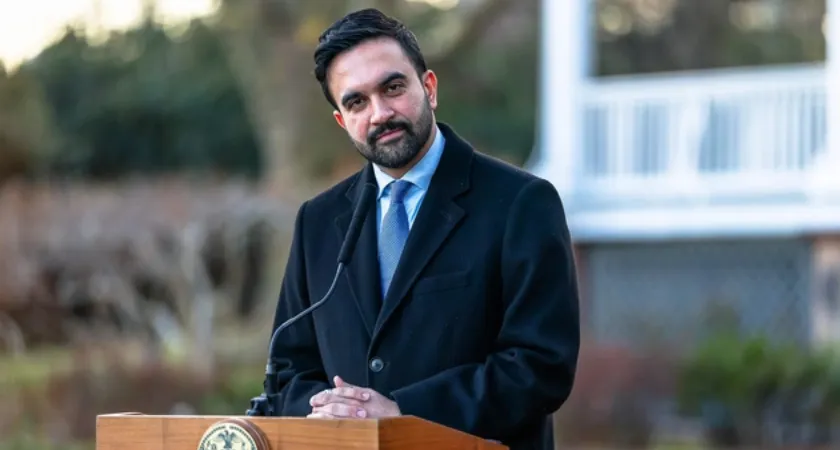
NEW YORK — Mayor Zohran Mamdani has pledged to dramatically increase affordable housing production in New York City while ensuring those new units are “union-built.” But housing experts and former city officials say delivering both promises at the scale he outlined during his campaign will require difficult decisions around cost, speed and financing.
Mamdani said he wants to triple production of city-financed housing over the next decade, aiming to build 200,000 new homes geared toward households making less than $70,000 per year — and at an estimated total cost of $100 billion. The proposal immediately puts him at the center of a major political and financial debate: whether adding labor requirements could reduce the number of units the city can afford to build.
.webp)
Supporters of union labor argue it delivers safer job sites, stronger wage standards and long-term economic stability. Critics counter that higher labor costs could shrink output in a city already facing an extreme shortage of affordable housing.
Multiple former city officials and housing advocates said the goal may be difficult — or impossible — under current fiscal constraints, especially with construction costs climbing and federal resources uncertain. Several also noted that a citywide requirement for union labor would mark a shift away from New York City’s long-standing approach to affordable housing construction.
“We took a strong stance on not requiring union labor for construction on affordable projects, and we were willing to take the political hit,” said Alicia Glen, who served as deputy mayor for housing and led an ambitious production plan under former Mayor Bill de Blasio. “We would rather spend less money, work with more diverse contractors and build more. It’s just math.”
Mamdani’s “union-built” promise was part of his campaign platform even though construction unions backed former Gov. Andrew Cuomo in the Democratic primary and stayed neutral in the general election. Now, observers say how Mamdani handles the issue could become an early indicator of how his administration manages competing priorities.
Despite unions not formally backing Mamdani during the election, some labor leaders have praised his decision to commit to union-built affordable housing on principle.
“What I think everyone needs to appreciate is this is a mayor who came in promising to build with union labor even though the construction trades didn’t endorse him, and I think it speaks highly to his moral compass,” said Kevin Elkins, the political director of the District Council of Carpenters, who also worked on Cuomo’s campaign.
At the same time, Mamdani’s evolving relationship with building trades could determine whether a large union labor commitment becomes an operating reality — or is modified through policy compromise.
The stakes are high because New York City’s low-cost rental market remains extremely strained. The city’s rental vacancy rate is less than 1 percent for apartments renting below $2,400 per month, making the creation of subsidized units one of the most direct levers a mayor has to expand housing supply for lower-income residents.
“Everyone is free to have their policy and legislative priority, but I don’t see how you can say your top priority is affordable housing if you’re prioritizing some other requirement before the ability to provide affordable housing,” said Howard Slatkin, executive director at the Citizens Housing & Planning Council.
Budget analysts and housing organizations estimate New York City will spend about $3.75 billion on affordable housing projects this year — a figure that includes both newly built housing and the preservation of existing units. If those projects were built with prevailing wages tied to union rates, observers estimate the total could increase sharply.

“My experience in affordable housing in New York City and state and across the country is, there are not unlimited resources,” said Kirk Goodrich, president at Monadnock Development, an affordable housing builder. He estimated that the increase from building with union labor “on hard costs alone is probably somewhere between 25 to 35 percent.”
Other estimates put the cost impact even higher — up to 50 percent — depending on project type, location, and delivery structure.
Mamdani’s pledge is also arriving as the city begins implementing a newer wage-and-benefits requirement for workers on city-financed housing projects. While less sweeping than applying union rates broadly, the city’s Department of Housing Preservation and Development estimated it could require about $425 million per year in added subsidy if the city maintains current production levels.
Labor advocates argue that stronger wage standards are critical in an industry where workers can be underpaid, exploited, or exposed to unsafe conditions. They also argue that workers building affordable housing should not be priced out of the communities where the projects are located.
“For [workers] to get paid the minimum wage to build housing that they themselves cannot afford to live in, that had to change,” said Dave Bolger, business manager at the Mason Tenders’ District Council, which represents laborers. Mamdani’s platform, he added, “holds a lot of great promise and I really hope that he keeps that promise. He’s the only candidate that was running for mayor that ever said that.”
Mamdani has not publicly clarified whether he intends to require union-level wages across all city-financed affordable housing construction. However, his team said the administration is moving quickly to develop a housing strategy focused on delivering the promised unit count.
“We are committed to delivering on the pledge to create 200,000 affordable homes and we are moving quickly to develop a housing plan that does just that, in partnership with leaders in Albany, the City Council, labor, tenants, and across the city,” Deputy Mayor for Housing and Planning Leila Bozorg said in a statement to POLITICO.
Some developers warned that requiring union labor at scale could slow down housing delivery if the city cannot expand its funding pool to cover the higher costs. Affordable housing projects often take years to secure financing, and increased subsidy requirements could lengthen those timelines.
One developer described the idea as a “huge concern,” saying it could cause the city to finance fewer deals.
“None of us want this to come in because we don’t want to build fewer projects,” said the developer, who was granted anonymity to speak freely about the new mayor.
Others were more skeptical that Mamdani would keep the pledge exactly as stated during the campaign.
“There’s no way,” said another affordable housing developer who was granted anonymity to speak candidly. “Someone’s going to tell him that there’s a reason that for the past 40 years people have been building affordable housing non-union.”
The administration could also face another core policy tradeoff — whether to fund deeper affordability levels or maximize the total number of units delivered. The lower the rent, the higher the subsidy needed per apartment, which can reduce total production capacity.
“Some of the tradeoffs that he’s going to have to grapple with are, are you going to do deeper affordability or more units? Are you going to do union labor or more units?” said Jessica Katz, who served as chief housing officer under Mayor Eric Adams.
That decision is coming amid a broader affordability crisis. The city reports more than 86,000 people sleeping in municipal shelters, while middle-income renters are also experiencing strain from rent increases and limited supply.
.webp)
Mamdani said his housing platform would require an additional $70 billion beyond the $30 billion the city already plans to spend, and he has argued that Albany should lift “arbitrary caps” on how much the city can borrow.
But even if the city’s borrowing limit changes, affordable housing developers note that federal tax credits remain essential — and limited — meaning the city may still face constraints once it maxes out its annual allocation. After that point, each project can require significantly more local subsidy.
Meanwhile, officials must also balance housing production against other city priorities, including resiliency projects, water and sewer upgrades, and public housing repairs.
Union leaders, meanwhile, suggested they are open to a phased-in approach rather than expecting immediate, system-wide changes overnight.
“We’re not expecting that since he switched the lights on in Gracie and City Hall that now everything is union labor, we understand this is a process,” Elkins said. “We’re not going to be extremist about this, this is going to be a collaborative relationship to get this done.”
Former officials also pointed out that campaign numbers and commitments often shift once governing realities set in.
“In Bill de Blasio’s policy platform, he said that he was going to adopt a mandatory inclusionary housing policy that was going to generate 250,000 units,” Glen recalled. “And then I walked in the door and we all walked in the door and we said, who came up with this number? What is this number?
“When the harsh reality of all these ideas hits you,” she added, “you have to start making some choices.”
Originally reported by Janaki Chadha in Politico.