McCarthy Building Cos. has reached a significant construction milestone on the $168 million expansion of the Signal Butte Water Treatment Plant in Mesa, Arizona, advancing a project designed to strengthen long-term water reliability for the rapidly growing East Valley region.
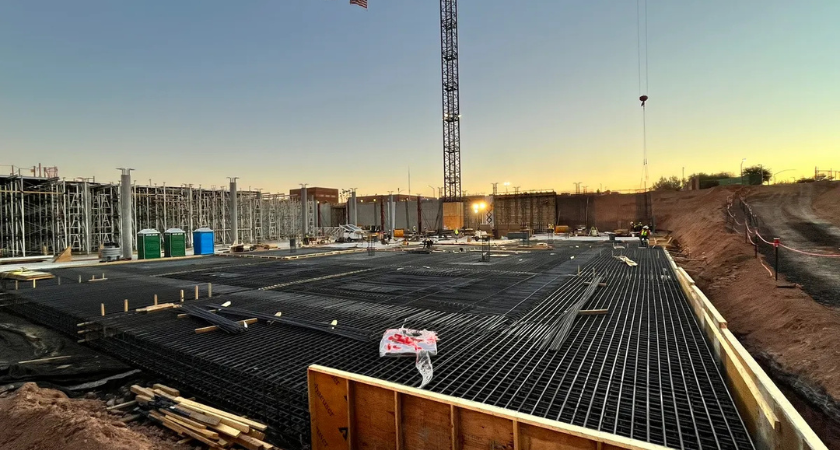
Construction officially began in January 2024 with phase one of the project, which includes building a new 8-million-gallon reservoir adjacent to the existing facility, according to a company news release. The new reservoir, measuring 234 feet by 234 feet and standing 25 feet tall, is located just south of the original reservoir — also built by McCarthy nearly 20 years ago.
While the project moved forward early in the year, site conditions presented a notable challenge. The soft soil surrounding the plant raised concerns about long-term settlement and potential leakage, risks that could have impacted both performance and durability.
To mitigate those risks, McCarthy partnered with engineer of record Black & Veatch to implement a leak-detection system beneath the reservoir — a proactive design approach that goes beyond traditional reservoir construction.
Crews installed a layer of #57 rock beneath the entire footprint of the tank and placed perforated piping across four quadrants, all connected to a sump system. This configuration will allow the City of Mesa to quickly identify the source of any potential leakage should it occur in the future.
McCarthy described the sub-slab system as a meaningful upgrade from standard reservoir designs, particularly for facilities built in challenging soil conditions.
“Our team was able to anticipate many of the project challenges, but there were still some highly unique circumstances for the project team to address, which would not have happened as successfully had it not been for the cooperative and collaborative relationship between everyone on the project,” Gray Wensley, senior superintendent for McCarthy’s water team, said in the release. “From the deep excavation and complex shoring to the leak-detection system and elevated deck, the team found solutions and delivered a high-quality structure on a very tight site while keeping the plant fully operational the entire time.”
Effective preconstruction planning helped accelerate the overall construction schedule by an estimated two to two-and-a-half months, McCarthy said. The project team also reduced costs by using space at a nearby city park to stockpile approximately 20,000 cubic yards of excavated material, avoiding the need to haul soil offsite and later bring it back for backfill.
City officials emphasized the importance of the new reservoir to Mesa’s long-term water strategy.
“This reservoir is a critical piece of our long-term water operational strategy for the East Valley, and it’s been delivered with the kind of care and innovation we expect on a project of this importance,” Chris Hassert, water resources director for the City of Mesa, said in the release. “The team found ways to save time and money while adding new tools, like the leak-detection system, that will help us manage this asset for decades.”
Phase one construction required approximately 8,300 cubic yards of concrete, poured in 40-foot-by-40-foot sections and sequenced diagonally to accommodate expansion joints. McCarthy expects to complete this portion of the work in October.
McCarthy and Black & Veatch relied heavily on virtual design and construction modeling to coordinate shoring systems, soil nails, excavation slopes and crane placement. Excavation extended roughly 30 feet below grade, with just 12 feet separating the new reservoir from the existing one. Crews also constructed a live fiber-optic duct bank between the two reservoirs to maintain plant operations.
Phase two of the project will focus on doubling the facility’s treatment capacity from 24 million to 48 million gallons per day. Planned upgrades include a mirrored sand-ballasted flocculation system, expanded ozone generation, and new sodium hypochlorite systems for disinfection.
McCarthy expects phase two to reach completion in early summer 2027, marking the full delivery of the multi-year expansion.
Originally reported by Sebastian Obando, Reporter in Construction Dive.