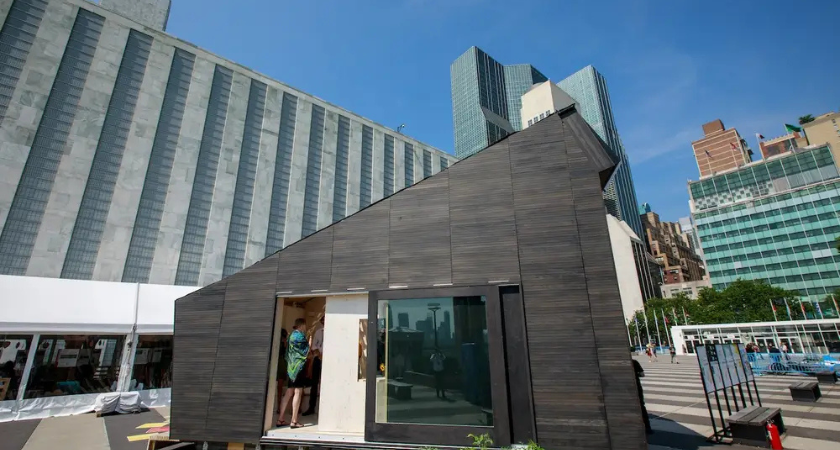
New York City homeowners can now legally build backyard “tiny homes,” marking a major shift in local zoning rules that city officials say could add tens of thousands of housing units — though high costs and regulatory hurdles may limit widespread adoption.
.jpg)
Under a zoning overhaul signed into law by Mayor Eric Adams last year, certain one- and two-family homeowners are allowed to add an additional residence, known as an ancillary dwelling unit, or ADU, on their property. On Sept. 30, 2025, the city finalized rules for backyard and attic ADUs and began accepting applications, while regulations for basement units remain under development.
The changes are part of the City of Yes for Housing Opportunity initiative, which city officials estimate could lead to about 25,000 new homes over the next 15 years through backyard cottages and converted garages, attics, and basements. Whether the reform meets those goals will largely depend on homeowners’ ability to navigate construction costs and permitting requirements.
Wil Fisher, a former city government employee, has been preparing for the shift for more than a year. Fisher founded Queens-based Unit Two Development to help homeowners determine whether their properties qualify for ADUs and to connect them with contractors and design professionals. He said his team has identified more than 100,000 potentially eligible properties and has spoken with over 100 homeowners, primarily in Queens and Staten Island.
"The rules of the road are now written," Fisher said. "It was a long process, but for the most part we're off to the races."
Many homeowners exploring ADUs are motivated by family needs rather than rental income. Fisher said most prospective clients want to house aging parents, relatives with disabilities, or adult children who cannot afford market-rate housing in the city.
One of those homeowners is Maggie Ornstein, 47, who lives with her mother in western Queens in a home that has been in her family since the 1800s. Ornstein hopes to convert her garage into an ADU to better accommodate her mother, who is undergoing cancer treatment and struggles with stairs.
"My dream for an ADU on my property would be something that would be accessible, but might also have a second floor where a family member could potentially stay if they wanted to visit, or if I wanted to be with my mom in the ADU," she said.
After months of discussions with clients, Fisher said interest is now shifting from conceptual planning to concrete decisions about design and budgets.
"Now is sort of the pivot from the conceptual to here's exactly what it will take, and here are the cost implications of that," he said.
Cost remains the most significant barrier. Fisher estimates that building a backyard ADU or converting a garage could start between $300,000 and $400,000, depending on size and complexity — a steep investment even as the city’s median home price hovers around $800,000.
Thomas Yu, executive director of Asian Americans for Equality, said those costs put ADUs out of reach for many homeowners who could benefit most from them, especially in lower- and middle-income neighborhoods. Yu said additional incentives such as tax abatements or grants may be necessary to make the policy effective.
"The ability for that generation to achieve independent homeownership is zero, particularly in New York City," Yu said of younger residents. "So ADUs are the next half-step that's needed for that."
Ornstein said she has been discouraged by both the price and the scope of construction, particularly while balancing work and caregiving responsibilities. She hopes to find public funding assistance to move forward.
"It's so much more expensive than I would have anticipated," she said. "On the one hand, you wouldn't be able to buy an apartment in New York City for what an ADU would cost to build. But on the other, it's really a lot of upfront cost."
Beyond cost, homeowners must comply with strict zoning and environmental rules. ADUs are capped at 800 square feet, cannot occupy more than one-third of a backyard, and face limits in flood-prone areas. Basement ADUs are prohibited in attached homes such as townhouses.
According to the Regional Plan Association, only about 68,000 lots — roughly 12% of the city’s one- and two-family properties — are currently eligible for an ADU.
City officials say they are developing a centralized “one-stop shop” to help homeowners navigate the process. The platform will include pre-approved ADU designs aimed at reducing design expenses and speeding up approvals.
"Efficiencies that can be built in are really going to be make or break for this market," Fisher said.
As applications begin rolling in, housing advocates and homeowners alike will be watching closely to see whether the zoning reform leads to meaningful new housing — or remains a niche option affordable only to a small segment of New Yorkers.
Originally reported by Eliza Relman in Business Insider.