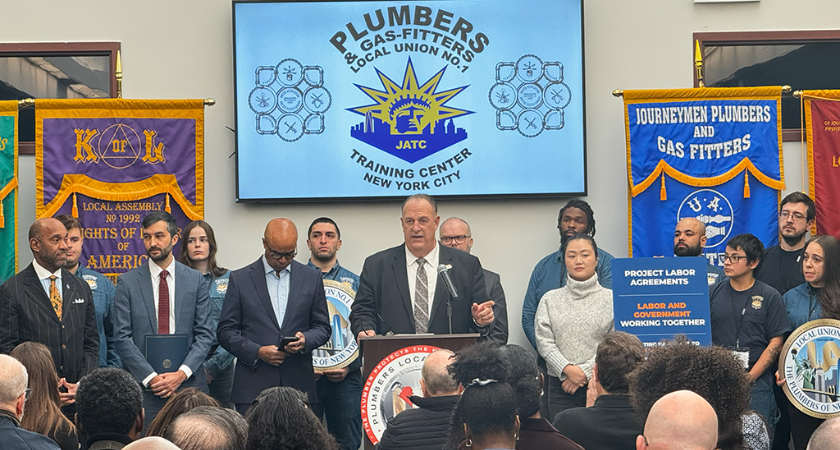
New York City’s recently announced Project Labor Agreements (PLAs), covering more than $7 billion in capital construction projects, are drawing renewed criticism from the merit shop sector, which argues the agreements unfairly exclude non-union workers from public construction opportunities.

Outgoing Mayor Eric Adams unveiled the PLAs earlier this month, applying them to a broad range of city-funded projects, including recreation centers, libraries, water treatment facilities, clean energy infrastructure and other public assets. City officials and labor leaders say the agreements are intended to guarantee standardized wages, benefits, safety requirements and training protocols across major projects.
However, Brian Sampson, president of the Associated Builders and Contractors (ABC), Empire State Chapter, said the agreements disproportionately benefit union contractors while sidelining a large segment of the city’s construction workforce. Roughly 70 to 80 per cent of construction work in New York City is performed by non-union tradespeople, according to Sampson.
“The notion that only union labor can deliver fair standards simply isn’t true and does a disservice to the hardworking non-union workers who help build this city every day.”
Sampson added that annual construction spending in the city typically ranges from $40 billion to $50 billion, making the scope of the PLAs particularly significant.
“Taking more than $7 billion out of that sum and awarding it to people that you are favorable to has a significant negative impact” on the non-union sector, he said.
The PLAs were negotiated between the Building and Construction Trades Council of Greater New York (BCTC) and the New York City Office of Talent and Workforce Development. BCTC president Gary LaBarbera defended the agreements, saying they expand workforce opportunities and strengthen labor standards.
“This kind of collaboration not only benefits the tens of thousands of union tradesmen and tradeswomen already working but opens more avenues for more individuals to build their own future in the city’s union construction industry,” LaBarbera said in a written statement.
.jpg)
He also emphasized the inclusion of community hiring provisions.
“It’s a win-win situation that will improve the lives of countless New Yorkers and set a standard for these agreements moving forward,” wrote LaBarbera.
Sampson countered that prevailing wage laws already ensured fair pay and benefits on public projects prior to the PLAs, regardless of union affiliation.
“So why rush to tie up billions of dollars in exclusive agreements with a single, politically-connected group?”
He argued that as merit shop contractors increasingly won public-sector work over the past several decades, unions have turned to PLAs as a way to reclaim market share.
“It is because so much work has transitioned over to the non-union side that the (union) building trades are asking government to put project labor agreements on them so they can get that market share back.”
Sampson noted that while large non-union firms sometimes partner with union contractors on major projects, most ABC members lack the scale to participate in joint ventures. He also disputed claims that PLAs improve efficiency, arguing that non-union crews with cross-trade skills can often complete work faster without jurisdictional constraints.
He added that ABC’s attempts to negotiate alternative approaches under the new agreements have been unsuccessful.
“We talk to them about alternatives, whether they want to go with apprenticeship as a means to qualify contractors (as an example). It’s still not perfect but it offers a fairer opportunity to bid and win work.”
Originally reported by Don Procter in Construct Connect News.