Oracle’s plans for a massive $10 billion data center in Michigan have been thrown into uncertainty after funding talks with its largest data center partner, Blue Owl Capital, broke down, raising fresh questions about the software company’s aggressive push into artificial intelligence infrastructure.
Blue Owl, a key financial backer behind several of Oracle’s largest U.S. data center developments, will not move forward with financing the planned 1-gigawatt facility in Saline Township, Michigan. The site is being built to support OpenAI, but negotiations involving Oracle, Blue Owl and lenders stalled and ultimately collapsed, according to people familiar with the discussions.
Blue Owl had been expected to arrange as much as $10 billion in financing for the project and contribute a substantial equity investment, continuing a structure it has used on previous Oracle developments. Under that model, Blue Owl typically forms a special purpose vehicle that owns the data center and leases it back to Oracle under a long-term agreement.
The breakdown leaves the future financing of the Michigan project unresolved. Oracle has not yet finalized a replacement funding partner, the sources said, though Blackstone has held preliminary discussions about stepping in. No agreement has been signed.
The setback highlights growing strain around Oracle’s AI infrastructure strategy. Founded by Larry Ellison, the company has embarked on a rapid expansion of its data center footprint to meet demand from AI customers such as OpenAI, while simultaneously taking on significant debt. That strategy has unsettled investors, rating agencies and analysts as borrowing has accelerated.
Oracle’s financial pressures are already being reflected in the market. The company’s shares have fallen roughly 46 percent from their September peak, while its bonds have also sold off. Following reports of the stalled Michigan financing, Oracle shares closed down 5.4 percent in one session, while Blue Owl shares fell 2.8 percent.
People familiar with the Michigan project said lenders pushed for tougher leasing and debt terms as sentiment cooled around the scale and pace of AI infrastructure investment. Those revised terms made the project less financially attractive for Blue Owl compared with earlier developments, according to several of the people. Blue Owl was also concerned that the Saline Township site, being developed by Related Digital, could face construction delays.
Oracle disputed the characterization of the funding impasse, saying: “Our development partner, Related Digital, selected the best equity partner from a competitive group of options, which in this instance was not Blue Owl . . . Final negotiations for their equity deal are moving forward on schedule and according to plan.”
Related Digital echoed that view, stating: “This is an exceptional project that drew significant interest from equity partners. We evaluated all of our options and selected our equity partner of choice for their unparalleled expertise in the space.”
Related Digital declined to identify the investor, though a person close to the company said it is in the “final stages of diligence” with its chosen partner.
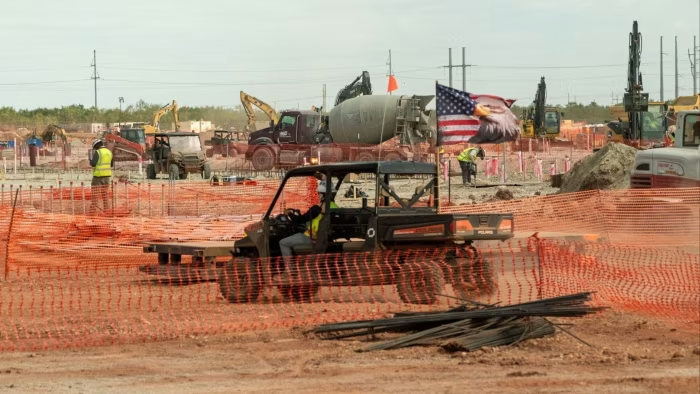
The Michigan facility is part of a broader $300 billion agreement under which Oracle will provide OpenAI with 4.5 gigawatts of computing power over the next five years. The project has already faced hurdles, including an initial rejection of a rezoning request by local authorities, which led to a lawsuit that has since been settled, clearing the way for construction to begin in the first quarter of next year.
Despite its ambitions, Oracle appears to be facing stiffer scrutiny from lenders than its larger cloud rivals. One person familiar with the financing structures said Oracle is encountering more onerous lease terms than companies such as Amazon and Microsoft. “They would rather work with a hyperscaler that has more experience and a less speculative project pipeline,” the person said.
Oracle’s debt has risen sharply. At the end of November, the company reported about $105 billion in net debt, including lease obligations, up from nearly $78 billion a year earlier. Morgan Stanley projects that figure could swell to roughly $290 billion by 2028. Oracle has already sold $18 billion in bonds and is seeking to raise an additional $38 billion through U.S. banks. Regulatory filings also showed total lease commitments jumping from $100 billion to $248 billion in just three months.
Blue Owl has played a central role in Oracle’s prior data center expansion, backing projects such as a $15 billion facility in Abilene, Texas, and an $18 billion campus in New Mexico. In Abilene, which is set to become OpenAI’s first major U.S. data center when completed in mid-2027, Blue Owl invested about $3 billion in equity and raised roughly $10 billion in debt, secured by Oracle’s 15-year lease. Returns on that project are expected to reach as high as 25 percent.
Blue Owl has also applied similar financing structures with other tech giants, including Meta, for which it helped raise $30 billion to fund a large data center development in Louisiana.
For now, however, the uncertainty surrounding Oracle’s Michigan project underscores the growing financial and execution risks facing even the largest players racing to build the infrastructure behind the AI boom.
Originally reported by Tabby Kinder in New York and Rafe Rosner-Uddin in San Francisco in Financial Times.