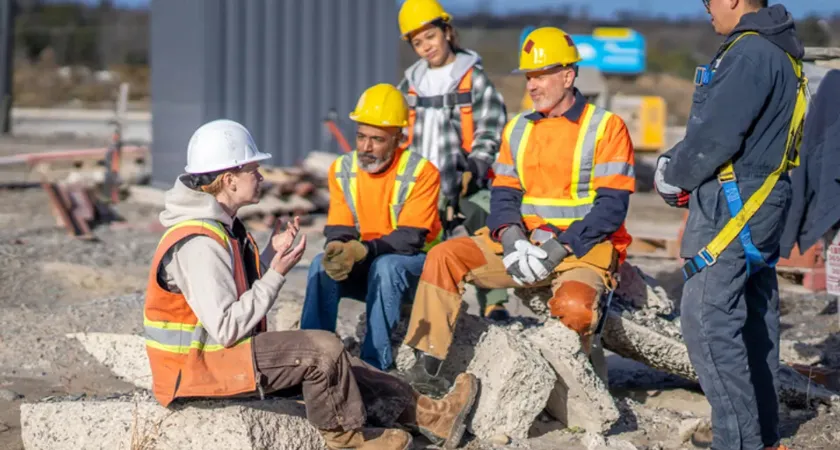
The National Center for Construction Education and Research has partnered with language upskilling platform EnGen to publish a construction foreman certification program for workers with limited English skills.
About three in 10 construction workers are immigrants, according to the National Association of Home Builders, and many have limited English skills. That language barrier can challenge communication, impact safety and limit career mobility. To address the issue, NCCER and EnGen are providing access to three months of construction-tailored English upskilling, which participants can take as a standalone option or en route to NCCER’s Construction Foreman Certification Program, according to a news release.
.webp)
Industry leaders say the initiative responds to a growing need on jobsites where bilingual communication is increasingly essential. Contractors across the U.S. have reported that miscommunication contributes to schedule delays, safety incidents and missed opportunities for talented workers to move into supervisory roles.
On jobsites, a construction worker may be asked to work as a skilled mason or carpenter one day and a superintendent or leader another, said Jennifer Wilkerson, vice president of innovation and advancement at NCCER, a nonprofit focusing on construction education.
“That’s great that you took your best tradesperson and you gave them this opportunity, but what you did simultaneously was not set them up for success because they need [English] training,” Wilkerson told Construction Dive.
Wilkerson said NCCER first provided training in Spanish for specific trades about a decade ago, but didn’t see major demand in response. That has slowly changed — one year after releasing the foreman certification, she said the group met the demand for a version of the course for primarily native Spanish speakers. The course costs $590.
Wilkerson said the program has been successful over what some employers have tried for English learners, such as sending workers to a local community college. Though those options may be helpful, they may not give workers the skills needed to communicate effectively on the job or to advance into supervisory roles.
“We all learn and communicate best in our native language, even if we identify as fully bilingual,” said Loretta Mulberry, a freelance language access consultant. “Many companies report that highly qualified candidates for leadership roles often hold themselves back from opportunities for fear of embarrassment or failure when taking certification tests or managing teams in their second language.”
Mulberry told Construction Dive she believes employers should continue to find comprehensive ways to support the careers of team members with limited English proficiency. That can include training like NCCER has rolled out, which Loretta applauded.
NCCER claims the initiative is already generating that positive feedback.
.jpg)
“This program is a gamechanger for our workforce—it’s helping our team leads strengthen their communication skills in ways that directly impact safety, productivity and collaboration,” Bradley Rowan, director of training and development for Houston-based Chamberlin Roofing & Waterproofing, said in the release. “One of our foremen, Raul, has been with us for 12 years. He came to the U.S. without speaking any English, and he can now communicate well on the job. This kind of targeted support gives Raul and others like him the tools to grow into even stronger leaders.”
The launch comes as the construction industry continues to grapple with severe labor shortages and rising project complexity. Analysts estimate that hundreds of thousands of new workers will be needed over the next several years to meet demand for infrastructure, manufacturing and energy projects. Advocates argue that helping existing workers advance is just as important as recruiting new entrants.
Traditional English-as-a-second-language courses often focus on everyday conversation rather than the technical vocabulary required on construction sites. The NCCER-EnGen program is designed specifically around foreman duties such as leading safety meetings, reading plans, coordinating crews and documenting work — skills that are critical for promotion but difficult to master without targeted instruction.
Contractors participating in early pilots say the training has already improved toolbox talks and reduced misunderstandings between crews and supervisors. Several firms are considering offering the program as part of standard leadership development tracks.
Supporters believe the effort could become a model for other segments of the trades, including electrical, mechanical and industrial construction. As projects become more technologically complex, the ability to communicate clearly across languages is expected to play an even larger role in productivity and safety performance.
Originally reported by Zachary Phillips, Editor in Construction Dive.
.png)


.png)