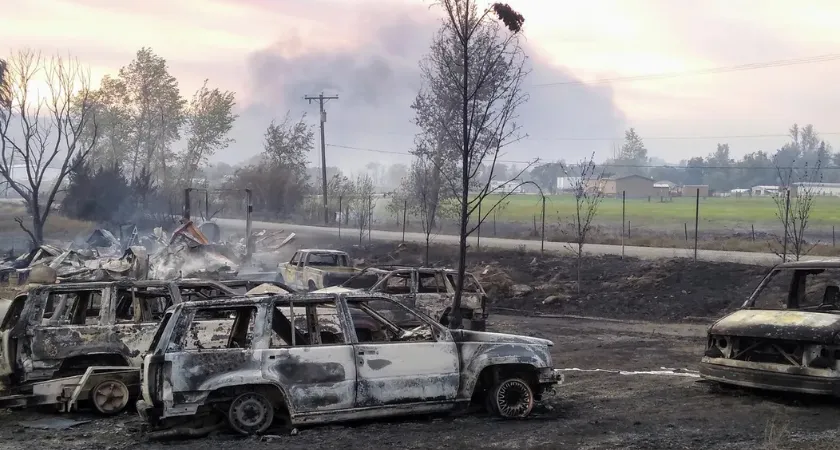
Five years after the devastating Almeda Fire, communities in southern Oregon are rebuilding with homes that are not only more resilient to wildfire but also among the most energy efficient in the country.
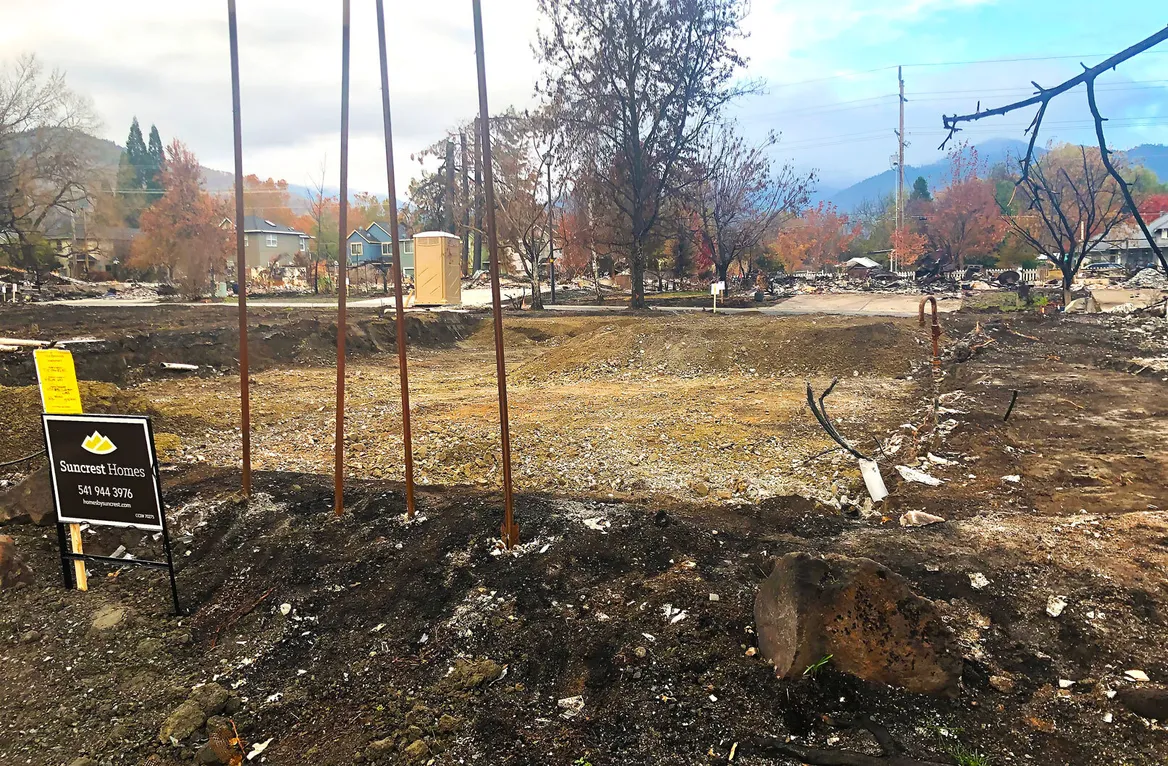
Carole and Alan Balzer had lived in Talent since 1998, drawn to the orchards and vineyards of the Rogue Valley. On Sept. 8, 2020, Carole was at work when she learned a fire had ignited in a grassy field in nearby Ashland.
“Do you think I should come home?” she asked her husband, Alan.
She never made it back. Driven by powerful winds, the blaze raced northwest along the Bear Creek corridor. Alan had only minutes to gather their cat, a computer and a box of photographs before evacuating.
The fire ultimately destroyed their home and much of Talent, along with large swaths of Phoenix and Medford. Weeks later, when volunteers sifted through the debris, Carole returned to the site.
“They found the three parts of my flute, but of course it was destroyed,” Carole recalls. “They gave me a chair to sit in, and I just started bawling.”
The Almeda Fire burned roughly 3,000 acres and damaged more than 3,000 structures, most of them homes. Nearly 40% of students in the Phoenix-Talent School District were displaced.
It was part of a wave of catastrophic blazes known as the “Labor Day Fires,” which collectively burned more than 1 million acres statewide and killed at least nine people — the costliest disaster in Oregon history.
In early 2021, the Oregon Legislature temporarily relaxed building codes to ease rebuilding. Homes destroyed that had originally been built before 2008 only had to meet 2008 standards, rather than the state’s more stringent 2021 energy code.
That trade-off made rebuilding faster and more affordable. But it also risked locking in decades of higher energy use.
According to the Oregon Department of Energy, homes built to the 2021 residential code are 30% to 35% more energy efficient than those built to 2008 standards. Because buildings account for about 40% of U.S. energy use, codes are central to reducing greenhouse gas emissions and meeting climate targets.
Rather than mandating higher standards, state leaders opted for incentives.
“We allowed people to build to energy-efficiency standards in the past, but we also put on the table incentives to encourage them to build to contemporary standards,” said state Rep. Pam Marsh, whose district includes southern Jackson County.
Funding came in part from the American Rescue Plan Act of 2021, which sent pandemic relief dollars to states and local governments.
At the same time, Energy Trust of Oregon revamped existing rebate programs to reward homeowners and builders who exceeded minimum standards.
“A lot was available to encourage people to try to build in the most efficient and fire-resilient way possible,” Marsh says.
The result: large numbers of rebuilt homes in the Almeda footprint now exceed modern energy codes, combining wildfire hardening with high-performance construction.
Charlie Hamilton of Suncrest Homes remembers seeing smoke near one of his company’s developments along Interstate 5 that morning in 2020. The subdivision survived — but the phone soon began ringing from former clients who had lost everything.
“Later that day, the phone started ringing,” Hamilton says.
For years, Suncrest Homes had built to Earth Advantage green-building standards. After the fire, the company helped homeowners apply for Oregon’s Fire Hardening Grant Program, which offered rebates for fire-resistant roofing, ember-resistant vents and other safety measures.
The state also introduced the Energy Efficient Wildfire Rebuilding Incentive program, offering $3,000 to $6,000 for rebuilding to modern or above-code efficiency standards — and up to $15,000 for low- and moderate-income households.
Energy Trust doubled certain incentives through its Energy Performance Score (EPS) program.
“The incentive we had for going up and above code was doubled, and that’s where we saw a lot of uptake,” said Scott Leonard, residential program manager at Energy Trust.
Karen Chase of Energy Trust said the organization modeled which measures offered both energy savings and fire resilience. Triple-pane windows, exterior rigid insulation and unvented attics rose to the top.
“One of the things that helped Energy Trust connect with the rebuild was that we had so many EPS builders already working with us in the Rogue Valley,” Chase says.
Suncrest rebuilt 35 homes in the fire zone, all taking advantage of enhanced incentives.
“I will say the single most rewarding thing I’ve ever done in my career is to hand keys back to somebody who’s lost everything,” Hamilton says.
The Balzers’ rebuilt home includes a ductless mini-split heat pump, a heat-recovery ventilator and a high-efficiency heat-pump water heater. Firewise landscaping and ember-resistant materials further reduce risk.
“To have this many highly energy-efficient homes in one community may make it one of the most energy-efficient cities in the country,” Chase says. “It really is the epitome of ‘build back better.’”
While many single-family homes were rebuilt quickly, manufactured housing — which made up about half the units destroyed — faced a tougher road.
Housing in the Rogue Valley was already tight before the fires.
“Housing was already a problem in the Rogue Valley,” Chase says. “Disasters bring to bear in such stark ways where we are weakest.”
At Bear Creek Mobile Home Park in Ashland, nearly all 71 units burned. Manager Kathy Kali estimates only about a quarter were insured.
“It was so shocking for me to see the discrepancy between our situation and [that of] many of my former neighbors,” she says.
Programs expanded through Oregon Housing and Community Services helped fund replacement manufactured homes that met Northwest Energy-Efficiency Manufactured Housing Program and Energy Star standards. Energy Trust incentives added up to $10,000 or $15,000 per unit.
At Talent Mobile Estates, residents formed a cooperative with help from Casa of Oregon and rebuilt as a resident-owned community with efficient, fire-resistant homes.
“So much of this is controlled by money,” said Peter Hainley, Casa’s executive director. “The legislature came through pretty quickly because there was the flood of money coming from the federal government — not because of these [fire] disasters, but because of the pandemic.”

The Balzers joke that their new house is “a kitchen with a house designed around it.” Efficiency features came standard, allowing them to focus on design details rather than insulation specs.
The long-term payoff extends beyond individual households. Lower energy demand reduces strain on utilities, cuts emissions and limits the need for new power plants.
As wildfires intensify with climate change, Oregon’s experience suggests that incentives — rather than mandates alone — can steer rebuilding toward both resilience and decarbonization.
“We have a lot of close friends — that’s what’s keeping us here,” Carole says. “Plus, it’s a beautiful area.”
Originally reported by Juliet Grable in Canary Media.



.webp)