The Occupational Safety and Health Administration is proposing a major reinterpretation of federal workplace safety law that could remove basic protections for workers in what the agency defines as “inherently risky professions,” including sports, entertainment, and potentially construction and manufacturing.
The proposal, announced in July, would exempt these occupations from OSHA’s General Duty Clause — a foundational provision of the Occupational Safety and Health Act of 1970 that requires employers to provide a workplace “free from recognized hazards” when no specific regulation applies. Critics say the change could leave hundreds of thousands of workers without meaningful federal safety oversight.
.jpg)
The agency’s proposal explicitly references a dissent written more than a decade ago by now–Supreme Court Justice Brett Kavanaugh, stating that OSHA “preliminarily concurs with the dissent’s concerns.” Kavanaugh argued that certain dangerous occupations should fall outside the reach of federal safety enforcement because risk is intrinsic to the work.
Fifteen years ago, Kavanaugh — then a federal appeals judge — opposed OSHA’s citation of SeaWorld following the death of trainer Dawn Brancheau, who was killed by a killer whale in 2010. At the time, OSHA fined SeaWorld and ordered the company to physically separate trainers from whales, citing known dangers.
“To be fearless, courageous, tough — to perform a sport or activity at the highest levels of human capacity, even in the face of known physical risk — is among the greatest forms of personal achievement for many who take part in these activities,” Kavanaugh wrote in his dissent. “American spectators enjoy watching these amazing feats of competition and daring, and they pay a lot to do so.”
OSHA’s proposal comes amid a broader effort to curtail workplace safety rules. Other initiatives include rescinding construction site lighting requirements, eliminating certain respirator medical evaluations, and weakening enforcement protections for migrant farmworkers. President Donald Trump has also issued a “Regulatory Freeze Pending Review,” halting several pending rules, including proposals that would have strengthened heat injury and illness prevention standards.
As the Lever has reported, OSHA is currently led by David Keeling, a former safety executive at UPS and Amazon. During his tenure, the two companies were fined a combined $2 million for more than three hundred safety violations.
The General Duty Clause has historically functioned as a backstop when no industry-specific standard exists. To issue a citation, OSHA must demonstrate that a recognized hazard exists and that the employer had a feasible means of mitigating it.
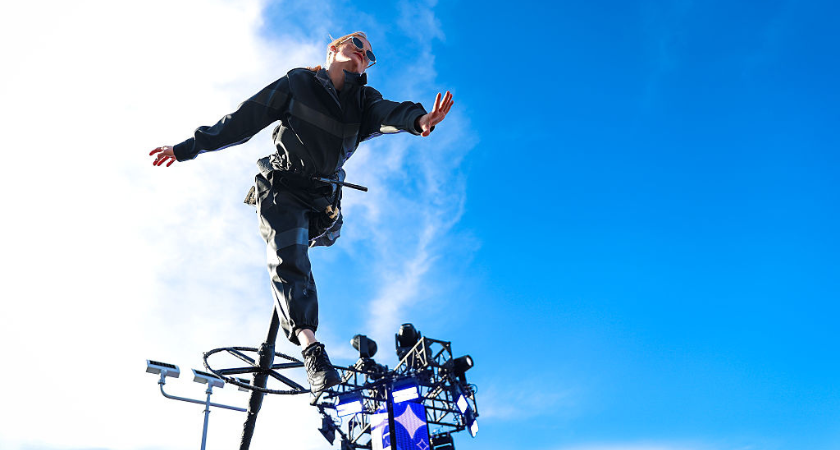
Past enforcement actions under the clause have included citations against a Broadway production following aerial performance injuries and against Rust Movie Productions after a crew member was killed on a film set by a loaded prop gun.
Under the proposed rule, OSHA would no longer issue such citations in fields deemed “inherently risky.” According to former OSHA official Jordan Barab, the affected categories could include performing arts, motorsports, combat simulation training, and “hazard-based media and journalism activities.”
By OSHA’s own estimates, more than 115,000 athletes, musicians, and entertainment workers could be affected immediately.
Industry groups representing construction, steel manufacturing, and transportation sectors have submitted comments urging OSHA to extend the carveout to their industries. A joint submission from the American Road and Transportation Builders Association, the Associated General Contractors of America, and the National Asphalt Pavement Association argued that exposure to traffic during highway construction should not fall under the General Duty Clause.
“In highway construction, exposure to moving traffic is an inherent hazard that cannot be fully eliminated without closing down large portions of critical roadways,” the groups wrote.
Labor advocates strongly dispute that reasoning.
.jpg)
“They’re kneecapping themselves on what they can do under the general duty clause,” Katie Tracy, senior regulatory policy advocate at Public Citizen, told the Lever.
Labor organizations warn that the proposal’s language could allow OSHA to expand exemptions far beyond sports and entertainment. The rule describes affected industries as a “non-exhaustive list,” and OSHA has solicited suggestions from other sectors seeking relief from enforcement.
“The General Duty Clause is essential,” wrote the International Union of Painters and Allied Trades in its public comment. “Weakening the requirement for workers in inherently dangerous industries is, we believe, contrary to the initial intent as well as subsequent interpretations of the OSH Act.”
North America’s Building Trades Unions echoed those concerns, warning that the proposal could eventually strip protections from construction workers — one of the most dangerous industries in the U.S.
Critics also point to a contradiction in OSHA’s approach. While the agency argues that the General Duty Clause makes certain safety standards unnecessary — such as construction illumination rules — it is simultaneously proposing to limit the clause’s scope.
“A specific standard for illumination is not necessary because a lack of illumination is a prototypical ‘recognized hazard . . . likely to cause serious death or serious physical injury’ under the General Duty Clause,” OSHA argued in support of rolling back lighting requirements.
Labor groups argue that narrowing the clause while relying on it to justify deregulation undermines the agency’s ability to protect workers.
The proposal is currently open for public comment, with labor advocates warning that codifying Kavanaugh’s dissent could mark one of the most significant rollbacks of federal workplace safety authority in decades.
Originally reported by Brock Hrehor in Jacobian.