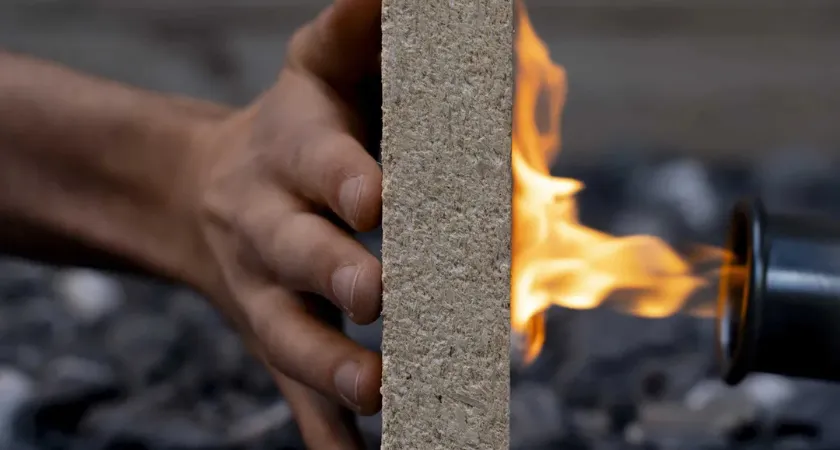
Researchers have developed a new type of fire-resistant building panel made from sawdust and a mineral commonly found in wastewater systems, offering a potential breakthrough in sustainable construction materials.
.webp)
The innovation comes from scientists at ETH Zurich, who discovered a way to combine sawdust with struvite — a crystalline compound that forms in water treatment pipes — to create durable interior wall panels.
Struvite, a magnesium ammonium phosphate mineral, is typically considered a nuisance in wastewater infrastructure because it accumulates in pipes and causes blockages. However, researchers found that its natural fire-resistant properties could make it valuable for construction applications.
By integrating struvite with compressed sawdust, the research team created a composite material that can withstand high temperatures while maintaining structural integrity.
“The struvite sawdust panels essentially protect themselves,” says Ronny Kürsteiner, a doctoral candidate and research assistant at ETH Zurich, who developed the process as part of his doctoral thesis.
“Struvite is not only non-combustible, it also helps to actively increase fire resistance,” the article says. “When heated, the mineral breaks down, releasing water vapor and ammonia. This process absorbs heat from the surrounding environment, producing a cooling effect. The non-combustible gases that are released also displace the air, hindering the fire from spreading further.”
To overcome the brittleness of struvite, researchers incorporated an բնական enzyme derived from watermelon seeds. This additive strengthens the mineral by enlarging its crystal structure, allowing it to effectively bind with sawdust particles.
The mixture is then poured into molds, heated and cooled to form rigid panel boards suitable for use in interior construction applications.
“The material is stronger … than the original spruce timber” from which the sawdust is derived,” Kürsteiner said.
Beyond fire resistance, the panels also present environmental benefits aligned with circular economy principles. According to researchers, the material can be broken down, separated and reused to produce new panels, reducing waste and resource consumption.
“This new material could therefore be an important contributor to the circular economy,” it says.
The concept also offers a dual benefit for wastewater management systems. By extracting struvite from sewage treatment facilities for construction use, manufacturers could help reduce pipe blockages while sourcing a key raw material.
“We could use these deposits as a raw material for our building material,” says Kürsteiner.
However, commercialization challenges remain. Struvite is currently more expensive than traditional binding materials such as cement or polymer-based alternatives. For the product to scale, manufacturers would need cost-effective methods to recover and process the mineral from wastewater systems.
Despite these hurdles, the research highlights a growing trend in the construction industry toward sustainable material innovation, particularly solutions that repurpose waste streams into high-performance building products.
If successfully commercialized, the sawdust-struvite panels could provide builders with a fire-resistant, recyclable and environmentally friendly alternative to conventional materials, helping advance both safety and sustainability goals across the sector.
Original reporting by Robert Freedman, Facilities Dive (via Construction Dive).
Read the original article here: https://www.constructiondive.com/news/sawdust-fire-resistant-panels-struvite-eth-zurich/