A key Senate panel on Friday approved a tax package that would allow construction companies to deduct gross receipts taxes (GRT) on labor and materials used to build multi-family affordable housing — a proposal supporters say could help ease New Mexico’s severe housing shortage.
.webp)
The New Mexico Senate Finance Committee advanced the measure as part of a broader tax package that includes up to $55 million in credits and deductions. Lawmakers say the housing incentive is one of the most significant policy responses to the state’s estimated shortage of roughly 32,000 affordable housing units.
Backers argue the deduction could help make projects financially viable at a time when rising material costs, high interest rates and labor shortages have constrained development.
The provision allows sellers of construction materials and labor contractors to deduct gross receipts taxes — New Mexico’s form of sales tax imposed on sellers — so long as the development qualifies as a multi-family housing complex in which at least 80% of units are affordable to residents earning 80% or less of the area median income.
Gross receipts tax rates vary statewide but generally range between 5% and 9%.
Sen. Michael Padilla (D-Albuquerque), who introduced the housing bill before it was folded into the broader package, said the measure is intended to address both affordability and workforce housing needs.
He noted that the state is experiencing an “enormous amount of economic activity in the state,” and the proposal would help ensure workers relocating to New Mexico have access to housing options.
Supporters estimate the deduction will cost state and local governments more than $10 million annually, though the long-term fiscal impact remains uncertain.
Not all lawmakers were fully convinced the proposal was adequately structured.
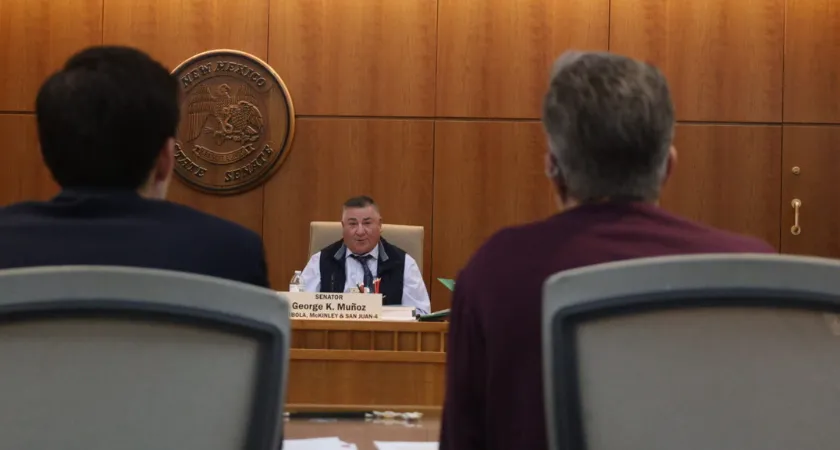
Sen. George Muñoz (D-Gallup), chair of the Senate Finance Committee, warned that the deduction could grow beyond projections due to the absence of a cap.
“I think the risk with this thing is it’s going to get way out of hand,” he said.
Muñoz expressed concern that without a ceiling on total deductions, the measure could become what he described as a “runaway” tax credit. However, Stephanie Schardin-Clarke, secretary of the New Mexico Taxation and Revenue Department, told lawmakers that imposing a cap on GRT deductions would be administratively impractical, given that thousands of sellers file GRT returns monthly.
Lawmakers also questioned the original timeline, which would have allowed the deduction to remain in place until 2033. In response, the committee amended the proposal to sunset in 2028 — five years earlier than originally planned — to limit long-term fiscal exposure.
With that amendment in place, the committee voted to advance the full tax package to the Senate floor.
In addition to the affordable housing deduction, the Senate package includes several other tax credits and deductions totaling up to $55 million:
Sen. Carrie Hamblen (D-Las Cruces), who presented the package, pointed to the closure of Gallup’s longtime newspaper and the growth of news deserts statewide as justification for the journalism credit.
The House of Representatives is expected to introduce its own tax package — also capped at roughly $55 million in credits and deductions — which will ultimately be reconciled with the Senate’s version.
The Senate package now heads to the full chamber for debate.
.jpg)
Housing advocates argue the construction deduction could help close financing gaps that often stall affordable projects. In New Mexico, developers frequently rely on layered funding sources, including federal Low-Income Housing Tax Credits, local subsidies and private investment. Reducing GRT costs on materials and labor could improve project feasibility, particularly in rural areas where margins are thinner.
Critics, however, caution that tax incentives alone may not solve the housing shortage without parallel investments in infrastructure, workforce training and land-use reforms.
As the 2026 legislative session continues, affordable housing remains one of the most closely watched policy debates, with lawmakers weighing economic growth, fiscal responsibility and the state’s urgent need for attainable housing options.
Originally reported by Patrick Lohmann in Source NM.