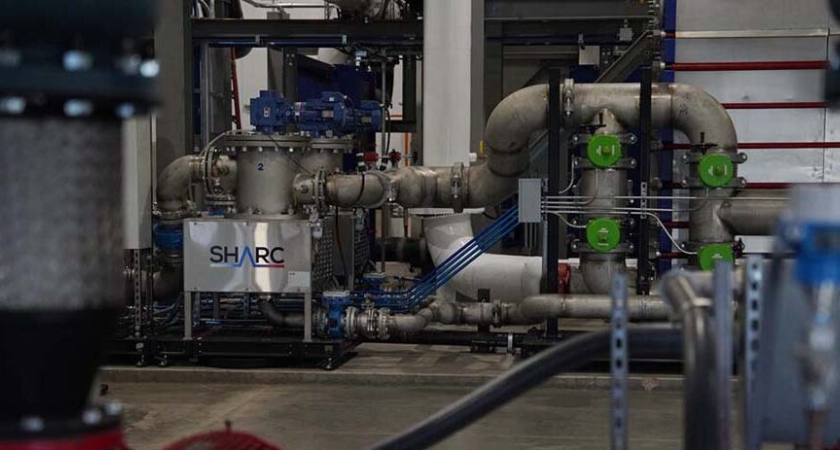
DENVER — What once posed a challenge for developers at Denver’s National Western Center has become a model for clean energy innovation.
During construction of the sprawling event complex, planners faced two massive sewer pipes that discharged into a nearby river. While developers initially sought to bury the pipes, utilities required that the wastewater release heat before entering the waterway. That constraint ultimately inspired a wastewater heat recovery system that now supplies most of the complex’s heating and cooling needs.
The system captures thermal energy from sewage to heat and cool classrooms, an equestrian center and a veterinary hospital at the National Western Center. Experts say wastewater offers a reliable and largely untapped energy source because it maintains a relatively stable temperature of about 70 degrees Fahrenheit year-round.
“Wastewater is the last frontier of sustainable energy,” said Aaron Miller, eastern regional manager for SHARC Energy. “Even in this current environment where environmental stuff doesn’t really sell, there’s a financial benefit that we can sell to business owners.”
Wastewater heat recovery systems are already operating in California, Washington, Colorado, New York and parts of Canada. Because sewer infrastructure is already in place, the technology can be deployed at lower cost than many other renewable energy systems while reducing reliance on fossil fuels.
At the National Western Center in Denver, wastewater heat recovery is transforming sewage into a dependable source of clean energy. The approach takes advantage of the steady temperature of wastewater flowing through existing sewer pipes, turning what is typically discarded into a valuable thermal resource.
The technology works by diverting wastewater from toilets, sinks and showers into a tank where heavy solids are removed. The remaining liquid then passes through a sealed heat exchanger, transferring thermal energy into a clean water loop without direct contact between the fluids. That energy is routed through heat pumps capable of providing heating, cooling and even hot water for buildings before the wastewater returns to the sewer system and flows to treatment facilities.
By replacing traditional boilers and chillers, the system significantly reduces electricity demand and emissions. Electricity is still required to run pumps and heat exchangers, but far less than conventional HVAC systems consume.
“Every city on the planet has a place just like this,” said Brad Buchanan, CEO of the National Western Center. “This is actually a value, a benefit that the bottoms have that the rest of the city doesn’t have.”
The Denver project is especially effective because the site sits near large sewer lines in a low-lying industrial area. While cooling towers and boilers supplement the system during extreme temperatures, wastewater provides the majority of the center’s heating and cooling needs throughout the year.
Experts say the technology is well suited for buildings with centralized hot water systems, including apartment complexes, factories, commercial laundromats and car washes. In residential settings, it works best in buildings with at least 50 units, according to Miller.
“If you can use wastewater, it’s going to be an enormous savings … its billions of kilowatts available to us to use,” said Ania Camargo Cortes, a thermal energy networks expert and board member of HEET.
The potential scale is significant. According to U.S. Department of Energy data, the equivalent of roughly 350 billion kilowatt-hours of hot water is flushed down drains each year.
Cities beyond the U.S. are already demonstrating the technology’s impact. In Vancouver, Canada, sewage heat recovery supplies heating and hot water to dozens of buildings through the False Creek Neighbourhood Energy Utility. In 2025, about 60% of the system’s energy came from wastewater heat recovery, according to city officials.
Looking ahead, researchers believe adoption will accelerate as communities search for reliable, low-carbon energy solutions that complement solar and wind power.
“I think that to decarbonize, we have to think of some innovative solutions. And this is one that is not that complicated as far as the engineering technology, but it’s very effective,” said Aaron Brown, an associate professor of systems engineering at Colorado State University.
Private companies are also expanding into the sector. Epic Cleantec recently installed a wastewater heat recovery system in a San Francisco high-rise, building on its work in water reuse. CEO Aaron Tartakovsky said attitudes toward wastewater are beginning to change.
“I think wastewater recovery is going to be a continuously growing thing because it’s something that we’re not taking advantage of,” said Tartakovsky.
Originally reported by The Associated Press in Finance - Commerce.