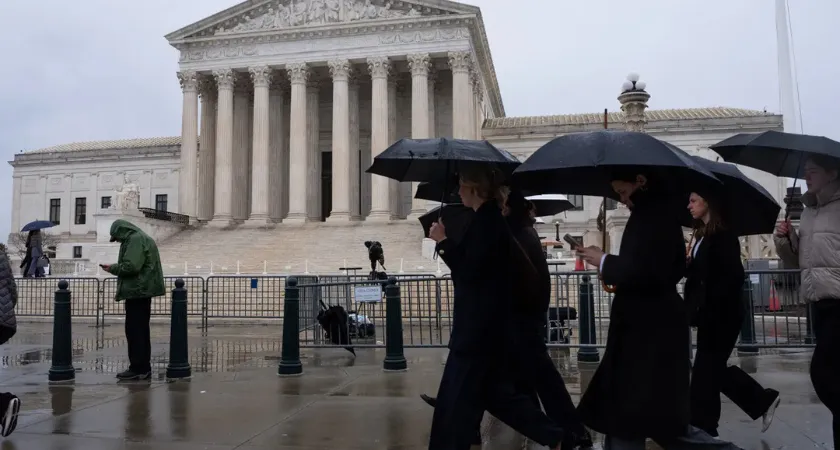
Contractors across several sectors may soon see a dip in material costs after the Supreme Court of the United States struck down most of President Donald Trump’s reciprocal tariffs in a 6-3 decision Friday.
.webp)
The ruling rejected Trump’s claim of broad executive authority to impose tariffs on global trading partners without congressional approval — a decision that could ease pricing pressure on specialty construction materials.
The decision immediately reverberated through the construction industry, where contractors have spent the last year navigating volatile price swings tied to trade policy shifts.
According to Associated Builders and Contractors, the ruling would drive “a modest but meaningful reduction in materials price escalation” for specialty equipment, HVAC systems, electrical components and fixtures.
Anirban Basu, chief economist at the trade group, noted that certain project categories — particularly those reliant on imported mechanical and electrical systems — stand to benefit the most from near-term price stabilization.
Similarly, the Associated General Contractors of America said contractors should expect at least temporary cost relief.
In practical terms, that could improve bidding confidence for projects currently in procurement stages, especially in commercial and institutional segments where mechanical systems represent a significant share of overall budgets. Developers that delayed procurement in anticipation of tariff clarity may now begin releasing held-back capital.
However, the relief may not extend evenly across all material categories.
Tariffs on lumber, steel, aluminum and copper remain in place and were not affected by the court’s decision. Those materials account for major cost drivers in infrastructure, industrial and multifamily construction, limiting the overall financial impact of the ruling.
Despite the ruling, industry observers caution that stability may prove fleeting.
The administration signaled shortly after the decision that it would explore alternative legal pathways to reimpose tariffs using different statutory authorities.
Taken together, that means the Supreme Court decision “could be short-lived and completely counteracted by heightened uncertainty during the transition from one tariff mechanism to another,” said Basu.
That kind of volatility often stalls project starts. Owners and contractors tend to pause major purchasing decisions until policy direction becomes clearer.
“If these are repealed, and then say three weeks from now, he reimposes them, that would cause more uncertainty in the market,” said Ken Roberts, partner with Venable and chair of the firm’s construction group. “I think the market will take a wait-and-see approach.”
The broader concern centers less on the tariff rate itself and more on predictability. Construction operates on thin margins and long planning horizons. Sudden shifts in import costs can quickly erode profitability or derail financing assumptions.
Brian Kassalen, principal and construction industry leader at Baker Tilly, emphasized that clarity is essential for long-term planning.
Firms can adapt to tariff rates if they understand the “playing field,” said Kassalen. Without a stable framework, however, capital allocation decisions become far more difficult.
“This yo-yo effect of tariffs created a lot of chaos,” said Kassalen. “If the Trump administration does go back and pursue other means to try to reimpose these tariffs … that does create uncertainty, which contractors and project owners alike don’t like.”
For projects already underway, whether savings translate into refunds depends heavily on contract language.
Cost-escalation clauses, force majeure provisions and tariff-specific riders will determine whether owners or contractors capture any pricing reversals.
For projects where tariff-related increases already pass through, whether any money flows back depends on how the contract was written, said Roberts.
In many cases, however, contractors should not expect retroactive financial relief.
“We have been cautioning our members for some time now that it is unlikely they will see any refunds for materials purchased during the past year,” Brian Turmail, AGC’s vice president of public affairs and workforce, said in an email.
Because most materials were purchased under binding supply agreements at elevated prices, any reversal would require renegotiation across multiple tiers of the supply chain — an unlikely scenario.
The ruling arrives at a pivotal moment for the construction economy.
Entering 2026, contractors were already grappling with elevated borrowing costs, labor shortages and project delays. Tariff volatility compounded those pressures by injecting additional risk into procurement timelines.
A sustained rollback of reciprocal tariffs could modestly ease inflationary pressure across commercial and industrial projects. Analysts note that even small reductions in materials inflation can improve feasibility for large-scale developments, including data centers, healthcare facilities and advanced manufacturing plants.
.webp)
However, if alternative tariffs are quickly introduced, uncertainty could outweigh any cost savings.
Markets tend to react sharply to policy reversals. Financial institutions funding construction projects may price in additional risk premiums, while suppliers could widen contingency margins to hedge against sudden regulatory changes.
For now, the industry appears to be adopting a cautious posture — welcoming short-term relief while bracing for further policy shifts.
Whether the court’s decision ultimately stabilizes material costs or simply marks another chapter in ongoing trade turbulence will depend on how quickly — and through what mechanisms — the administration responds.
Originally reported by Sebastian Obando, Reporter in Construction Dive.