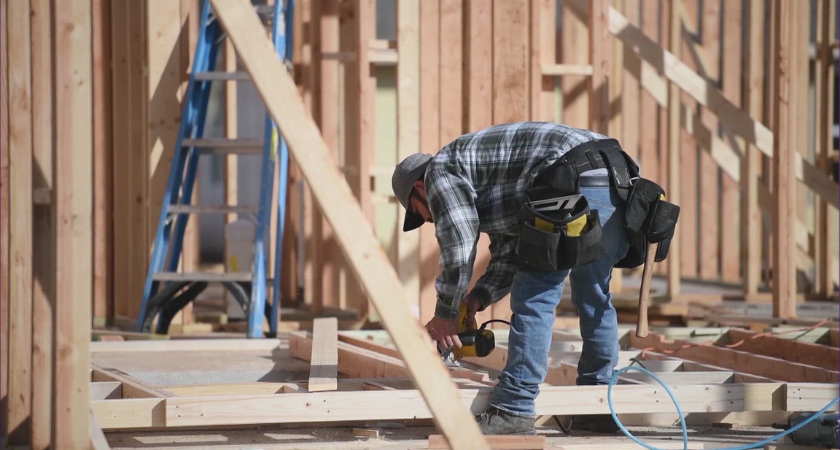
AUSTIN, Texas — Jan. 13, 2026 — Increased immigration enforcement in Texas is creating significant challenges for the construction industry, according to local leaders. ICE raids and the fear of additional enforcement actions are causing workers to avoid job sites, slowing down projects, and prompting the industry to turn to lawmakers for policy solutions.

“There's a bunch of fear in not just the workers, but also the community,” said Mario Guerrero, executive director of the South Texas Builders Association.
The shortage of workers is affecting projects across the state. Even workers with proper documentation are hesitant to report to work, creating bottlenecks in industries such as construction and hospitality. Normally, a basic 2,100-square-foot home with a two-car garage would take three to four months to complete, Guerrero said. Now, similar projects are taking nine to 11 months.
“Time is everything, especially in the construction industry,” Guerrero said. “When you're trying to figure out your logistics on time, on how you're going to be moving a project, and now you have to take this into consideration and there's no workforce.”
The Rio Grande Valley has been particularly affected. ICE made 9,100 arrests in South Texas last year, nearly one-fifth of statewide arrests. Guerrero criticized some enforcement practices, noting that people with proper documentation were sometimes detained without judicial warrants.
“It would be one thing if they're showing up with a warrant, and a judge signs that warrant, and they're saying, 'Hey, I'm looking for X, Y and Z,'” Guerrero said. “But that's not what's happening when they're showing up and they're questioning everybody, even if you do have proper documentation.”
According to the Federal Reserve Bank of Dallas, the Valley experienced a 5% drop in construction jobs in the third quarter of 2025, the largest decline among major regional industries.
The construction sector heavily relies on immigrant labor. The American Immigrant Council reports that in 2022, over 507,700 immigrants worked in construction—40% of all industry employees—with approximately 295,400 undocumented workers, or 23.3% of the workforce.
“We have a system in the United States that has failed us to prepare a proper workforce for our communities,” Guerrero said. “They never actually teach us that trades like framing, roofing, or electrical work are good careers. The system has failed to provide a proper workforce for us.”
The ripple effects extend beyond construction, impacting the local economy and housing supply, potentially driving up costs. Guerrero noted that a Mexican restaurant chain in the Valley experienced a 50% decrease in sales due to these enforcement actions.
.jpg)
“If this administration continues on this path for another year, it will really impact the economic outlook on the Valley – and not just the Valley; I believe it also affects San Antonio, Dallas and Houston,” Guerrero said. “It's not sustainable.”
To address these challenges, industry leaders are engaging lawmakers for solutions that balance immigration enforcement with workforce realities. Meetings with U.S. Representatives Henry Cuellar (D-TX 28) and Monica De La Cruz (R-TX 15) focused on legal pathways for construction workers. De La Cruz has expressed support for a visa program similar to the agricultural H-2A program.
“My top priority is to hear from South Texans and deliver solutions to ensure our communities remain prosperous,” De La Cruz said. “I will continue to focus on what matters: delivering common-sense policy solutions for the hard-working immigrants who strengthen our communities and making homeownership affordable for all Americans.”
Other legislative proposals include a new visa category for nonagricultural workers introduced by Rep. Lloyd Smucker (R-PA), and De La Cruz’s plan to extend H-2A visas for agricultural workers to 12 months.
Guerrero emphasized that the industry also needs guidance on workers’ rights when construction sites are targeted by ICE.
“We're actually trying to figure out what laws, if any, apply to the immigration raids that we're seeing at construction sites,” he said.
Meanwhile, federal lawmakers stress border security as a prerequisite for comprehensive immigration reform. U.S. Sen. John Cornyn said, “There is no way that the American people… would allow us to take another stab at reforming our immigration laws until we get the border secure.” Senate Majority Leader John Thune added that once secure, legislation could allow legally present workers to contribute to the workforce.
As debate continues, construction leaders like Guerrero are striving to keep projects on schedule while communities grow and the need for skilled labor remains high.
Originally reported by Daniel Perreault in KVUE.