Infrastructure construction in the U.S. faced a year of uncertainty and recalibration in 2025, as shifting federal priorities collided with large-scale projects already underway. President Donald Trump’s return to the White House triggered rapid policy reversals that placed portions of previously approved infrastructure funding under review, leaving contractors, owners and public agencies navigating an uneven landscape.
Several signature initiatives from the Biden administration, including the Infrastructure Investment and Jobs Act, were temporarily thrown into limbo as new executive orders prompted funding freezes and legal scrutiny. Despite this, demand in certain sectors—particularly water infrastructure—continued to accelerate, while megaprojects nearing completion proved difficult to halt.

Against this backdrop, Construction Dive identified the most consequential infrastructure stories of the year, reflecting how regulatory uncertainty, climate pressures and federal intervention reshaped project timelines and investment decisions.
Major airport expansions and transportation upgrades remained active throughout 2025, with contractors such as Hensel Phelps, Turner and Balfour Beatty advancing large terminal redevelopments and airfield upgrades. These projects underscored the resilience of long-planned infrastructure investments, even amid broader funding questions.
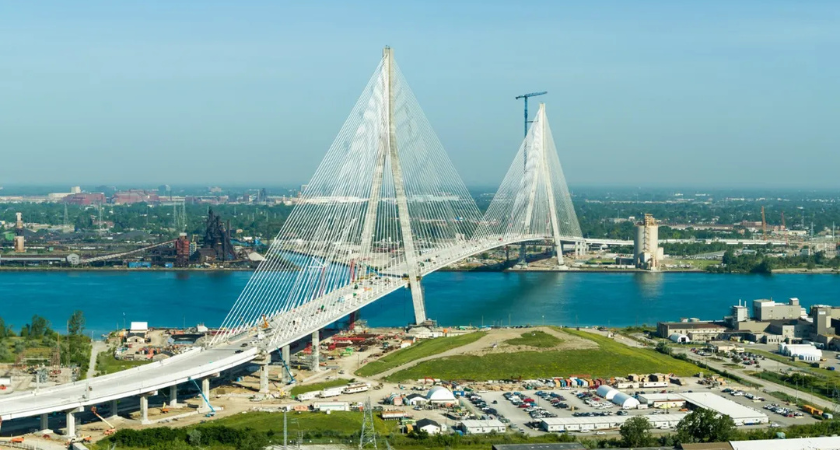
Meanwhile, the $4.7 billion Gordie Howe International Bridge—linking Detroit and Windsor, Ontario—faced reported delays despite reaching 98% completion. While the opening was initially expected in 2025, scheduling setbacks could push delivery into 2026.
In New York, work continued on high-profile megaprojects such as the Gateway Tunnel and the Second Avenue Subway, even as an $18 billion federal funding pause raised concerns about longer-term impacts if policy reviews extended into 2026.
The Trump administration’s decision to take control of the $7 billion Penn Station redevelopment marked one of the year’s most significant federal interventions. Neither the Metropolitan Transportation Authority nor the U.S. Department of Transportation disclosed how the move would affect construction sequencing or contractor coordination.
Additional executive actions signaled tighter conditions for transportation funding. Transportation Secretary Sean Duffy announced that projects incorporating diversity, equity and inclusion requirements could face funding cuts, while also warning that noncompliance with immigration enforcement could expose recipients to civil or criminal penalties.
Water infrastructure emerged as a growing priority in 2025, driven by aging systems, climate-related risks and the spread of contaminants such as PFAS. Experts warned that existing funding levels remain insufficient to address mounting threats, increasing pressure on municipalities and utilities to accelerate upgrades.
At the same time, disaster recovery projects demonstrated progress. Florida’s $328 million Sanibel Causeway restoration—damaged by Hurricane Ian in 2022—reached completion, highlighting the role of infrastructure resilience in post-storm rebuilding.

One of the year’s most disruptive developments came in December, when the Trump administration halted all large-scale offshore wind projects under construction in U.S. federal waters. The move affected five major developments, including the 2.6-gigawatt Coastal Virginia Offshore Wind project.
The administration cited classified “national security risks” as the basis for the decision, sending shockwaves through the renewable energy and construction sectors and raising questions about future offshore wind investment in the U.S.
Despite policy turbulence, several major contractors reported strong backlogs. Tutor Perini ended the year with a $21.6 billion backlog, buoyed by ongoing infrastructure demand, and identified $25 billion in upcoming bid opportunities. The results illustrated how long-cycle public works projects can continue generating revenue even during periods of political uncertainty.
Overall, 2025 reinforced a defining theme for infrastructure construction: while policy direction can shift rapidly, projects already underway often carry enough economic, logistical and political momentum to continue. As federal agencies, contractors and owners head into 2026, the sector remains shaped by regulatory risk, funding volatility and an ongoing need for resilient, modern infrastructure.
Originally reported by Construction Dive Staff in Construction Dive.