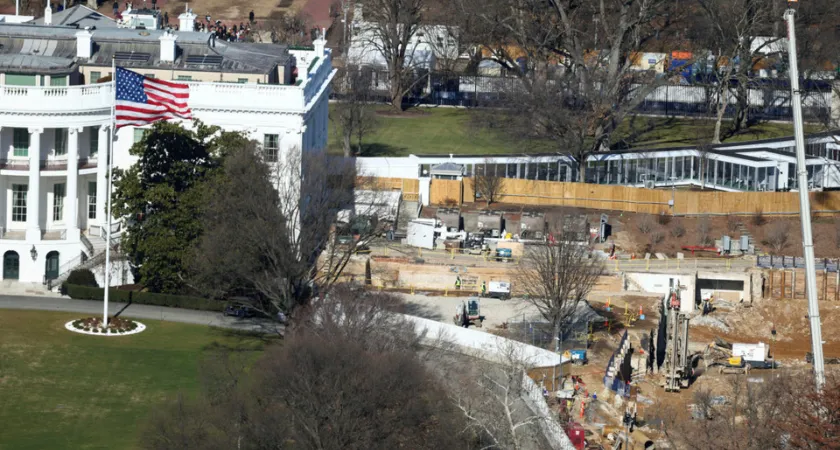
Some of President Donald Trump’s key appointees overseeing federal design review are raising new concerns about the look and size of the White House ballroom project — even while signaling they largely support the administration’s overall vision.
During a Commission on Fine Arts discussion Thursday, commissioners questioned the proposed scale of the addition and asked for clearer visuals, including physical 3D models to better understand how the new structure would fit into the existing White House complex. The meeting also included a brief review of public feedback, which officials said was largely negative.

"This is an important thing to the president. It's an important thing to the nation," said the new Fine Arts chairman, Rodney Mims Cook Jr., in the panel's first public hearing on Trump's proposal.
Cook stressed that major official events cannot remain dependent on temporary setups, adding: "You can't have the United States of America entertaining people in tents," while emphasizing the goal is to ensure any changes remain consistent with the White House’s character and appearance.
After lead architect Shalom Baranes shared updated renderings in Thursday’s online session, the commissioners requested an in-person follow-up presentation — including 3D scale models of the White House complex and nearby government buildings.
Baranes said he would return with models that include the U.S. Treasury Department to the east and the Eisenhower Executive Office Building to the west, helping commissioners evaluate how the new structure would affect surrounding sightlines and architectural balance.
The administration, meanwhile, defended the project’s intent and framing as a long-term improvement.
"President Trump is working 24/7 to Make America Great Again, including his historic beautification of the White House," said West Wing spokesman Davis Ingle.
Baranes confirmed the proposed expansion would add nearly 90,000 square feet in total, including roughly 22,000 square feet for the ballroom itself. Before the East Wing — first built in 1902 and expanded during the 1940s — the White House totaled about 55,000 square feet.
Commission officials acknowledged public reaction ahead of the hearing was largely unfavorable. Thomas Luebke, the commission’s executive director, said comments were "almost all" negative, with critics targeting both the approval process and the design.
Even a rare positive comment, Luebke noted, still warned that "the scale appears oversized, making the main structure dominated."
Baranes responded by describing multiple design elements meant to preserve the historic appearance, including positioning the northern boundary further back from the North Portico and aligning the height of the new structure with the main façade. He also highlighted a new two-story east colonnade, replacing the one-story section that was removed.
Even with adjustments to the north-facing side of the White House, commissioners suggested the design may significantly change the appearance from the South Lawn.
One rendering shows a multistory, 10-column porch on the ballroom addition that some said resembles the Treasury Department more than the White House itself.

"It's immense," Cook said to Baranes. "If the president just wants cover, do you think you might be able to tone down that element?"
The architect responded that earlier versions explored different options but the current plan reflects the president’s preference: "We looked at ways of covering it at different scales with different numbers of columns, and there's a president's desire to proceed with this one."
The Fine Arts Commission is one of several bodies that must review major federal construction projects in Washington, alongside the National Capital Planning Commission.
Separate from the design review, the ballroom expansion also faces a legal fight that could determine whether construction continues without interruption.
Historic preservationists are asking a federal judge to pause the $400 million project, arguing it lacks the required approvals and oversight.
U.S. District Judge Richard Leon heard arguments Thursday but did not issue an immediate ruling. Leon said he plans to make a decision next month on whether to grant a preliminary injunction, acknowledging the ruling is likely to be appealed regardless of outcome.
Plaintiff attorney Thad Heuer argued the White House does not belong to any one president and that the administration must have specific authority for a large-scale undertaking.
"He isn't the landlord," Heuer said. "He is a steward."
Government attorney Jacob Roth pushed back, saying the president has broad authority to alter the White House and that stopping mid-construction would create operational and security challenges.
"I don't think there's any question that this modernization is in the public's interest," Roth said.
Originally reported by PBS News.