President Donald Trump has signed a new executive order aimed at expanding homeownership by limiting the role of large institutional investors in the single-family housing market, declaring that the United States “will not become a nation of renters.”
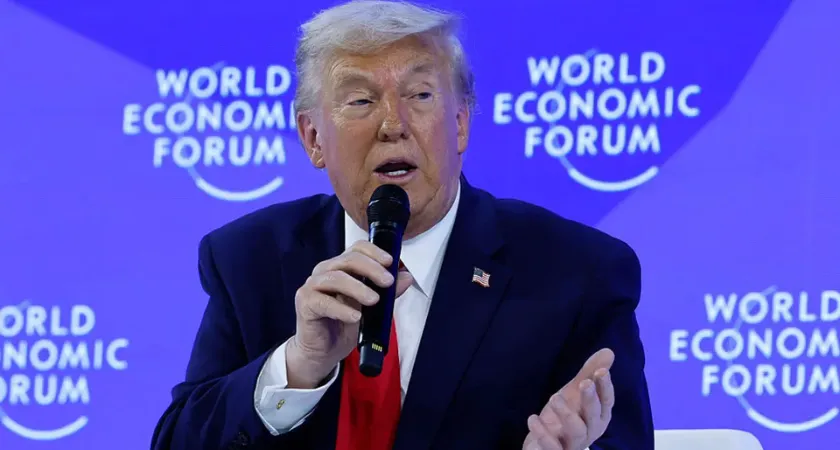
Speaking Wednesday at the World Economic Forum in Davos, Switzerland, Trump reiterated the intent behind the order, which bars large institutional investors from purchasing single-family homes that could otherwise be bought by individual families. The move was first announced earlier this month in a Truth Social post and formally signed Tuesday.
.webp)
“America will not become a nation of renters,” the president said during his Davos address. “That’s why I’ve signed an executive order banning large institutional investors from buying single-family homes. It’s just not fair to the public. They’re not able to buy a house.”
The executive order, titled “Stopping Wall Street from Competing with Main Street Homebuyers,” directs the Treasury Department to define the terms “large institutional investor” and “single-family home” within 30 days. Trump also urged lawmakers to codify the ban into federal law.
“I’m calling on Congress to pass that ban into permanent law, and I think they will,” Trump said. “Homes are built for people, not for corporations.”
Trump argued that institutional investors have played a growing role in driving up housing costs by purchasing large volumes of single-family homes, describing the trend as highly profitable for Wall Street firms but detrimental to aspiring homeowners.
Reactions from housing analysts and investors have been mixed. According to a Jan. 20 analyst note from Mizuho Americas, some REIT analysts characterized the announcement as a “nothing-burger” and “better than feared,” while others warned that “the policy risk overhang continues.”
While institutional ownership remains a relatively small share of the national market — about 3% of the single-family rental stock as of 2022, according to a 2024 Government Accountability Office analysis — those investors tend to concentrate holdings in fast-growing metros. In cities such as Atlanta, Jacksonville, Florida, and Charlotte, North Carolina, institutional ownership accounts for roughly 25%, 21% and 18% of the single-family rental market, respectively.
Leaders from major rental housing organizations cautioned against limiting the role of rental providers in addressing affordability challenges.
“Our nation’s housing crisis – undoubtedly one of the defining issues of our time – cannot be solved without the involvement of every corner of the housing ecosystem, from rental housing to the for-sale market,” said National Multifamily Housing Council President Sharon Wilson Géno and National Apartment Association President and CEO Bob Pinnegar in a joint statement. “For millions of Americans across our country, renting provides the flexibility and lifestyle needs that best support them.”
.webp)
A major concern within the industry has been whether the executive order would restrict institutional investors from developing single-family homes specifically intended for rental use. According to experts polled by Mizuho Americas, the ban appears tied to properties “that could otherwise be purchased by families,” potentially leaving room for build-to-rent communities.
“The whole community for build-to-rent has been allowed,” said Ivy Zelman, executive vice president of research and securities at Zelman & Associates, during a webinar discussing the policy. However, she noted that the treatment of mixed-use developments remains unclear. Zelman also pointed out that Invitation Homes, the nation’s largest single-family rental operator, recently acquired build-to-rent firm ResiBuilt for $89 million.
During his Davos remarks, Trump also criticized tax advantages available to corporate homebuyers.
“The crazy thing is you can’t get depreciation on a house, but when a corporation buys it, they get depreciation,” Trump said. “That’s something we’re going to have to think about too.”
He further identified household debt as a barrier to homeownership and said he is encouraging Congress to enact a one-year cap on credit card interest rates at 10%.
“This will help millions of Americans save for a home,” Trump said. “They have no idea they’re paying 28%, they’re a little late on their payment and they end up losing their house. It’s terrible.”
The proposal has drawn criticism from the banking industry and is widely viewed as unlikely to gain sufficient congressional support, according to CNBC.
Trump also said his administration is leveraging government-backed mortgage giants to influence borrowing costs.
“Finally, I have instructed government-backed institutions to purchase up to $200 billion in mortgage bonds to bring down interest rates,” Trump said. “And I’ll be announcing a new Fed chairman in the not-too-distant future,” adding that his pick was “very respected.”
Originally reported by Julie Strupp, Senior Editor in Construction Dive.
.png)


.png)