
BALTIMORE — The U.S. Army Corps of Engineers, Baltimore District, has awarded a $53.83 million contract for critical ecosystem restoration work at James Island, part of the broader Mid-Chesapeake Bay Island Ecosystem Restoration project in Maryland.
The contract was awarded to C&C Joint Ventures LLC of Gloucester, Virginia, and represents the first phase of restoration efforts for the Mid-Bay project in Dorchester County.
.webp)
The total contract value could reach $122.19 million when options are exercised, including additional construction and environmental restoration activities.
Initial work under the contract will include mobilization, hydrographic surveys, perimeter dike construction and dredging operations. The project will also establish a sand stockpile to support future dike construction efforts.
Officials said the work is critical to maintaining navigation channels that support the Port of Baltimore while also restoring lost island habitats in the Chesapeake Bay.
“We are proud to announce this contract award which supports vital maintenance dredging for the approach channels leading to the Port of Baltimore,” said Baltimore District Commander Col. Frank Pera. “Our continued partnership with the Maryland Department of Transportation’s Port Administration on Mid-Bay will build on innovative and proven solutions that serve and strengthen national security and will energize the economy, while also benefitting the Chesapeake Bay’s ecosystem for generations to come. It is a win-win project.”
Construction is expected to begin in late April, with officials urging mariners to exercise caution around the designated construction safety zone near James Island due to underwater operations that could pose hazards to vessels and equipment.
The Mid-Bay project is a cost-sharing partnership, with 65% federal funding and 35% state funding through the Maryland Department of Transportation’s Port Administration.
The initiative aims to restore 2,072 acres of remote island habitat at James Island and an additional 72 acres at Barren Island using dredged material from navigation channels. The restored habitats will include wetlands, marshes, upland areas and aquatic ecosystems designed to support wildlife and improve environmental resilience.
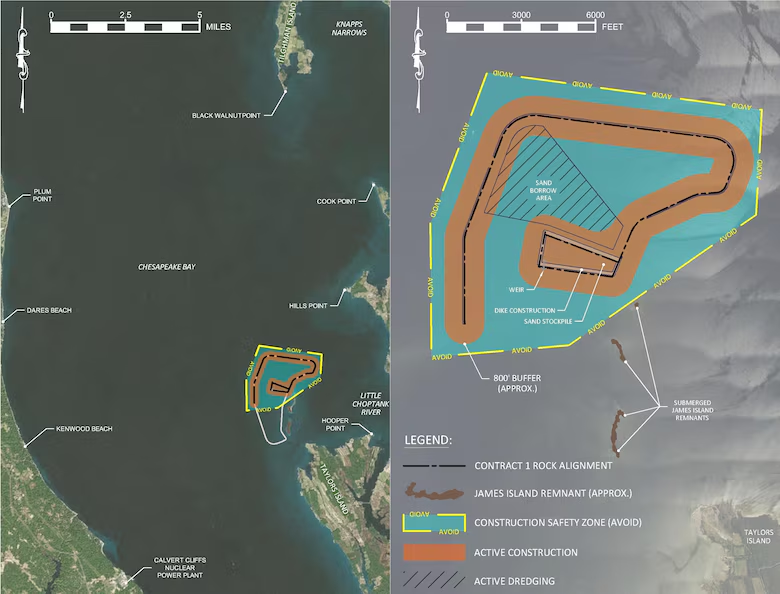
Upon completion, James Island is expected to consist of approximately 55% wetlands and 45% upland areas, with dikes reaching heights of about 20 feet.
"This represents the latest significant milestone in the long-awaited Mid-Bay project, which will benefit commerce and the environment," said Maryland Port Administration Executive Director Jonathan Daniels. "Working alongside the Army Corps of Engineers, Maryland has become a leader around the world in beneficially reusing sediment dredged from our shipping channels to rebuild and restore long-eroded islands while creating habitats for wildlife to flourish."
The project is designed to provide long-term capacity for nearly 95 million cubic yards of dredged material and is expected to be completed in 2067, supporting more than three decades of dredging needs for regional navigation channels.
Additional phases will include work at Barren Island, which is expected to begin accepting dredged material in 2026, while James Island is projected to begin doing so around 2030 following completion of containment infrastructure.
Officials say the Mid-Bay restoration effort builds on the success of similar projects, including the Poplar Island ecosystem restoration initiative, which has provided both environmental benefits and dredging capacity for the Port of Baltimore.
Originally reported by U.S. Army Corps of Engineers, Baltimore District in US Army.